
David Dent
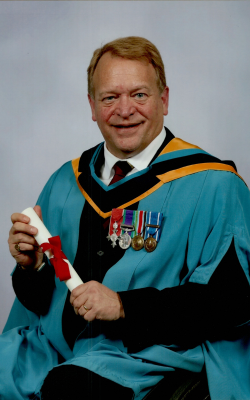
As an inclusion champion, honoured with an MBE (Member of the Order of the British Empire) for services to veterans, students, and people with disabilities, David Dent describes the Open University (OU) in Scotland’s commitment to open access as “fundamental” – enabling former military veterans and disabled people like himself to achieve their full potential.
David, now vice president at an international company, observes: “Many people never reach their potential because systems are not designed with them in mind.
“The Open University actively designs for diversity of age, ability, geography, and circumstance. That approach is not philanthropic. It is strategic and socially necessary.”
Since studying with the OU for a Master of Business Administration (MBA), David has become a passionate ambassador for the OU’s Disabled Veterans’ Scholarship Fund.
Raised in a military family, David worked as a frontline trauma specialist during the 1990s, carrying out resuscitation and treatment of people injured in combat.
However, he himself was injured – firstly receiving shrapnel injuries following a blast in Bosnia, and later a spinal injury that led to neurological damage and subsequently needing to use a wheelchair. In 2000, he retired from the Army due to his injuries.
‘Creates opportunity’
Now aged 59 and living near Carluke in South Lanarkshire, and a vice president for global clinical development partner Parexel, David describes the transition from military to civilian life at the time as a “significant culture shock”.
He explains: “Military life provides clarity of purpose, hierarchy and belonging, while civilian professional life is more ambiguous and often less values-driven. That shift can feel disorientating, particularly following injury or ill-health.
Support for disabled students is embedded rather than the exception at the OU, with staff who understand real world constraints and remove barriers early.”
“Studying with the OU helps bridge that gap by restoring structure, intellectual challenge and progression,” he says.
“It also reframes veterans as learners and contributors rather than as people who have left something behind.”
To anyone who has had to leave the military due to ill-health or injury and is unsure what to do next, David says: “My advice is simple. Do not rush to redefine yourself through job titles alone. Invest time in learning, reflection, and capability building. Seek environments that respect your experience but do not define you by your past. Education can be a powerful reset.”
Discussing the importance of the OU’s Disabled Veterans’ Scholarship Fund in giving ex-military personnel a “hand up”, David comments: “The fund removes structural barriers at exactly the right moment. It does not create dependency – it creates opportunity.
“For many veterans, finances, confidence and uncertainty converge at transition points. The scholarship enables individuals to invest in themselves, develop new identities beyond uniformed service and re-enter civilian life on equal footing with their peers.”
He believes that veterans receiving this assistance will “give back ten-fold in response”.
‘Proactive support’
For David, graduating with an MBA in 2023 had been a long-standing aspiration, filling in formal business training gaps and consolidating his experience from the military, public service, academia and senior leadership roles.
“The OU was a natural fit because it respected work-based learning, valued mature students and offered academic rigour without requiring withdrawal from professional life,” he says.
The flexibility offered by The Open University was also essential in enabling David to study for an MBA, as he explains: “At the time I was working in a director-level role within a large international clinical research organisation, while also competing as a para-athlete.
The emphasis was on enabling performance rather than lowering expectations, which matters greatly to disabled professionals.”
“Traditional universities would not have accommodated travel schedules, peak workload periods or rehabilitation demands.
“The OU’s flexible learning model, extended assessment timelines and clear planning structures made sustained study possible rather than aspirational.”
David also appreciates the support he received during his OU studies, describing support staff as playing a “critical role”.
“They helped me navigate registration, disability support, assessment adjustments, and pacing of modules. Importantly, this support was proactive rather than reactive,” he says.
“As a disabled student, having knowledgeable staff who understand systems reduces cognitive and administrative burden. It allows energy to be spent on learning.”
Tailored adjustments put in place for David included accessible digital materials, flexibility in assessment formats, reasonable adjustments to deadlines where needed and study support.
He comments: “The emphasis was on enabling performance rather than lowering expectations, which matters greatly to disabled professionals.”
He moves on to conclude: “Support for disabled and mature students is embedded rather than the exception at the OU, with staff who understand real world constraints and remove barriers early.
“The Open University in Scotland demonstrates that educational excellence, accessibility, and social purpose can coexist without compromise.”
A lot of ex-military people, we kind of talk about just needing a hand up, not a helping hand. So as soon as you give somebody a little bit of support, then they give back tenfold.
I'm really proud to be an ambassador for The Open University's Disabled Veterans' Scholarship Fund. I was invited by the then Director of The Open University in Scotland, because I live in Scotland and studied through The Open University there.
Part of that is just explaining to people, be they donors, be they other students or academic staff or even potential students, actually, this is a great way to further your education, further your career. And be a real-life example of how that's made a difference.
I was in the British Army through the 1990s to 2000. I was specifically in the Army Medical Services. Initially starting as a nurse, I qualified before going into the military, having trained in the Royal Infirmary in Edinburgh and specialised in critical care.
But my war role essentially was battlefield trauma. So that was, frontline resuscitation and treatment of people who'd been injured in combat.
I acquired my disability really through a combat injury. Initially a blast and shrapnel injury while I was in Bosnia.
Changing from the military to civilian life is quite a culture shock. And it is for a lot of people. I was also brought up in a military family. So even as a child I was kind of used to that world.
I think one thing that a lot of service people struggle with, and I did, was translating what your skillset is into a civilian kind of counterpart.
And I think a lot of people also underestimate the skillset that comes with having served in the military, at whatever level you were at.
So things like resilience, organisational skills, time management. And then quite often when you transfer from the military and civilian life, you may have been abroad, you've been a part of a regimental family or a ship or an establishment where you've got a lot of friends and family and you're used to kind of moving around every couple of years.
So getting the school, the kids in a school, finding a dentist, finding a GP, all of that kind of stuff you didn't really have to do before. But education is an important part because you may not know your local university. You may not know your local schools, you don't know how to kind of access that education, that you may need to either translate skills or further your education to progress in your career.
So when looking at the options for things to study at The Open University, through the Disabled Veterans' Scholarship Fund, for me, the Master's in Business Administration, the MBA, was really, an aspiration, but something that I thought would be the perfect fit.
You know having a triple-accredited MBA does add to your CV. But for me it was really about the learning.
I just wanted to understand, and I think as you get older as well, I think a lot of people get curious and you realise how much there is to learn out there. You know, maybe when I was my 20s, I thought I knew everything. I think as I get older, I think how much I don't know.
Part of the damage I received with my blast injury has a kind of neurological impact. So in terms of memory recall, sometimes the function of my hands, typing is not that great.
So The Open University was great, in terms of connecting you with specialist people, I engaged initially with The Open University Scotland, where I'm based. And we had a local liaison person there who could access and navigate throughout the University.
Part of the beauty of disability is that it's so diverse. Nobody's disability is the same as the next person's. And that personal support was great.
And it enables people with disability to not see that as a hurdle. But actually to see it as enabling, and then you can reach the potential, just like every other student.
This really counts.


Explore

Undergraduate
Postgraduate
Policy
-
Follow us on Social media
-


