
George Connor
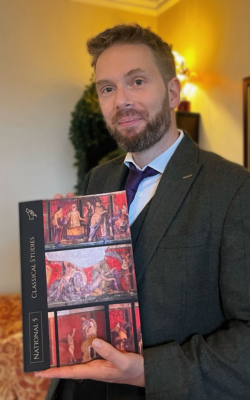
Just like The Open University, graduate George Connor shares the same ethos in widening access to education, working hard to ensure that state pupils have the same opportunities to study Classical Studies as their private school peers.
Originally an English teacher, George studied a Bachelor of Arts (Honours) Classical Studies degree with The Open University (OU) in Scotland, followed by a Master of Arts in Classical Studies.
“It is no understatement for me to say that the OU was a gigantic influence in my professional life going in a completely different direction,” he says.
Now aged 49 and living in Arbroath, Angus, George teaches Classical Studies and Latin at Monifieth High, launched the first Classical Studies textbook for Scottish schools in 30 years, and his work has been recognised by the Classical Association.
Towards the end of his degree, George and his partner Miri set up a business with the mission of making the Classics more accessible in state schools – leading them to form a social enterprise called Working Classicists.
He explains: “It was obvious to me that the issue of declining teacher numbers in state schools risked leaving Classics only to those pupils whose parents could afford to send them to private schools.
“We decided on a format whereby we could raise up voices from less privileged backgrounds, whilst also offering support, solidarity and concrete resources.”
The OU’s essence, of widening access to education, and enabling those who might be excluded in other situations, is something we profoundly agree with.”
When Working Classicists published their first book in 2025, ‘A Periodic Table of Greek Mythology’, they invited more than a hundred different writers from diverse backgrounds to contribute.
George highlights: “These are people who, through no fault of their own, might find it difficult to get published, and we are so proud of them all for submitting such excellent work.
“The OU’s essence, of widening access to education, and enabling those who might be excluded in other situations, is something we profoundly agree with.”
‘First-class tutors’
Studying with the OU gave George a valuable insight into creating resources supporting solo studying.
He highlights: “From quite early on we knew we had to start producing materials for schools to use, but which required no teacher preparation.
“Not all schools have a subject specialist, so new teachers, pupils and parents should all be able to use them without extra input.
Having tutors who have a genuine interest in your development, and are willing to accommodate your personal circumstances in order to let you flourish, was huge.”
“Last year we produced the first Classical Studies textbook aimed at the Scottish curriculum in several decades, and there is a bit of OU DNA in there. In order to make it accessible to anyone, we made it available for free.”
Previously having studied at a bricks and mortar university, George says he has become “an evangelist” about the OU due to the “first-class” standard of tutoring delivered.
“Having tutors who have a genuine interest in your development, and are willing to accommodate your personal circumstances in order to let you flourish, was huge,” he comments.
“My mental health isn’t always great, and my tutors were never anything less than understanding and compassionate. Combined with their clear subject expertise, I could not have asked for a better learning experience.”
George adds: “Anyone thinking of beginning a course of study, at any stage of life, and in any walk of life, should look at what the OU has to offer.
“The array of courses available is extraordinary. Combined with the flexibility to make the study for your individual circumstances, you’d be hard-pressed to find a better place to study.”
‘Overcoming imposter syndrome’
As for what’s next for George, he says: “An OU degree can open doors professionally, but it can also open minds to new horizons.”
An OU degree can open doors professionally, but it can also open minds to new horizons.”
He explains: “The habits that my OU studying helped me with in terms of carving out pockets of time for concentrated work mean that I now have a novel at 80,000 words.
“It is set in the Roman Republic of course.
“The confidence that the OU inspired in me, especially in overcoming my imposter syndrome, allowed me to do things I wouldn’t have previously attempted.
“Working Classicists has presented papers at Cambridge and St Andrews Universities.”
Plans are afoot to create another textbook and develop online resources next year.
But for now George shares: “The big thing is that Miri and I are getting married, and after a truly hectic 2025 we think we’ve earned a bit of a slowing-down of things.”
I'm George Connor from Working Classicists, a community interest company that was set up to promote the study of classical subjects in Scotland's state schools.
I spent seven cheerful years studying with the OU, initially for my undergraduate degree and then for my master's degree.
Anyone thinking of beginning a course of study at any stage of life and from any walk of life, I think should have a look at what the OU has to offer. I've long advocated for the opportunities that arise from the huge array of subjects which the OU is able to offer. But when you combine that choice with the flexibility to make the study suit your circumstances—whether that be your financial circumstances, your family, or your work circumstances—whatever it is, you'd be hard pressed to find a better place to study. On top of that, I have to say the courses are really, really interesting. The teaching is excellent and the tutors are simply amazing.
It is no understatement for me to say that working with the OU changed the direction of my professional life. At 38, I was an English teacher in a Scottish state high school. By 47, I was still a teacher of English in a Scottish state school, but I was also teaching classical studies and I was also teaching Latin.
I'd founded my community interest company to promote the subject which would become my passion. I'd spoken at Cambridge University. I'd spoken at Saint Andrew's University. The Classical Association had praised me for my work in outreach, and I had found a renewed sense of purpose for my life, which sustains me to this day.
It is true that a degree from The Open University will open doors professionally for you, but more than that, it will open your eyes to horizons which you had never thought possible.


Explore

Undergraduate
Postgraduate
Policy
-
Follow us on Social media
-


