
Catriona Anderson
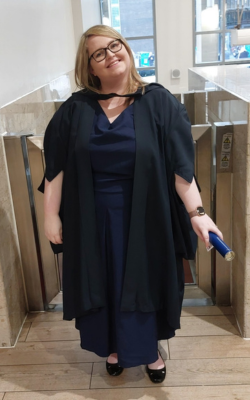 Gaining a Diploma with the OU in Scotland has set Catriona Anderson on a new trajectory that proves coming from a disadvantaged background doesn’t mean you need to be disadvantaged educationally.
Originally a child carer before being taken into foster care, Catriona was determined not to end up being another “statistic” and dependent on benefits like her parents had been.
Now aged 31 and living in the north east of Scotland, she graduated in 2024 with a Diploma of Higher Education (DipHE) in Education Studies (Primary) from the OU in Scotland and runs her own tutoring business.
“My inspiration was never to be like my mother and be stuck in a rut, dependent on social benefits,” Catriona says.
“That has changed, and now my inspiration is my son and showing him that even though you might be at a disadvantage that doesn't have to mean that you can't achieve your full potential.”
She adds: “As someone who had no financial support other than what I was able to bring in, the Part-Time Fee Grant was invaluable. It allowed me to be able to pay for a qualification I would otherwise not have been able to afford at that point in my life.”
Academic confidence boost
Previously dropping out of college multiple times, Catriona found that the flexibility and support offered by the OU in Scotland was a good fit for her.
The OU gave me the flexibility to take a break from coursework if needed, giving me a boost in my confidence academically."
Alongside being more motivated and finding the right course for her, she says: “The OU gave me the flexibility to take a break from coursework if needed, giving me a boost in my confidence academically.”
Catriona was able to take a break when she was very ill during pregnancy and after her baby arrived.
She shares: “It was difficult to juggle studying around a newborn baby, so I took time out and came back that October to complete my second year with a new study buddy, my son.
“There were lots of late nights and tears shed when assignments were due, but this was well worth it.”
To anyone else needing time out, she stresses: “You can always come back to your studies when you can. Also, the lecturers are there to help you. Use that support if you need to; there’s no shame in it.”
Catriona adds: “It was through the OU that I was able to finally be diagnosed with dyslexia and a processing disorder that causes my processing of information, particularly new information, to be slower than normal.”
Post-diagnosis, she found course feedback became more constructive to help her develop academic writing skills “at a pace that suited me, as well as still producing high-quality assessments that were able to show my growth and understanding of the materials”.
Accessible university studies
Catriona comments that the flexibility offered by the OU also “afforded me the luxury of starting my own business whilst I was in my first year of studying, along with helping me to carry on within the volunteering roles that I had within the community with children in the early years”.
Whilst loads of people think that university isn’t for them, the OU in Scotland makes it accessible to those of us from a background that wants to make us a statistic."
Since graduating, she has gained the confidence to return to campus learning to study for a National Certificate in Applied Sciences and work towards her dream of being a teacher.
“The OU has helped to solidify the belief that I want to teach and shape the minds of children, particularly within STEM,” she explains.
“This means that I am now back at college doing a science qualification to move into teaching science.”
Describing the feeling of graduating, Catriona says: “I cried when I was listening to the speeches during the ceremony.
“As I glanced up at the seats where my family were and locked eyes with my son, I was so proud of everything I had accomplished at that point.”
She concludes: “Whilst loads of people think that university isn’t for them, the OU in Scotland makes it accessible to those of us that have come from a background that wants to make us a statistic.
“Thank you, OU, for helping me show my son and younger self that we are not going to be a part of a statistic because of the circumstances we initially had no say in.”


Explore

Undergraduate
Postgraduate
Policy
-
Follow us on Social media
-


