
Centre for Scholarship and Innovation
Encouraging engagement: what motivates students to take up optional learning opportunities?
Over the past few years, I've found myself thinking increasingly about how universities encourage students to engage with optional opportunities. Beyond the formal requirements of a qualification, students are offered a rich range of activities intended to support their learning, wellbeing and future careers. Yet participation in these opportunities can be difficult to encourage when students are balancing study with work, family commitments and other responsibilities. How do we persuade students that these additional activities are worth their time?
Educators carefully craft students’ learning journey through a module, creating activities for students to gain new knowledge and consolidate it through practice and application. While we might traditionally associate assessment with the exam at the end of a module, assessment occurs frequently throughout the learning process. Such formative assessment provides opportunities for students to evaluate their learning in a low-risk setting. “Failure” in a formative assessment does not mean failing the module; instead, it helps identify areas that require further attention. Such insightful failure is not really failure at all. Rather, formative assessment provides valuable guidance about where students should focus their efforts next.
Unfortunately, there is a paradox at the heart of formative assessment. These activities, despite being highly effective learning tools, are low risk, carry no module credit and are often entirely optional. As a result, student participation can be surprisingly low.
In studies examining the use of interactive quizzes in introductory undergraduate courses, instructors have experimented with offering module credit as an incentive for engagement. Kibble (2007) investigated a variety of approaches, varying both the amount of credit available (0-2% per quiz) and the criteria students needed to meet to receive it, including participation, minimum performance thresholds and best-of-two-attempt models. Agnew, Kerr and Watt (2021) investigated two strategies within a single cohort, first offering an incentive and then removing it, while comparing outcomes with a control group that never received an incentive. (For fairness, both groups ultimately received the same amount of module credit.) In both studies, when no incentive was offered, engagement with the quizzes, defined broadly as completing at least one quiz during the module, was approximately 50%. When module credit was available, participation increased dramatically, with engagement reported between 87% and 99% depending on the specific incentivisation strategy.
Offering a small amount of module credit, effectively transforming a formative activity into a summative one, has therefore proven to be an effective way of encouraging participation. When I was an undergraduate student, I remember being incentivised to complete pre-lecture reading. We received 0.1% module credit each week for completing a short quiz based on the reading, amounting to 1% over the semester. It worked. At least, it worked on me.
More recently, policy across many UK universities has moved away from this “salami-slicing” of module credit. While these studies demonstrate the effectiveness of grade-based incentives, they also raise an important question: can meaningful engagement be encouraged without linking activities directly to marks?
In a recent scholarship project, I investigated the effectiveness of an alternative approach based on reflection. Rather than awarding credit for completing formative activities, many of our modules invite students to reflect on how they used these resources and what they learned from them. The incentive is attached not to the activity itself, but to the process of considering and articulating its value and impact on students’ learning. In effect, students were not being rewarded for completing the activity; they were being rewarded for engaging thoughtfully with what the activity had taught them.
Specifically, we investigated how students studying S217, Physics: from classical to quantum, engaged with online quizzes and with structured reflective questions about those quizzes in tutor-marked assignments. Importantly, the tutor-marked assignments were themselves formative and carried no summative weighting. Students therefore received no academic credit for either completing the quizzes or reflecting on them.
The results were encouraging. Using the same broad definition of engagement employed by Kibble (2007) and Agnew, Kerr and Watt (2021), engagement was approximately 81%. While this was not as high as the near-universal participation achieved when module credit was attached directly to quiz completion, it substantially exceeded the engagement levels typically observed when no incentive was provided. Reflection appeared capable of motivating many students to engage with an optional formative activity even in the absence of a grade-based reward.
Alongside participation rates, we observed another interesting pattern. Students who made greater use of the quizzes were also more likely to achieve positive module outcomes (Figure 1). As every educational researcher will be quick to point out, correlation does not imply causation. We cannot conclude that quiz use caused improved outcomes. However, even if quiz engagement is simply associated with success rather than responsible for it, it still represents a characteristic behaviour of successful students. Encouraging such behaviours therefore seems worthwhile. From this perspective, reflection-based incentivisation serves a dual purpose: it increases participation in a valuable learning activity while also encouraging students to think more critically about the learning habits they are developing.
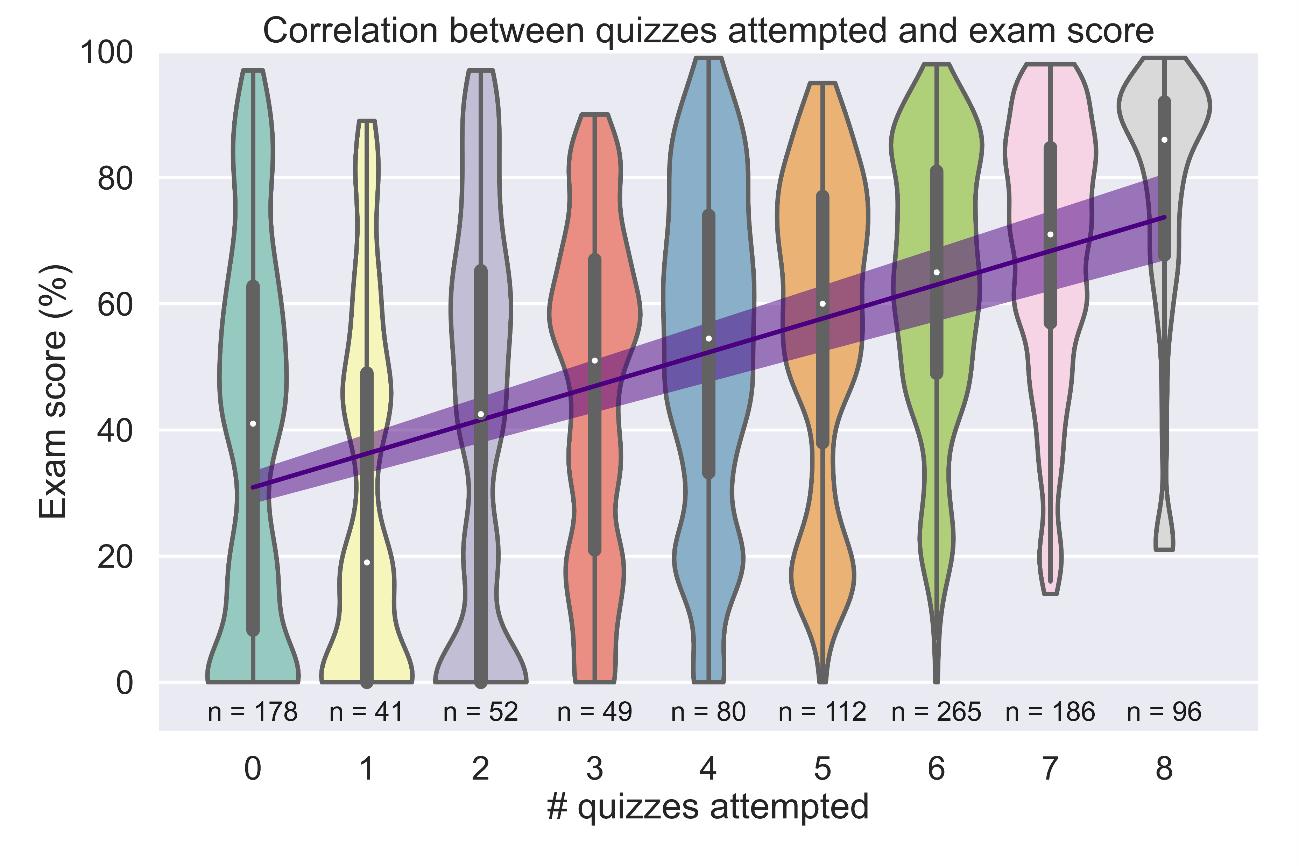
Figure 1: Correlation between number of quizzes attempted and end of module exam score. Coloured shapes indicate the distribution of exam scores within the sub-population for each number of quizzes attempted (white dots indicate median score. The purple line indicates the linear line of best fit to the data. Figure from Nylk and Diament 2026.
I find it particularly interesting that this idea extends beyond formative activities designed purely to support student learning. Within the School of Physical Sciences, and more broadly across the STEM Faculty, we have also been exploring how reflection can encourage engagement with activities linked to Education for Sustainability and the UNESCO Key Sustainability Competencies framework (Figure 2). Students are already undertaking a range of activities that develop these competencies, but recognising, articulating and evidencing that development can sometimes be challenging. Reflection offers a way of making this learning visible, helping students identify connections between individual experiences and their broader personal and professional development.
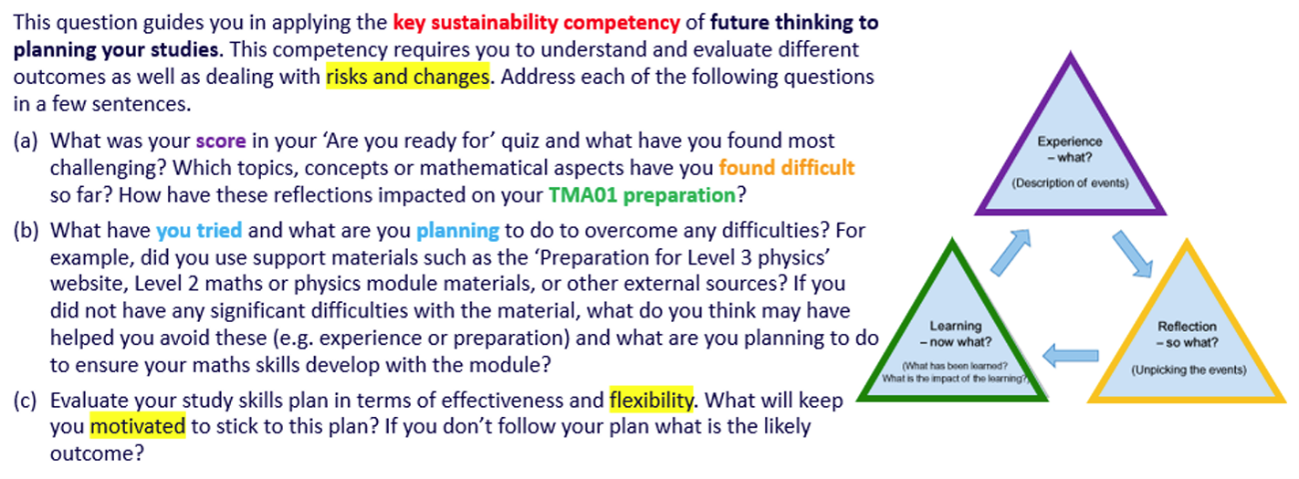
Figure 2: Example of a question in a tutor-marked assignment from SM381, Electromagnetism, which asks students to reflect on the key sustainability competency of future thinking (left). Reflection is structured around Boud’s triangle (right). Figure from Braun 2026.
Perhaps this is the most important lesson reflection offers. Incentives are often understood as something added to an activity to encourage participation. Reflection works differently. Instead of introducing an external reward, it helps students recognise the value already present in an experience. By making learning more visible, reflection connects activities to their wider purpose and encourages students to see the benefits they are gaining for themselves. If students can clearly recognise the value of an opportunity, they may need less external encouragement to participate in similar opportunities in the future. In that sense, reflection is not simply a means of recording learning; it can become a powerful incentive for learning itself.
Jonathan Nylk, Lecturer in Physical Sciences Education and Scholarship Lead for the School of Physical Sciences
Dr Jonathan Nylk is Lecturer in Physical Sciences Education, Scholarship Lead for the School of Physical Sciences and Research Area Lead for Physics Education Research at The Open University. His research interests lie at the intersection of conceptual understanding, assessment and technology-enhanced learning. Jonathan’s current research focuses on understanding the rich information contained within students’ responses to open questions.
References (alphabetical)
Agnew, S., Kerr, J. & Watt, R. (2021), The effect on student behaviour and achievement of removing incentives to complete online formative assessments, Australasian Journal of Educational Technology, 37(4), pp. 173–185, https://doi.org/10.14742/ajet.6203
M. Braun (2026), Engaging physics students with the key competencies for sustainability through reflective assessment tasks, eSTEeM project, https://university.open.ac.uk/scholarship-and-innovation/esteem/projects/themes/engaging-physics-students-with-key-competencies-sustainability-through-reflective
J. Kibble, (2007), Use of unsupervised online quizzes as formative assessment in a medical physiology course: effects of incentives on student participation and performance, Advances in Physiology Education 31(3), pp. 253–260, https://doi.org/10.1152/advan.00027.2007
J. Nylk and A. Diament (2026), How should formative assessments be assessed? A study of S217 online quizzes, eSTEeM project, https://university.open.ac.uk/scholarship-and-innovation/esteem/projects/themes/innovative-assessment/how-should-formative-assessments-be-assessed-study-s217-online
13th November 2026
Blog
-
19th October 2026
-
5th October 2026
-
7th September 2026
-
26th June 2026


Explore

Undergraduate
Postgraduate
Policy
-
Follow us on Social media
-


