

Centre for Scholarship and Innovation
The importance of face-to-face spaces for home workers when working in online education and educational research
Having worked at the Open University for over twenty years as a designated home worker I am well versed in spending my working hours online and from home. I am lucky to have my own physical office space at home where I can close the door both metaphorically and physically on my work when the day is over. Being able to work this way was useful during the pandemic as I was able to adapt quickly and support my family with tips and tricks on how to achieve a work/home life balance (often with mixed results!). And during the last twenty years I would often (2 or 3 times a month) work face-to-face too: by giving face-to-face tutorials to our students, going to Open University campus for meetings or travelling to different universities for face-to-face conferences and events. The balance of working from home and face-to-face opportunities meant my ability to work and mental health were supported.
After the pandemic ended, as with much of the UK, the move to home working became more common and face-to-face working opportunities decreased. For me, like others, my time online working from home increased. More online meetings with fewer breaks meaning fewer opportunities to catch up or chat something through. Conversations now occur via instant messaging and using SharePoint for module collaboration. Online working can be draining both physically and mentally and there is less time for blue sky thinking and social interactions. We all know this, but is this really an issue for me? Haven’t I already managed for years? The answer of course is yes; it’s a big issue. The decrease in physical face-to-face interaction with colleagues has changed how I work, changed my relationships with colleagues and how we support each other, and puts more pressure on my mental health.
So, what can be done? I can adapt my home/life balance to ensure I take breaks, remember to shut the door on my work and see friends/family for social interaction, but what how can the OU to support me in this changing environment? One way that eSTEeM (Faculty of Science, Technology, Engineering and Mathematics Centre for Scholarship and Innovation based at the Open University) has supported me is via writing retreats, providing space and time for focused working without disturbances. Although online writing retreats are useful, for me one of the most successful events was a face-to-face eSTEeM reading and writing retreat earlier in 2026.
How does a face-to-face writing retreat work? The event was two half days spread over one afternoon and the following morning, which included an overnight stay. This format allowed attendees to travel to and from the event in good time (no early morning drive to campus through rush hour traffic resulting in me being frazzled!). On arrival, I joined fellow attendees and the eSTEeM team in a library meeting room, we had a welcome and short discussion about our plans for the event before we moved separately to other areas of the library to work. For this event I worked with Zoë Chapman, my LHCS colleague and fellow eSTEeM project leader, to create a poster for both the eSTEeM annual conference and the Horizons in STEM Higher Education Conference. Our time was well spent, we were able to talk through ideas, work separately on different components of the poster and work together side by side on the final version. By the end of the retreat, we had two versions of our poster ready for printing.
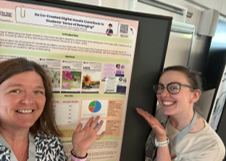
Image 1: Janette (left) and Zoë (right) and one of the posters produced at the retreat.
The face-to-face environment meant Zoë and I worked quicker and more efficiently than had we been online. We were able to chat easily about issues and there was no drain from being online for all that time. The social aspects of working with others (attendees and eSTEeM team) created an enjoyable and supportive environment and thus benefited my mental health. Altogether a success.
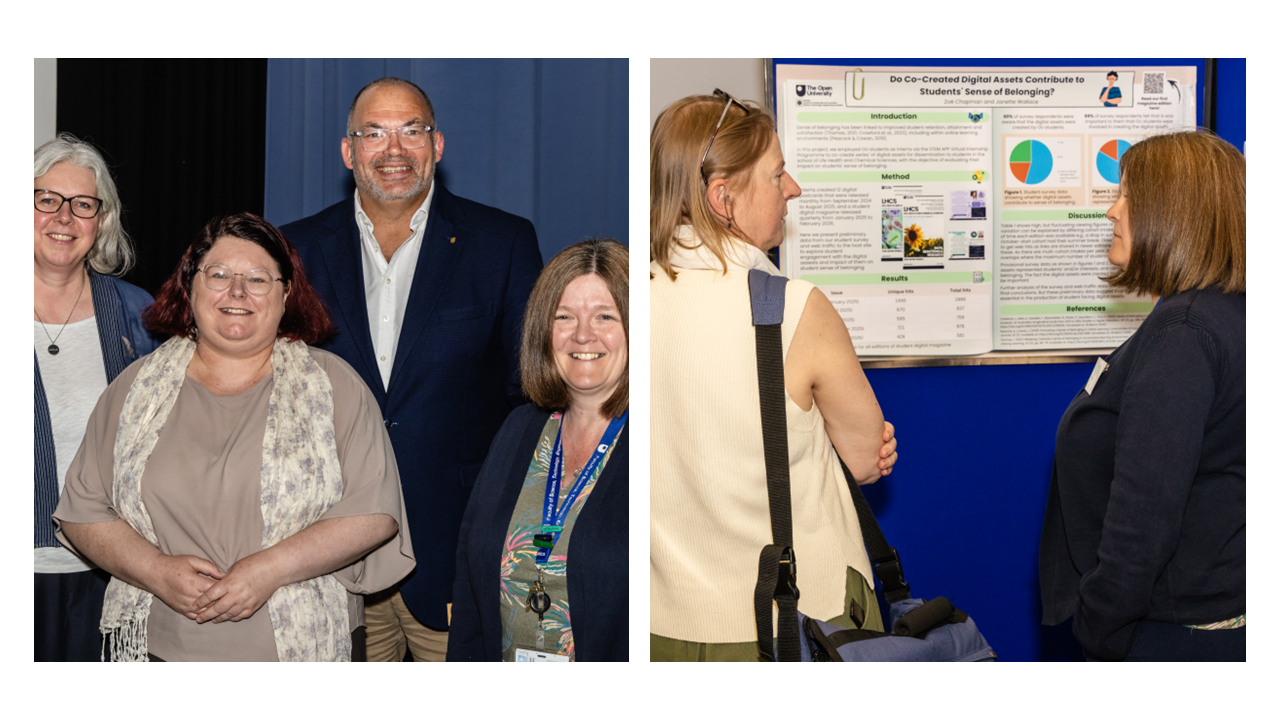
So, what next? For us, we won ‘Best Poster Presentation’ at the eSTEeM 15 years of growing the eSTEeM community conference in April. For the University, I can only hope that our winning poster shows the importance of continuing to fund much needed face-to-face events for homeworkers, including the eSTEeM reading and writing retreat.
Image 2: Janette receiving the Best Poster Presentation award from Vic Nicholas, Liz Hardie and Ian Pickup at the eSTEeM Annual Conference; Janette presenting her poster during the conference.
Please contact Janette for more information or discussions by emailing [email protected].
Janette Wallace, Senior Lecturer and Staff Tutor, School of Life, Health and Chemical Sciences (LHCS)
Janette Wallace is a Senior Lecturer, Qualification Lead and Staff Tutor in the School of Life, Health and Chemical Sciences (LHCS) at the Open University. Janette’s work focuses on teaching undergraduate and postgraduate science, in particular neuroscience. In addition, Janette has an interest in how student community can be supported through digital mediums with two recent projects in this area. One project researched the student co-creation of digital assets and the impact on student sense of belonging and the second a project researched the use of Virtual Reality tutorials in teaching, learning and student community.
Blog posts
- How disseminating your scholarship can expand horizons 5 October 2026
- Teaching in a virtual environment 7 September 2026
- 15 years of growing the eSTEeM community 29 April 2026


