

Centre for Scholarship and Innovation
Teaching in a virtual environment
I’m Sarah Daniell and a Senior Lecturer, Staff Tutor and Scholarship Lead in the School of Life, Health and Chemical Sciences (LHCS). One of the fabulous aspects of working for the Open University (OU) is that whatever our role, we’re here to support all our amazing students in their distance learning journey, whoever they are, wherever they’re from and whatever their previous academic background. Scholarship of Teaching and Learning (SoTL) underpins all our teaching and everything we do to provide the most effective and inclusive learning environment for our students. As part of my role, I work with others to support their scholarship research and am also actively involved in some really exciting projects with other colleagues, one of which I’ll discuss here.
I originally joined the Open University as an Associate Lecturer and then became a Staff Tutor, so have always been very much involved in teaching. One of the more challenging aspects of distance tuition is that we rarely see our students to build up relationships and the students don’t often get to meet or work together informally either. Together with other colleagues, I was keen to offer students an alternative platform for learning This really appealed to me as a wonderful way of teaching molecular scithat might appeal to those who enjoy more visual and active learning, and so I initiated a project to trial the use of a virtual reality (VR) platform.ence in a fun and colourful way – avoiding people snoozing and checking emails mid-session!
To begin with, VR was piloted on just one second-year undergraduate module teaching cell and molecular biology. This was incredibly exciting and somewhat daunting, as we didn’t know if students would come along to our VR tutorials, what technical problems they might encounter, if they would have VR headsets or not, if they would enjoy it and most importantly, if they would be able to learn!
Similarly to other universities, it can be a challenge to get students to engage with teaching and for the OU accessibility is paramount as we can’t troubleshoot with students in the room. We therefore use platforms that can be accessed via a browser, and we don’t expect our students to join using a VR headset (although we love it if they do!). In an ideal world, we would give all our students headsets, but that’s just not possible, so we adapted the VR rooms to look great on a laptop, tablet and phone, and to be open, relaxed and inviting, using 3D models to teach the content, as you can see in image 1.
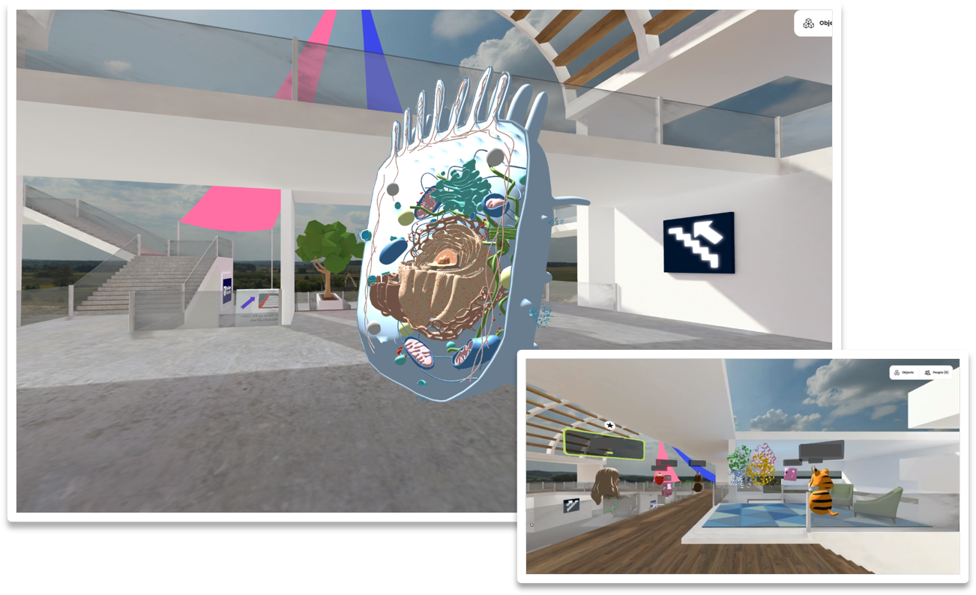
Image 1: A 3D model of a mammalian cell, and students as a variety of avatars in a VR environment studying a 3D model of haemoglobin.
Our initial pilot was popular with the students who enjoyed feeling more relaxed and able to have a chat and felt they had learned from the different style of teaching using the 3D models in the room. Watching and interacting with students naturally talking to us and each other felt brilliant! VR does facilitate a level of anonymity, as students can be represented as different avatars and they can choose what name they want to be identified by. This improves accessibility for some people and opens the door to less inhibited interactions. This is something we always strive for – no wrong answers or silly questions!
Based on the success of this pilot, we were encouraged to introduce VR tutorials on a third-year module too, teaching about the different senses. This is now very much ‘business as usual’ on this module and part of the tuition programme.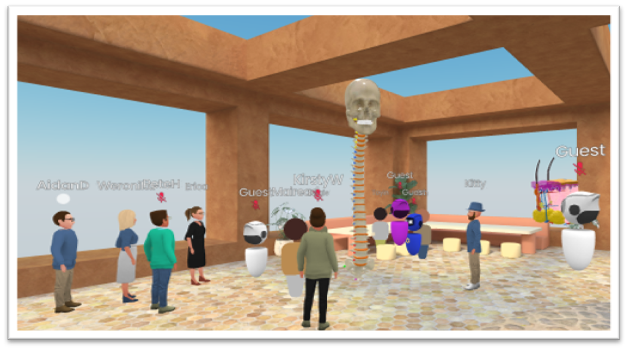
Image 2: Students joining in a VR tutorial as human and android avatars, learning about the nervous system.
Not all students choose to come along and not everyone enjoys the experience. Some people feel it’s too gimmicky, but many enjoy that feeling of learning together as a group in the room, which is otherwise hard to achieve online. The purpose is to be adaptive and address different student needs.
One of the positive aspects of introducing the VR tutorials at module level has been discovering how versatile the VR environment can be. It’s been great for days schools, poster presentations, scavenger hunts, staff briefings and get togethers!
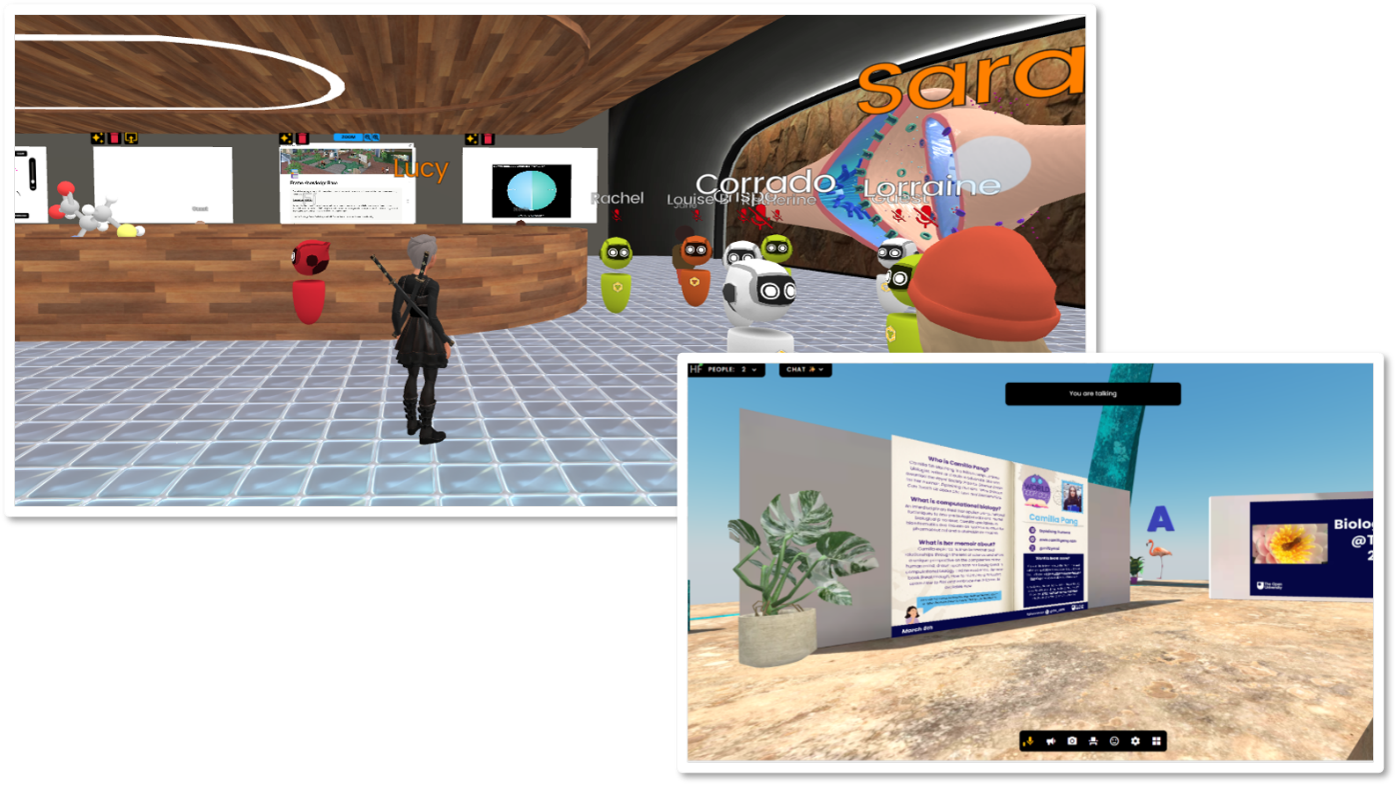
Image 3: A VR environment being used for a school event with staff and a poster conference and scavenger hunt for Biology week.
We’re now very much at the stage of spreading the word and making VR more accessible for both staff and students by producing an online site with guidance and resources so it can be used as widely as possible within the school and beyond.
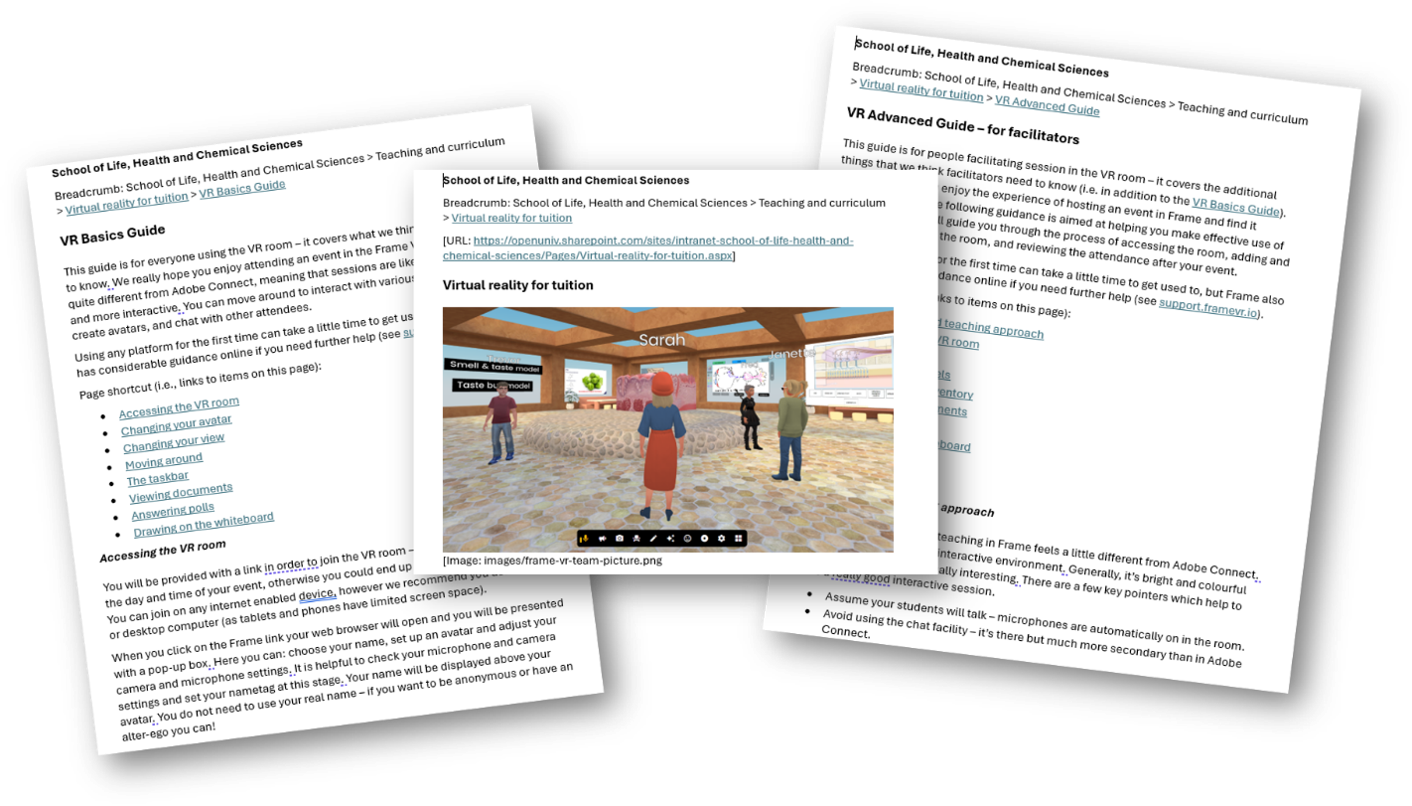
Image 4: Guidance resources to facilitate use of VR environments for students and staff.
So, the question is – how can VR be useful for you?
Please get in contact ([email protected]) if you would like to hear more about our research or are a staff member in LHCS and would like to get involve with scholarship research or would like to discuss your ideas.
Sarah Daniell, Senior Lecturer and Staff Tutor, School of Life Health and Chemical Sciences (LHCS).
Project team: Lucy Anderson, Staff Tutor, LHCS; Janette Wallace, Senior Lecturer and Staff Tutor, LHCS; Trevor Collins, Senior Research Fellow, Earth, Environment and Ecosystems Sciences (EEES).
Blog posts
- Teaching in a virtual environment 7 September 2026
- 15 years of growing the eSTEeM community 29 April 2026


