
Words of Wisdom: Creating a compendium of Sustainability
You may have read our previous blog post with reflections on our experiences at the Environmental Association for Universities and Colleges (EAUC) conference in Sheffield last year. And if you did, you may remember that at that time we gave an overview of a project called Words of Wisdom.
In our session we discussed the Goldilocks style challenge of presenting practice examples in a way that is ‘just right’ – finding the right balance of being detailed and engaging whilst also being maintainable. A key takeaway from this discussion was the value of ensuring examples don’t get siloed in their specific subject or context and demonstrating where possible the wider value and links it can have.
It has been a few months since the conference, and we have now published the first version of our compendium which we are excited to share! Before we do so, we will give a quick overview of the pilot project to refresh everyone’s memory. The aim of the Words of Wisdom project was to demonstrate how sustainability is being meaningfully embedded into Open University curricula and the student learning experience, through short, insightful contributions from educators and practitioners.
Each Word of Wisdom (WoW) is a bite-sized piece of advice between 50 and 200 words which shares practical examples, reflections, and lessons learned. Each WoW was reviewed using four key criteria: replicability, impact, inclusivity, and alignment with sustainability values and competencies. The aim is to inspire and inform others across the sector by highlighting actionable steps that can be taken.
But this isn’t just about staff voices. Students are at the heart of this project. Student feedback helps us understand what resonates, what motivates, and what matters. Throughout the compendium, we’ve included student quotes and insights about what learners have told us they value most in sustainability education

Creating draft Words of Wisdom
The Words of Wisdom collection started after Paul and the Learning Design AI team contributed to an AI focused compendium called ‘Using GenAI in HE teaching, learning and assessment: Inclusive, ethical and sustainable innovation’ in 2023. We were inspired by this approach and wanted to create something that made it easier to quickly find sustainability examples (something we were often asked for).
Our goal was to curate examples which would inspire colleagues to embed sustainability in their work, while also connecting, where possible, to what students thought. It was important to us that the examples were action focused and could be reused or adapted in different contexts.
We started by building on the insights gathered during the 2024 Responsible Futures (RF) audit at the OU, as it provided a rich source of data that could be repurposed. We spent time identifying which RF examples would be most useful to include and reviewed those selected against the inclusion criteria we outlined earlier, to make sure every entry was actionable and adaptable to different contexts. We also invited a small number of staff to submit examples from their own work to test the process of collecting new contributions.
What role did students play
Students were central to this project. We wanted their voices and opinions to be reflected in both the development and the final outputs. Two student volunteers helped review our submission form and assessed the entries drawn from the RF 2024 audit. They used the inclusion criteria to decide whether submissions met the standard. Their feedback was paired with the project team’s review to confirm decisions.
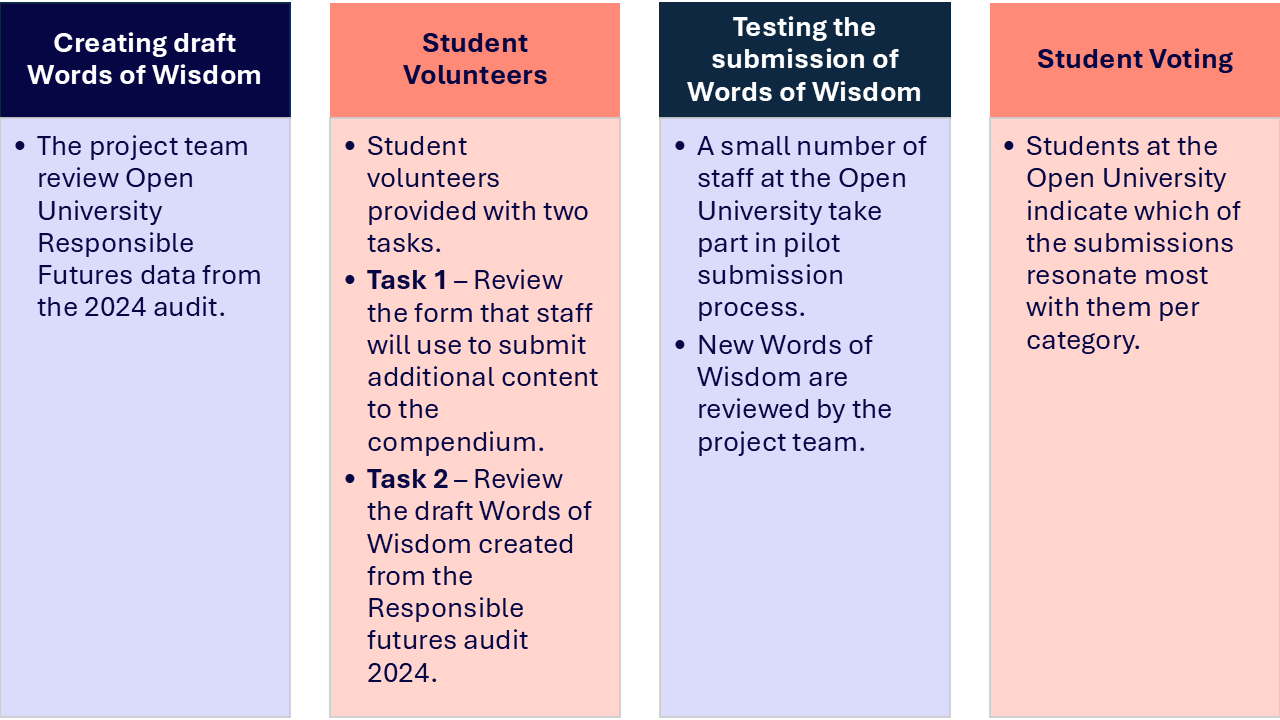
Figure 1: A table outlining the stages of the Words of Wisdom project. The peach columns show how student voice work contributed.
Once we had collected all of the examples, we shared them with a group of OU students and asked them to vote on which example in each of the categories we had assigned them too stood out most to them. They were also asked to rate how well their chosen example supported learner’s awareness of sustainability and preparedness to address future sustainability challenges. We marked the submissions that received the most student votes with a badge and, where students gave permission, we included quotes throughout the compendium. This has allowed us to share their valuable insights into what resonates, motivates, and matters most to learners.
Figure 2: The badge awarded to the student vote winners.
How do I access the Words of Wisdom compendium?
You can access our Words of Wisdom resource on OpenLearn Create by following the link (https://www.open.edu/openlearncreate/course/view.php?id=16298)
We hope this collection sparks ideas, fosters collaboration, and supports the continued integration of sustainability across learning and teaching at the Open University and beyond.
Call to action
Throughout January 2026 we have been sharing spotlights across our social channels for Words of Wisdom. Our aim has been to inspire you to consider how the examples in the compendium could be taken/adapted into your context and would like to hear your thoughts.
We are specifically keen to understand:
- If you plan to and/or have adapted any existing course material after reflecting on submissions to the compendium.
- If it has helped with staff development.
We are in the early stages of planning the next phase of Words of Wisdom. Watch this space for updates and how to get involved!
This blog was originally published on the OU Learning Design team blog section on the 5th February 2026.
The authors are Paul Astles and Catriona Matthews, both Learning Designers in the OU Learning Design Team at The Open University.

Blog posts



Explore

Undergraduate
Postgraduate
Policy
-
Follow us on Social media
-


