
Sharing lessons learnt when working with students as partners

Based on a 2024-2025 case study conducted in The Open University (OU) Law School, this blog explores the benefits and beneficiaries to mobilising students as partners (SaP) within higher education, and considers challenges faced during the project. Based upon our experiences, we offer three top tips to working with SaP.
In terms of the importance of SaP, Healey, Flint and Harrington (2014, p.7) state that ‘[e]ngaging students and staff effectively as partners in learning and teaching is arguably one of the most important issues facing higher education in the 21st century.’ They further explain that SaP has the potential to engage with, and contribute to, key areas within higher education ‘including assessment and feedback, employability, flexible pedagogies, internationalisation, linking teaching and research, and retention and success’ (Healey, Flint and Harrington 2014, p.7).
SaP rationale
We explored staff-student partnerships through co-designing and assessing module materials from production to presentation. Our SaP project considered an OU module titled W350: Exploring Legal Boundaries, as the authors were leading the production of an updated version of the module. As part of the production, we wanted to update tutorial teaching materials and thought this was an opportune moment to recruit a student to join our team.
The aim of the partnership was multifaceted in that the project aimed to help bring the student voice and experience to the design of the materials, to encourage confidence and a sense of belonging for our student, and to align with the OU Law School employability strategic goals which includes equipping our students to achieve successful careers in, and beyond, the legal sector.
Furthermore, by engaging with SaP, there is alignment with the OU Scholarship Plan 2024-2029 | Scholarship and Innovation “to increase collaboratively developed, research-informed knowledge exchange and teaching that meets the needs of our students, we will commit to actively engage students as partners (including as advisors and co-researchers) in scholarship activities”. (p.12). As part of the Scholarship Plan, Focus Three specifically relates to engaging students as partners.
Benefits, beneficiaries and challenges of SaP
In SaP scholarship, there is an acknowledgement of the multiple beneficiaries of SaP projects. Those who benefit from such initiatives include the student(s) and staff directly involved with the project (University of Cambridge, 2023) but there are also institutional benefits (Healey, Flint and Harrington 2014). As a team, we all reflected on our own experience of our staff-student partnership. Both staff and the student enjoyed working together, networking and learning about each other’s ideas on teaching, learning and research.
The student reported feeling a greater sense of belonging in the Law School and that by working ‘behind the scenes’ they understood the university a bit more. They also stated that they enjoyed interacting with staff and felt they had created new networks. Additionally, he shared that he saw value in his participation and that his involvement in the project would help to support his future employment and career goals.
The student found the project highly interesting, and when asked if he would apply to work as a SaP in future, he responded that he would “grab it with both hands if I have the opportunity in future”. Whilst the findings are limited, given one student participating, our research provides additional evidence to support the OU Scholarship plan.
Reflecting on her experience within the project, Dr Sophie Doherty writes:
‘At the beginning I was centring the student benefits to the project but by the end I felt I had experienced a transformation in my own professional practice and approach to material production.’
Mel Holmes also shared how the team gained access to a different perspective, which we directly used in our teaching materials.
Challenges with SaP
While there are many benefits of SaP, there were particular challenges the authors faced, namely recruitment of students and operational challenges. In terms of recruitment, adverts were shared internally, including on OU wide shared student webpages and relevant course sites. The adverts were broadly worded and encouraged all students to apply. The benefits to joining the project were explicitly referred to in the adverts, and as part of SaP scholarship review, the student confirmed these had motivated him to apply.
However, there is limited advice and data to understand and support researchers on the best way to recruit students within the university on SaP projects and more broadly. For future projects, it would be beneficial to explore some key questions relating to recruitment, e.g. why students applied, the suitability of the timing of the advertisement and project and where is best to place adverts.
The most challenging operational issue was expectation of student involvement and input, and how to make participation meaningful. As a team, this was discussed on commencement of the project. Whilst the student could not directly produce tutorial teaching materials, structured meetings were held to obtain SaP feedback and ideas on draft materials and approaches to be taken by staff. Therefore, expectations, roles and contribution by the SaP were explicit and agreed, in line with Suart e.t al.’s (2023) recommendations. The team also ensured role descriptions, expectations and contributions were outlined explicitly for all three project team members (namely staff and the SaP).
Our top three tips
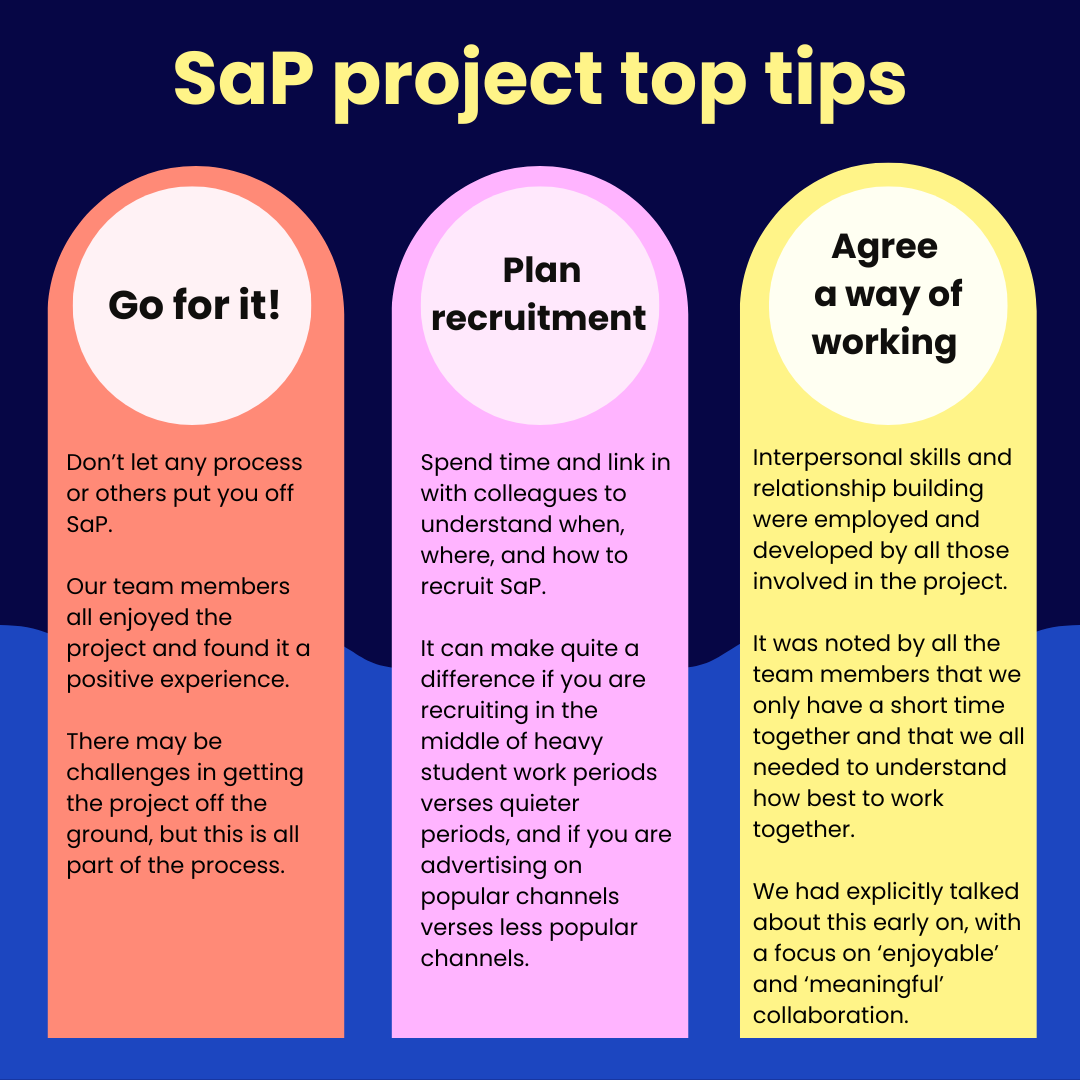
Having worked on a SaP project, what would our three top tips be for anyone interested in partnerships with students?
Dr Sophie Doherty
Sophie is a Lecturer in Law and the FBL Media Fellow. She is passionate about creative legal education, fostering engagement, and building student relationships.
In recognition of her commitment to enhancing student experience in legal education, Sophie has been nominated for, and awarded, multiple honours including, National Teaching Hero Award, issued by National Forum for the Enhancement of Teaching and Learning in association with the Union of Students in Ireland and The Open University’s Excellence in Teaching Award.

Mel Holmes
Mel previously worked as an inhouse solicitor, joining The Open University in 2000, as an Associate Lecturer on Access and Level 1 Law modules.
She is Head of Academic Student Experience and Senior Lecturer in the Law School, which includes bringing the student perspective to developing module/programme teaching and learning design. As the first person in her family to attend university, she is particularly interested in how universities can best support all students to achieve their study goals.
Mel is working on projects focused on developing study skill resources and support, and on how best we can collaborate with students.
References
Healey, M., Flint, A. & Harrington, K. (2014) Engagement through partnership: students as partners in learning and teaching in higher education (The Higher Education Academy). Available at engagement_through_partnership_1568036621.pdf.
Scholarship of Teaching and Learning (2024), Scholarship Plan 2024-2029 (The Open University). Available at Scholarship Plan 2024-2029.
Suart, C., Harvey, K., Zhu, J., Ali, M., Cassidy-Neumiller, M. (2023) ‘Students as Partners versus Students as Employees: Division of Labour between Students, Faculty, and Staff in the McMaster Student Partners Program’, Imagining SoTL, 3(2), pp. 64–88. Available at: https://doi.org/10.29173/isotl689.
University of Cambridge (2023) Working with students as partners guidance and resources (Cambridge Centre for Teaching and Learning). Available at: https://www.cctl.cam.ac.uk/files/students-as-partners-guidance.pdf.

Blog posts



Explore

Undergraduate
Postgraduate
Policy
-
Follow us on Social media
-


