
Rethinking leadership education – brick by brick

What do LEGO® bricks and leadership development have in common? At first glance, perhaps very little. Yet both involve building, experimenting, adapting and imagining new possibilities.
At the UALL–SCUTREA conference at the University of Warwick in June 2026, we explored this connection in a workshop titled 'Learning to Lead in a Changing World of Work: Reimagining Later-Life Learning Pathways'. Using creative methods, including LEGO® SERIOUS PLAY®, participants were invited to reflect on how mature workers can continue to develop leadership capabilities in, for and through work during a period of significant change.
The workshop was co-delivered by colleagues from The Open University (OU), Nottingham Trent University and the University of Lancashire, and this blog draws on reflections from both facilitators and participants.
But why was this conversation needed in the first place? As leadership and management degree apprenticeships face significant policy and funding changes, educators and practitioners are increasingly asking how mature workers can continue to access meaningful opportunities for leadership development. It was this challenge that provided the backdrop to our workshop and the discussions that followed.
Leadership development beyond degree apprenticeships
Before exploring creative approaches to leadership development, we first considered the context that made this conversation necessary. What might be lost as opportunities for leadership and management degree apprenticeships diminish, and what should replace them?
The workshop began by presenting findings from OU research on the lived experiences of leadership and management degree apprenticeships. Degree apprenticeships have offered an externally funded route to leadership development that has been transformative for many mature workers. The research highlighted that, for individuals who had previously struggled with ‘traditional’ educational approaches, apprenticeships have provided a pathway to career progression and increased confidence, with their learning contextualised within their workplace. These learners had clearly benefited from the work-based learning (WBL) pedagogy at the heart of apprenticeships, pedagogy which emphasises applying learning within their own contexts rather than through abstract case studies. They had also benefited from the additional support of higher education institutions (HEIs) and workplace mentors designated within the apprenticeship model.
Many of the apprentices interviewed reported experiencing imposter syndrome (Shek et al., 2026a) prior to starting their programmes. This was often replaced by renewed confidence in both work and life - described by one participant as “walking in the office with my head held high” (Shek et al., 2026b) – having undertaken their apprenticeship.
However, the landscape has shifted significantly. Notably, the defunding of leadership and management apprenticeships has coincided with wider pressures, including organisational budget cuts, technological developments such as the growth of Artificial Intelligence, and the introduction of the new - yet often confusing - Lifelong Learning Entitlement.
In this context, the workshop aimed to create space for participants from HEIs across the sector to reflect on ‘what next’ and to explore how we might continue to provide mature workers with similarly transformative leadership development opportunities beyond the apprenticeship framework.
Using creative methods to elicit perspectives
If the challenge was clear, the next question was how to explore it. Why use LEGO® SERIOUS PLAY® (LSP) to discuss leadership development and lifelong learning?
We wanted participants to move beyond conventional discussion and surface perspectives, experiences and ideas that might otherwise remain hidden. Creative methods can encourage reflection, storytelling and sense-making in ways that traditional conversations do not always enable. Rather than asking participants to simply describe their views, we invited them to build them.
We began the workshop using a set of Centre for Creative Leadership postcards (Bloomfield et al., 2025), inviting participants to select an image that reflected how a mature lifelong learner seeking to develop leadership skills in, for or through work might be feeling at this point in time. Building on this perspective-taking exercise, participants then used LSP bricks to represent the experience of that mature worker learning to lead, including the characteristics, challenges and support needs associated with that journey.
Given the 40-minute timeframe, it was not possible to run a full LSP workshop. Nevertheless, participants quickly engaged with the activity and produced a rich range of models that captured different experiences of learning and leadership development.
A key insight emerged during the sharing phase. While the models provided a focal point for discussion, their significance lay in the narratives attached to them. The same structure could carry very different meanings depending on the builder's experiences and interpretation. This combination of making and storytelling encouraged participants to reflect more deeply on their assumptions and experiences.
This highlights one of the strengths of LSP. By externalising thoughts through a model, individuals can explore complex issues in a way that feels less personal yet remains deeply meaningful. The model becomes a vehicle for reflection and dialogue, enabling participants to ‘think with their hands’ and often discover connections or insights that might not emerge through conversation alone. As Kristiansen and Rasmussen (2014) suggest, the builder retains ownership of both the model and its story, while the group works with the meaning that the builder attributes to it.
Interpreting the builds: participant narratives
Our small group brought together a range of perspectives, including a recent work-based graduate and lecturers from both Canada and the UK, which broadened our understanding of the adult learner journey. Our Lego model represented this journey as initially non-linear.
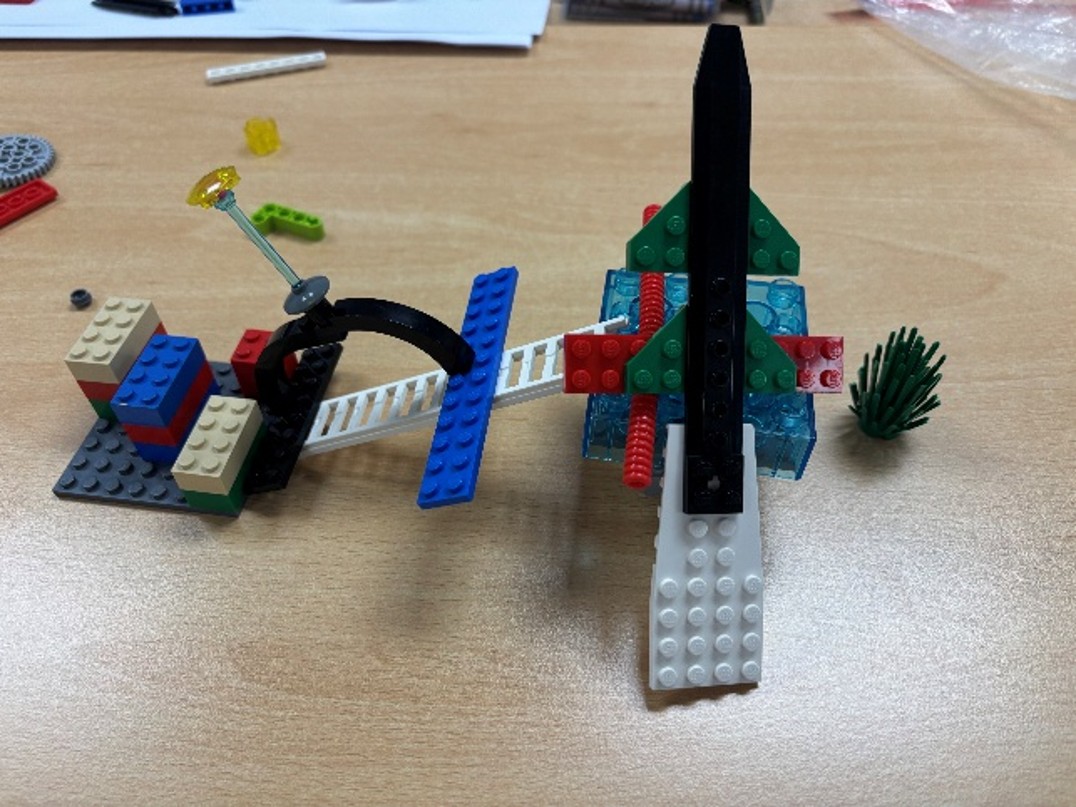
Figure 1: Structure one
The pieces on the left of structure one (figure 1), symbolised common barriers such as competing responsibilities, self-doubt and unfamiliar academic expectations, depicted as a maze where learners must reframe, adapt and sometimes change direction before reaching the starting point of the course.
Once on the course, the model showed a clearer path, represented by a bridge. This symbolised a key milestone, as learners complete their foundational first year and begin to gain clarity and confidence captured as “seeing the light” shown by the Lego piece. Beyond this, a ladder illustrated the gradual development of knowledge, skills and behaviours. This progression was supported by “rockets”, representing motivation from peers, tutors and self-directed learning, alongside opportunities to apply and showcase their expertise.
Finally, a tree symbolised a sense of grounding and identity. At this stage, learners feel more confident, experience less imposter syndrome, and increasingly embed and embody leadership in their professional practice.
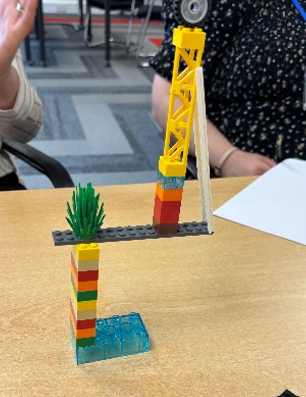
Figure 2: Structure two
Our group brought together an educator on degree apprenticeships, a senior university leader, and a learner on a senior leader degree apprenticeship. Specifically structure two (figure 2) indicates the journey of the senior leader learner. Pictured is stability in family life, whilst a ladder dangles precariously on the edge, symbolising the many strands of her life, including learning and career, and that unless something changes to free up more time for the apprenticeship, it is subject to falling.
Conclusion
The workshop was not designed to generate research data. Rather, its purpose was to create a collaborative space in which participants could explore how lifelong learning provision might respond to changing government priorities, workplace demands and global challenges. By combining dialogue with creative methods, participants were able to reflect on how leadership development opportunities for mature workers might be reimagined beyond the apprenticeship framework.
The workshop demonstrated that approaches such as LEGO® SERIOUS PLAY® can do more than increase engagement; they can create opportunities for conversations that are often difficult to access through traditional discussion alone
Through building, sharing and reflection, participants surfaced nuanced experiences of adult learning, leadership development and professional identity that might otherwise have remained hidden.
For us as facilitators, the workshop reinforced the value of creative approaches in helping people make sense of complex challenges. Several themes emerged that we intend to explore further, particularly around confidence, identity and the changing nature of leadership development in later working life. We are also keen to continue experimenting with creative methods within research, teaching and professional learning spaces.
As the landscape of leadership development continues to evolve, so too must the ways in which we engage learners and practitioners in conversations about the future. We would encourage other researchers and educators to consider how creative approaches can enrich both inquiry and dialogue. Sometimes the most insightful discussions begin not with a question-and-answer session, but with a handful of bricks and an invitation to think differently.
Acknowledgements
The interviews referred to in this blog were part of three different research projects that were supported and funded by SCiLAB – The OU Scholarship Centre for innovation in online Legal and Business education (Project References SCiLAB 9.2, SCiLAB 15.3 and SCiLAB242506). We would also like to acknowledge the following people who were involved in the original data collection and analysis within those projects: Mary Shek, Fran Myers, Kulvinder Buray, Alice Winters, Kristen Reid, Mike Phillips, Marni McArthur, Jaqueline Basquille, Nicola Bowman, Clare Horackova and Fidele Mutwarasibo.
AI Use Statement: Microsoft 365 Copilot (GPT-powered AI assistant), accessed via Microsoft 365 Cloud Chat: https://m365.cloud.microsoft/, was used to refine and improve the wording and readability of portions of this blog post. The authors reviewed, edited, and took responsibility for the final content. AI-generated assistance was generated on 19th June and 20th and 21st July 2026.
Sarah Bloomfield
Sarah is a Senior Lecturer in Work and Organisational Learning and the Director of Undergraduate Apprenticeship Qualifications in the Open University Business School. Her research and practice focus on how individual and collective managerial effectiveness can be improved in the workplace, recognising that each work situation is unique.
Joanna Booth
Joanna is a Principal Lecturer at Nottingham Business School. Shis is the course leader for the Chartered manager Degree Apprenticeship and the Executive MBA. Her research is based around the experiences of work-based learners and how these can be improved especially for upskillers and those experiencing menopausal symptoms.

Rebecca Quew-Jones
Rebecca is a Principal Lecturer and the Learning and Teaching Coordinator for the Faculty of Business and Law at the University of Portsmouth. A specialist in degree apprenticeships and work‑integrated learning, she has played a sector‑leading role in shaping innovative pedagogic practice and community‑building initiatives within higher education. Her research focuses on improving the experiences of work‑based learners, strengthening academic practice across complex teaching teams, and enhancing inclusive, resilient and future‑focused learning environments.

Louise Oldridge
Louise is an Associate Professor of Careers and Employability Education at the University of Derby. Prior to this, she worked as an Assistant Course Leader on the Chartered Manager Degree Apprenticeship at Nottingham Business School, Nottingham Trent University. Louise is particularly interested in the learning and career experiences of work-based learners.

Francesca Walker-Martin
Fran is a Reader in Work Based Learning and Academic Lead for Degree Apprenticeships in the Business School at the University of Lancashire. Fran has worked in the area of Placements and Work Based Learning for eighteen years. Her approach has always been that ‘learning should be great fun’ and a little bit challenging. She is a LEGO® SERIOUS PLAY® Practitioner, regularly working with students, learners and industry to enhance their skills and gain personal insights one brick at a time.
References
- Bloomfield, S., Mooney, E. and Salter, A. (2025). Picture this: Using visual imagery to explore workplace mentorship in experiential learning. SCiLAB, The Open University. URL: https://university.open.ac.uk/scholarship-and-inno...
- Kristiansen, P., and Rasmussen, R. (2014) Building a Better Business Using the Lego Serious Play Method, Wiley, New Jersey
- Shek, M., Myers, F., Bloomfield, S., Winters, A. and Buray, K. (2026a). I Can Do a Lot More than I Thought: Facilitative Factors on Work-Based Learning for Upskillers. In: Work-based learning: Forging pathways between theory and practice in higher education, 30 Apr 2026, Milton Keynes, UK.
- Shek, M., Myers, F., Bloomfield, S., Buray, K. and Winters, A. (2026b). Walking in the Office with My Head Held High: Tales of Gains from Lifelong Learning. In: British Sociological Association Annual Conference (2026); Paper session 3: Work, Employment and Economic Life, 8-10 Apr 2026, University of Manchester, Manchester, UK. URL: https://www.britsoc.co.uk/media/27153/ac2026_day1_...

Blog posts



Explore

Undergraduate
Postgraduate
Policy
-
Follow us on Social media
-


