
From classroom to clinic: Scaling Clinical Legal Education through simulation and AI

As a solicitor and supervisor of the Family Law Clinic run by the Open Justice Centre, I see each year the benefits students receive from putting their knowledge and skills into practice advising members of the public who have a family law issue. Real-life clients present with messy problems, emotional responses to their situation and sometimes unrealistic expectations of legal solutions. The skills needed to obtain relevant information, research the law, and provide written advice is quite different from traditional legal teaching, where the facts are presented in a nicely wrapped package without the uncertainty the human element can bring. Some students thrive in this real-world environment, while others decide that client-facing legal work is not for them.
The problem
However, providing law students with authentic opportunities in experiential learning is difficult at scale due to the cost of supervision. Where real life clients are involved, there needs to be a high degree of supervision from qualified academics to ensure the accuracy and quality of the advice and to comply with legal regulatory requirements. The Open Justice Centre offers experiential learning to over 200 students a year and is one of the largest clinical legal education providers in the UK. However, this number is small compared to the number of our law students. We are the largest law school in Europe with around 8,000 undergraduate law students each year.
One possible solution
I started to think about whether simulation may offer a solution to this problem. Simulation involves the creation of scenarios within which learners play roles, interact with people, create documents, and make choices based on their legal knowledge, and all available data (Maharg 2007). Concerns have been raised about whether simulation can replicate the ‘accidental and random’ qualities of reality (Maharg 2007).
It does require less supervision as students can practise within an environment that is close to the world of practice, but safe from the realities of malpractice and negligent representation (Maharg 2007). Within the Family Law Clinic, we use a simulated case to train students before they start work in the live client clinics. However, our experience is that this is still resource intensive at scale with the supervisor explaining each task to the students and the need to recruit someone to play the part of the client for the interview.
From classroom to clinic: A simulated Family Law Clinic case
Technology has changed the way in which teaching can be provided: could it be used to create a simulated law clinic case which requires little input from academics and therefore can be used at scale with students? Funded by SCiLAB’s Innovation Fund, I designed an interactive web-based course incorporating Generative AI tools. The course is based on a family law clinic case and enables the student to role-play a Law Clinic volunteer. The student is allocated a case by their supervisor and works through the usual steps from the initial enquiry to the drafting of a letter of advice. Students sequentially carrying out the activities needed for a clinic case, including:
- completing conflict checks through an interactive activity to learn about solicitors’ ethics and codes of conduct
- interviewing the client through a customised GenAI tool, with appropriate teaching materials
- watching a video of an interview of the client, to ensure they all have the appropriate information before starting their research
- researching the law, with guidance materials provided
- writing a letter of advice, using a template and with guidance documentation
- reflecting on their work, including comparison with a model letter of advice, and identifying the solicitor core competencies they have developed during the case.
All students who complete the case and upload a letter of advice receive a digital badge, which can be used as evidence in any job application.
Why does this work at scale: Automation
There are three key features which allow the simulation to be provided at scale. The first is that the case is automated so requires no intervention from an academic. Students must complete a task at the end of each stage, and once that task is completed the next task is given to them, along with relevant teaching materials. Students do have a generic email address for queries.
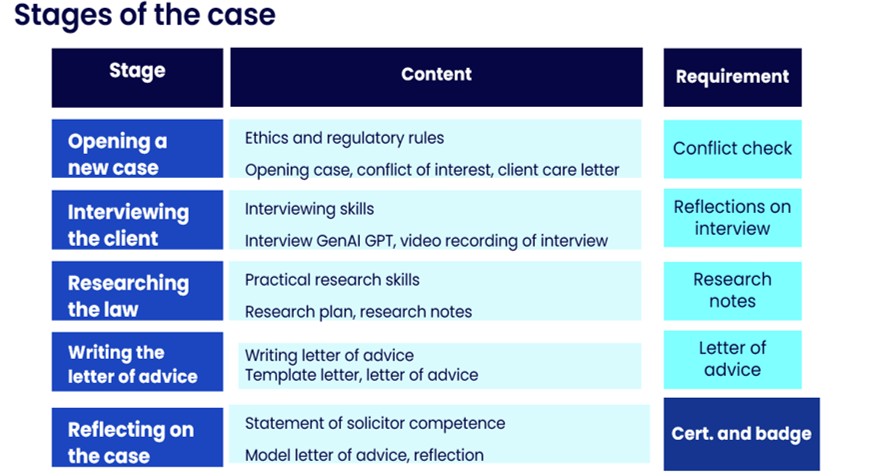
Figure 1: Stages of the simulated case, with associated activities and the compulsory activity to unlock the next stage.
Why does this work at scale: Interactive online activities
The second feature is that students carry out the tasks required through interactive online activities. For example, the conflict-of-interest check (when law centres and law firms must check they have not acted for the other party in a legal dispute before) is carried out through searches in an online database. Students therefore can conduct authentic tasks in a realistic way, which helps them to acquire the knowledge and skills needed to ensure they are ready for legal practice.
Why does this work at scale: Generative AI
Thirdly, the use of Generative AI enabled me to programme an agent to function as the client so that the students could interview her. The agent is given the case facts, a chronology, the family structure, and instructions to answer the students’ questions using only the facts contained within the information provided. The written text-based approach allows the student to think about their next question and focus on information-seeking. However, I am conscious that this approach means the student is not able to practice using soft skills such as body language, tone, and empathy. This will be considered during the evaluation: I wonder whether it is possible to interview a Generative AI avatar in the future?

Figure 2: Picture of Jennie Jones, the fictious client which is displayed in the GenAI tool.
This picture was created by ChatGPT using a prompt given by the author.
What next?
The simulated case has now been finished and was available to family law OU law students to work through on a voluntary basis during Summer 2026. An evaluation is planned in Autumn 2026 to consider how effective the case was. This will include a student survey and focus groups, and a content analysis of the letters of advice. If the case is successful, we will develop a second law centre simulated case based on an employment law query which will be made available to business and employment law students in Summer 2027. We also plan to develop an introductory simulated road traffic accident case for our first-year tort law students, which will focus on skills development, whilst still being based in a law clinic environment.
The hope is that this pilot will demonstrate that the use of technology offers a way for simulated experiential learning to be provided at scale and low resource. This will enable authentic experiences to be provided to more students, as well as being used to train student before live-client work.
.jpg)
Liz Hardie
Liz is Director of SCiLAB and a senior law lecturer. She is also a solicitor and leads the Open Justice Family Law Clinic. She has been involved in online Clinical Legal Education programmes for the last 8 years. Her research interests include the use of technology in legal education, and she has published extensively on Generative AI in the last three years.
References
Maharg, P. (2007). Transforming Legal Education: Learning and Teaching the Law in the Early Twenty-First Century. Farnham: Ashgate Publishing, Ltd.



Explore

Undergraduate
Postgraduate
Policy
-
Follow us on Social media
-


