
Picture this: Using visual imagery to explore workplace mentorship in experiential learning

Unpacking the workplace mentor’s role in experiential learning
Universities have a key role to play in enhancing the skillset of our future workforce. One way this can be achieved is through providing experiential learning opportunities in the workplace as part of degree programmes (Bloomfield and Salter, 2025). A key driver to the success of such programmes is the ‘workplace mentor’: a member of the employing organisation who is tasked with supporting the learner in the work situation. Despite the added value they can bring to the learning experience, workplace mentors are often ‘unseen, under-appreciated and under-studied’ (Myers et al, 2025, p.1),
The authors are researching experiential learning in the workplace as part of an Open University pan-university scholarship funded project. Given our expertise in this area, we were invited to run a workshop at the University Vocational Award Council’s conference in Birmingham in November 2026. We decided to use the opportunity to enhance understanding around the role of workplace mentors.
As a pan-university project team, we represent different programmes within the University: policing, nursing and management. Our workshop participants were even further dispersed across disciplines and functional areas, though they were all involved in experiential learning in the workplace in one way or another. We therefore needed to find a way to get our diverse participant group to focus on workplace mentors as a common element across their various programmes at the start of the workshop, to enable richer reflection related to that role. We did this through the use of visual imagery.
From images to insights: Exploring mentor roles creatively
At the start of our workshop, we used a very large set of postcards created by the Centre for Creative Leadership. The multiple cards were laid out on tables at the back of the room, and the participants were asked to choose one that symbolised supporting learning in the workplace. The choices were insightful, highlighting the value that visual imagery can play within research.
As examples, cards were chosen that highlight the following themes related to the roles of workplace mentors:
1) Workplace mentor role as nurturing and supportive

2) Workplace mentor as part of the team, on the journey alongside the learner

3) Workplace mentor’s role helping see through the complexity
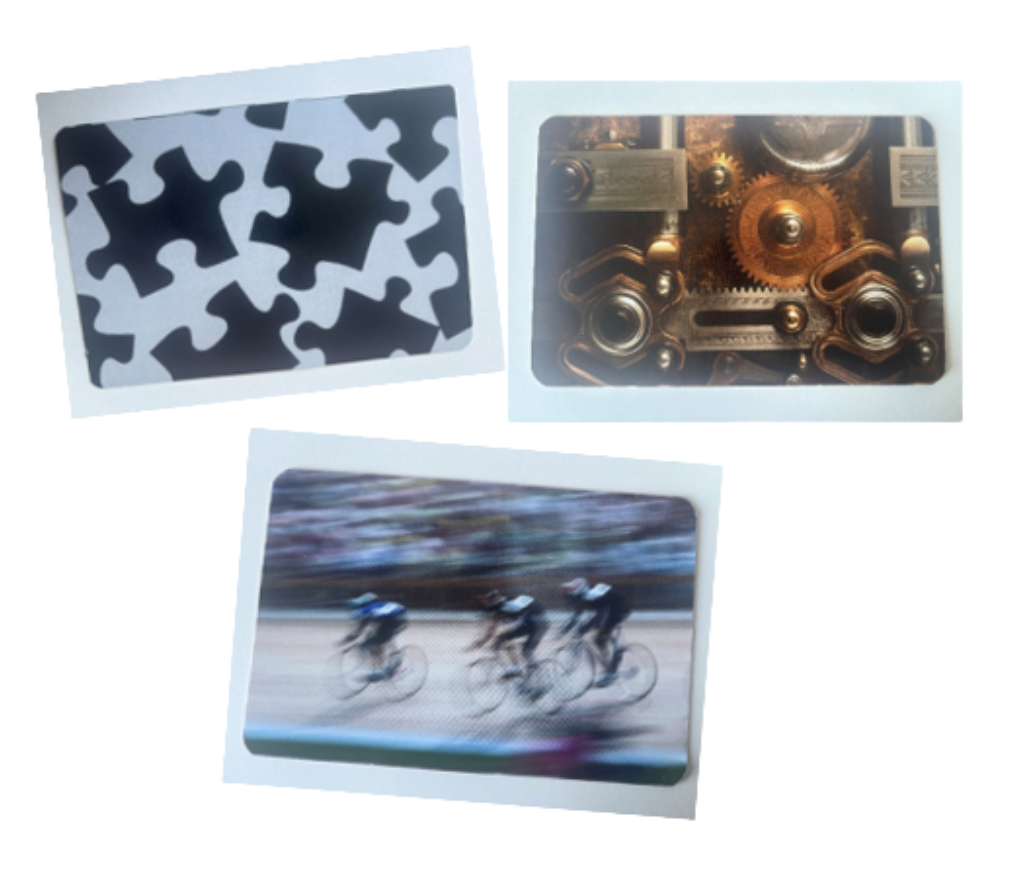
As well as providing valuable insight around the workplace mentor role in experiential learning, the workshop provided important lessons around using creative techniques to gather participant views.
We believe it’s essential that participants have the chance to explain why they selected a particular image. In our workshop, this happened through small-group discussions - serving both as an ice-breaker and a way to set the scene for the session. When using this activity for research, we’ve adapted the process by also asking participants to write three descriptive words on a Post-it note and attach it to their image. These notes are then collected with the images for later analysis. While three words provide less depth than capturing full group conversations, this approach is efficient and still offers valuable insight into the reasoning behind each choice.
Although gaining Research Ethics approval may be less straightforward than for traditional interviews or focus groups, creatives techniques often yield powerful additional insights. We encourage fellow scholarship practitioners to consider incorporating creative approaches - such as visual imagery - into their research practice.
Towards a stronger future for experiential learning
During the rest of the workshop, we ran a ‘world café’ to enhance understanding around the challenges that workplace mentors face and how they could be overcome. Reoccurring themes included the pressures workplace mentors face in terms of time, operational priorities, and mentoring skills.
Our exploration using visual imagery is just the beginning of our scholarship project, which will consider work-based and work-integrated experiential learning more broadly across sectors and countries: what is employed, where, why and how. What is already clear however is that as educators and practitioners, we have an opportunity to champion workplace mentors as key partners in experiential learning. By continuing to innovate in how we understand and support workplace mentors, we can strengthen experiential learning and, ultimately, prepare a workforce ready for the complexities of tomorrow.
References
Bloomfield, Sarah and Salter, Abigail (2025). Learning to work or working to learn: entangling the difference between ‘work-integrated’ and ‘work-based’ learning. SCiLAB, The Open University, Milton Keynes, UK.
Myers, Frances; Bloomfield, Sarah; Reid, Kristen; Marshall, Helen and Timmins, Susan (2025). Problematising the unseen role of the line manager in degree apprenticeships: Where do we go from here? Higher Education, Skills and Work-Based Learning, 15(6) pp. 1183–1196. DOI: https://doi.org/10.1108/HESWBL-01-2025-0036

Sarah Bloomfield
Sarah Bloomfield is Senior Lecturer in Work and Organisational Learning and the Director of Undergraduate Apprenticeship Qualifications in the Open University Business School. Her research and practice focus on how individual and collective managerial effectiveness can be improved in the workplace, recognising that each work situation is unique.
Evelyn Mooney
Evelyn is a Lecturer in Nursing within the Faculty of Wellbeing, Education, and Language Studies at The Open University (OU). Since joining the OU in 2017, she has made significant contributions to the development and delivery of nursing and nursing associate education programmes. She has also co-led several Pan-University scholarship-funded projects, focusing on strategies to support learners during practice-based learning experiences and evaluating the effectiveness of the tripartite relationship.

Abigail Salter
Abigail is a Lecturer in Policing Organisation and Practice in the Faculty of Business and Law at The Open University (OU). Since joining the OU in 2018, she has contributed to the development and delivery of policing education programmes and led several scholarship projects funded by SCiLAB and Pan-University initiatives. Her work has been published and presented at national and international conferences. Abigail is currently undertaking a Doctorate in Education, exploring the lived experience of workplace learning in the Police.

Blog posts



Explore

Undergraduate
Postgraduate
Policy
-
Follow us on Social media
-


