
Leading with algorithms: why the Harper (2025) Reflexive Leadership Model redefines AI-era leadership

The Harper (2025) Reflexive Leadership Model is grounded in research exploring the longstanding “born versus made” leadership debate and the emerging influence of AI-enabled learning, positioning leadership development within a technologically mediated and evolving societal context.
The Model reimagines AI-era leadership, placing ethical reflexivity, governance and adaptive experimentation at its core, shifting focus from technical mastery to responsible human-AI judgement within complex sociotechnical systems.
Introduction
Artificial intelligence is no longer confined to automation or operational efficiency. It increasingly shapes managerial judgement, strategic interpretation and professional learning. Leaders now operate in sociotechnical environments where algorithms generate insights and influence organisational decision pathways. The question is no longer whether leaders should use AI, but how leadership must evolve when intelligence is distributed between humans and machines.
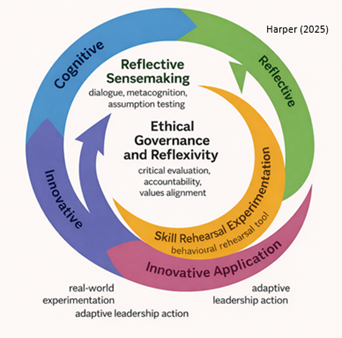
The Harper (2025) Reflexive Leadership Model (Figure 1) addresses this shift by embedding AI within a structured cycle of reflective sensemaking, ethical governance and adaptive experimentation. Rather than framing AI as merely a productivity enhancer, the model positions it as a catalyst for reflexive practice and accountable decision-making. Leadership effectiveness in AI-mediated contexts depends less on technical expertise and more on the ability to interpret, question and ethically govern algorithmic outputs.
Figure 1: Harper Reflexive Leadership Model (Harper, 2025)
Repositioning leadership in the age of human-AI collaboration
Traditional leadership models focus on traits, behaviours or relational competencies but do not fully account for intelligent systems shaping organisational knowledge. Harper extends reflective practice (Schön, 1983), sensemaking (Weick, 1995) and double-loop learning (Argyris and Schön, 1978) into algorithmic environments. Leaders must now interrogate not only their own assumptions but also those embedded in data systems and predictive tools. Without such reflexivity, automated systems risk reinforcing bias and flawed logic (O’Neil, 2016; Eubanks, 2018).
Ethical reflexivity as a core leadership capability
A defining feature of the model (Figure 1) is its insistence that ethical governance sits at the centre of leadership practice, visually represented as the core organising principle from which all other components extend. The Harper (2025) Reflexive Leadership Model is structured to illustrate leadership as an interconnected, dynamic system, where ethical reflexivity underpins and informs surrounding elements such as governance, adaptive experimentation, and human-AI decision-making. Rather than functioning as a standalone competency, ethical reflexivity operates as the central mechanism through which leaders interpret, evaluate, and respond to complex sociotechnical challenges.
This central positioning is significant, as it demonstrates how each element of the model is both dependent on and influenced by ethical judgement. For example, governance processes are not treated as static compliance mechanisms, but as evolving practices shaped through continuous reflection and accountability. Similarly, adaptive experimentation, positioned within the model as a key leadership activity is mediated by ethical considerations, ensuring that innovation is balanced with responsibility. The model therefore depicts leadership as a cyclical and reflexive process, where feedback loops between these components reinforce ongoing learning and adjustment.
Concerns around bias, opacity and accountability gaps in AI systems are well documented (Floridi et al., 2018; Mittelstadt et al., 2016). While governance frameworks emphasise transparency and fairness (UK Government, 2023), they rarely address how leaders develop the cognitive capability to enact responsible AI oversight. Harper integrates governance directly into leadership development, positioning leaders as ethical stewards of sociotechnical systems. This is reflected in the model’s design, where ethical reflexivity enables leaders to critically engage with AI outputs, question underlying assumptions, and make informed, context-sensitive decisions. In doing so, the model moves beyond procedural governance, advancing a more holistic conception of leadership that is adaptive, morally grounded, and responsive to the complexities of AI-integrated environments.
Learning, simulation and the expansion of leadership capability
The model also emphasises rehearsal and experimentation through AI-enabled simulations. Research demonstrates that immersive rehearsal enhances complex skill acquisition (Chernikova et al., 2020). AI coaching tools can further support reflective development, though concerns remain about relational depth and accountability (Passmore and Tee, 2023). Harper addresses these tensions by ensuring AI complements rather than replaces human judgement.
Filling a critical gap in leadership and ai research
Despite widespread AI adoption, leadership theory has lagged behind. Much organisational AI research focuses on efficiency and transformation (Brynjolfsson and McAfee, 2014; Davenport and Kirby, 2016), while leadership studies continue to prioritise relational dimensions without fully addressing algorithmic influence. Harper’s model bridges reflective theory, AI-enabled learning and governance, reframing leadership as the orchestration of responsible action within complex sociotechnical systems.
Applying the Harper (2025) Model in practice
Applying the model requires embedding structured reflection into decision processes. Leaders must articulate the rationale behind AI-supported decisions, identify bias risks and align choices with organisational values. Simulation-based rehearsal can test ethical dilemmas and strategic responses before implementation. Organisational cultures must also support questioning and critical dialogue; reflexivity cannot flourish in purely performance-driven environments. Governance mechanisms should be integrated into leadership training, so accountability becomes a lived capability rather than a compliance afterthought.
Conclusion: toward reflexive, responsible and adaptive leadership
The Harper (2025) model ultimately reframes leadership as reflexive, responsible and adaptive. Effectiveness in the AI era depends not on technological fluency alone but on the capacity for ethical judgement and critical engagement with intelligent systems. Leadership’s future is neither purely digital nor purely human; it is fundamentally sociotechnical.
In practice, the model has been used as a conceptual framework to guide leadership development, particularly in contexts where AI is increasingly embedded in decision-making, learning, and organisational processes. It offers a structure through which leaders can navigate uncertainty, balance innovation with accountability, and develop the reflexive capabilities required to question both human and machine-generated insights. As the model continues to evolve, the next steps focus on its application within real-world settings, including leadership training environments and AI-enabled learning systems, to further test and refine its practical value.
From my perspective as the author, the model is intended not as a fixed solution, but as a living framework, one that encourages ongoing reflection, adaptation and dialogue. Its strength lies in its flexibility and its ability to provoke critical thinking about how leadership must change in response to technological advancement. I would be particularly interested in how others interpret and apply the model within their own contexts, as its continued development depends on shared insight and collaborative exploration.
I would love to hear your views. Connect with me on www.linkedin.com/in/dr-jennifer-harper-roberts2026
Dr Jennifer Harper

Jennifer is Strategic Implementation Lead in the Faculty of Business and Law at The Open University, with over 12 years’ experience across higher and further education. Her work spans teaching and learning enhancement, academic quality, workforce development, and digitally mediated student experience.
A Senior Fellow of Advance HE (SFHEA), she lectures and supervises at postgraduate level and researches leadership and strategy in technology-enabled education, with a focus on generative AI, organisational capability, and inclusive, sustainable change.
References
- Argyris, C., & Schön, D. A. (1978). Organisational learning: A theory of action perspective. Reading, MA: Addison-Wesley.
- Brynjolfsson, E., & McAfee, A. (2014). The second machine age: Work, progress, and prosperity in a time of brilliant technologies. New York: Norton.
- Chernikova, O., Heitzmann, N., Stadler, M., Holzberger, D., Seidel, T., & Fischer, F. (2020). ‘Simulation-based learning in higher education: A meta-analysis’, Review of Educational Research, 90(4), pp. 499–541. https://doi.org/10.3102/0034654320933544
- Davenport, T. H., & Kirby, J. (2016). Only humans need apply: Winners and losers in the age of smart machines. New York: Harper Business.
- Davenport, T. H., & Ronanki, R. (2018). ‘Artificial intelligence for the real world’, Harvard Business Review, 96(1), pp. 108–116. https://hbr.org/2018/01/artificial-intelligence-for-the-real-world
- Eubanks, V. (2018). Automating inequality: How high-tech tools profile, police and punish the poor. New York: St Martin’s Press.
- Floridi, L., Cowls, J., Beltrametti, M., Chatila, R., Chazerand, P., Dignum, V., Luetge. C., Madelin, R., Pagallo, U., Rossi. F., Schafer. B., Valcke. P., & Vayena, E. (2018). ‘AI4People—An ethical framework for a good AI society’, Minds and Machines, 28(4), pp. 689–707.
- Harper, J. (2025). Are leaders born or made? Can technological approaches assist the development and training of future leaders. PhD thesis, University of Chester. https://chesterrep.openrepository.com/
- Mittelstadt, B. D., Allo, P., Taddeo, M., Wachter, S., & Floridi, L. (2016). ‘The ethics of algorithms: Mapping the debate’, Big Data & Society, 3(2), pp. 1–21.
- O’Neil, C. (2016). Weapons of math destruction: How big data increases inequality and threatens democracy. New York: Crown.
- Passmore, J., & Tee, D. (2023). ‘AI coaching and the future of leadership development’, International Coaching Psychology Review, 18(1), pp. 5–19.
- Schön, D. A. (1983). The reflective practitioner: How professionals think in action. New York: Basic Books.
- UK Government. (2023). Ethics, transparency and accountability framework for automated decision-making. London: Cabinet Office.
- Weick, K. E. (1995). Sensemaking in organizations. Thousand Oaks, CA: Sage Publications.

Blog posts



Explore

Undergraduate
Postgraduate
Policy
-
Follow us on Social media
-


