
Our success measures - Equity, Diversity and Inclusion Strategic Plan (Light)
5. Our success measures
The Key Performance Indicators (KPIs) below reflect the priority areas of the EDI Strategic Plan: Disability, Neurodiversity and Accessibility, LGBTQIA+, Race and Gender inclusion. They are evidence-informed and based on areas where data shows persistent inequities in staff and student experience, representation, recruitment, progression and outcomes.
Gender and race KPIs align with areas requiring improvement and are supported by the Race Equality Charter and Athena Swan action plans.
For disability, neurodiversity, accessibility and LGBTQIA+ inclusion, KPIs focus on colleague experience and will inform SMART action plans through the relevant governance groups. Sexual orientation and gender identity are measured separately to avoid masking differences in experience, particularly for trans colleagues.
Student KPIs are drawn from the approved Access and Participation Plan 2025–2029. Together, the staff and student KPIs provide an evidence-informed framework for annual monitoring across the life of the Strategic Plan.
5.1 Staff KPIs
By the end of the Strategic Plan period:
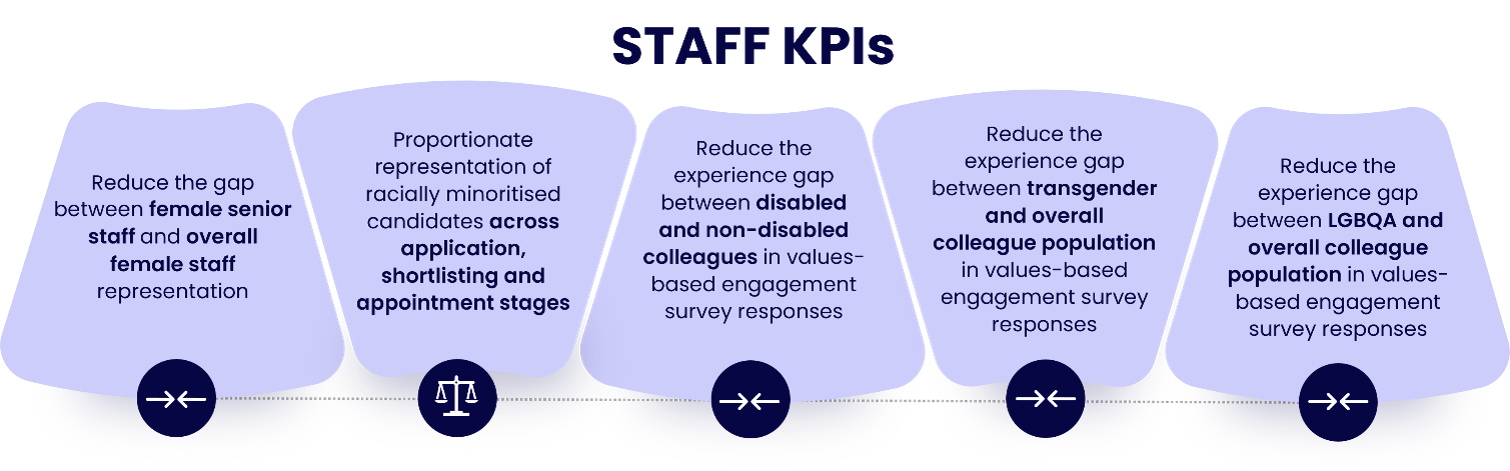
- The gap between female senior staff representation (defined as staff on PB or SS pay grades) and overall female staff representation will be reduced from 9 percentage points (2024/25) to within 4 percentage points (2030/31).
- The proportion of racially minoritised candidates at appointment stage will be consistent with proportion at application and shortlisting stages. In 2024/25 the gap from applicant to appointment for racially minoritised colleagues was 22 percentage points.
- The gap in positive responses to values based engagement survey questions between colleagues who shared disability(ies) and those who do not will reduce from 9 percentage points (2024/25) to 3 percentage points or less (2030/31).
- The gap in positive responses to values based engagement survey questions between transgender colleagues and the overall colleague population will be reduced from 8 percentage points (2024/25) to 3 percentage points or less.
- The gap in positive responses to values based engagement survey questions between LGBQA colleagues and the overall colleague population will be reduced from 3 percentage points to 2 percentage points or less. It was 3ppt in 2024/25.
5.2 Student KPIs
By the end of 2029, we will:
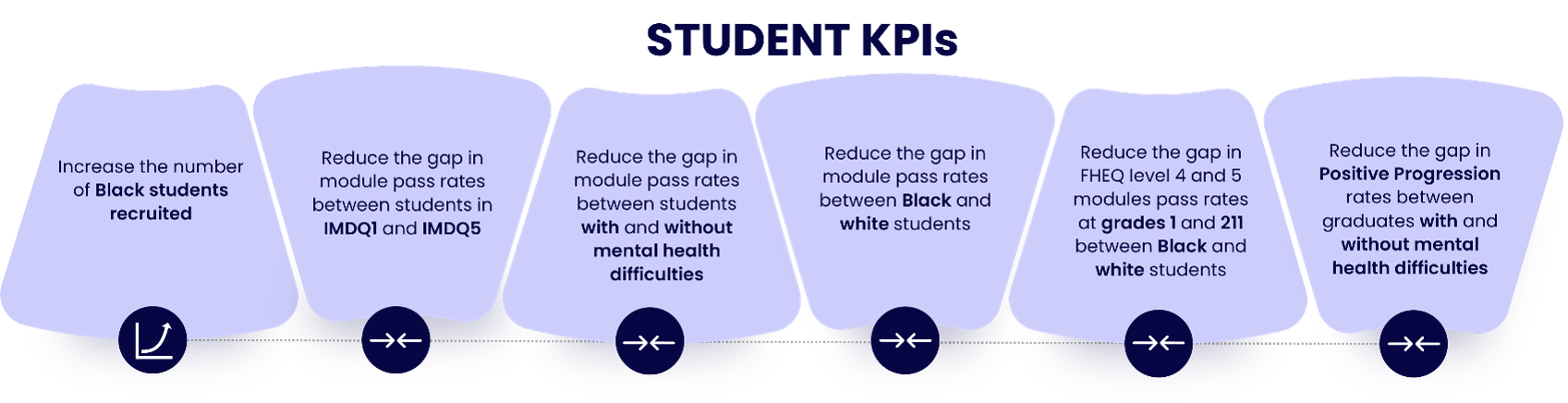
- Increase in the number of Black students recruited, above that expected from population changes, from 1,131 (2023/24) to 1,256 (2028/29).
- Reduce the gap in module pass rates between students in IMDQ1 and IMDQ5, by increasing the pass rates for students in IMDQ1 from 58.0% (2022/23) to 62.8% (2028/29).
- Reduce the gap in module pass rates between students with and without mental health difficulties, by increasing the pass rates for students with mental health difficulties from 54.9% (2022/23) to 63.7% (2028/29).
- Reduce the gap in module pass rates between Black students and white students, by increasing the pass rates for Black students from 56.8% (2022/23) to 63.7% (2028/29).
- Reduce the gap in FHEQ level 4 and 5 module pass rates at grades 1 and 211 between Black students and white students, by increasing the pass rates for Black students from 36.9% (2022/23) to 50.3% (2028/29).
- Reduce the gap in Positive Progression rates between graduates with and without mental health difficulties by increasing the Positive Progression rates for graduates with mental health difficulties from 67.9% (2022/23) to 71.7% (2028/29).
Contact us
Equality, Diversity and Inclusion
The Open University
Walton Hall
Milton Keynes
MK7 6AA
Email [email protected]


Explore

Undergraduate
Postgraduate
Policy
-
Follow us on Social media
-


