
Our priority areas - Equity, Diversity and Inclusion Strategic Plan (Light)
3. Our priority areas
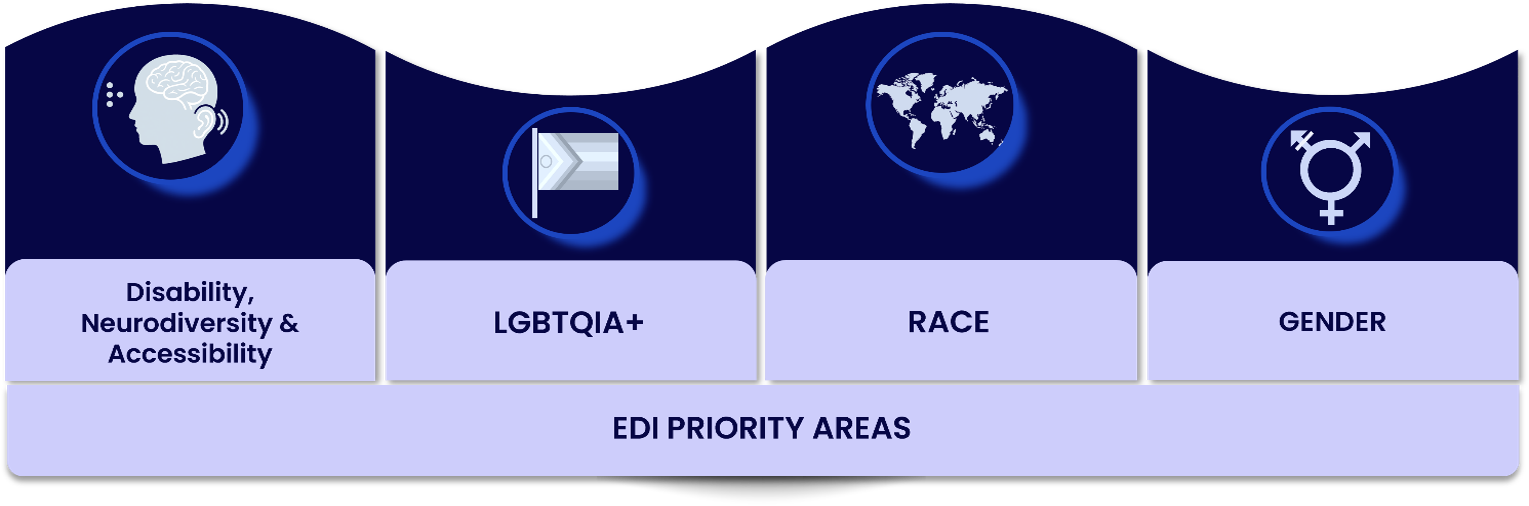
The Plan identifies four priority areas for focused action between 2026 and 2031. They are:
- Disability, Neurodiversity and Accessibility
- LGBTQIA+
- Race
- Gender
These priority areas reflect persistent inequities in staff and student experience and outcomes, and existing frameworks such as Athena Swan, the Race Equality Charter, the APP and staff networks. These priorities do not limit our broader commitment to tackling all forms of inequity.
3.1 Disability, Neurodiversity and Accessibility 
The OU is the largest UK provider of higher education for disabled people, with over 39,000 students who have shared a disability studying with us.
We also employ disabled and neurodivergent colleagues across all parts of the institution.
Accessibility lies at the heart of our OU mission and values and is the key to enabling success for our disabled and neurodivergent staff and students.
In this Strategic Plan, we use the terms ‘disability, neurodiversity and accessibility’ to encompass disabled and neurodivergent staff and students, as well as individuals with diverse access needs. The actions set out in the Plan will be underpinned by an intersectional approach.
Our objectives for 2026 - 31
Over the lifetime of this Strategic Plan, we will:
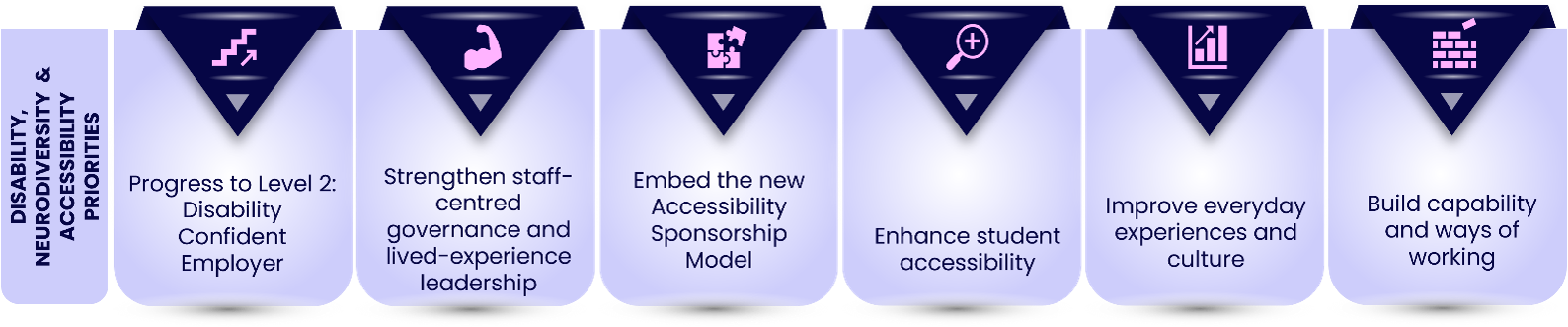
- Progress to Disability Confident Level 2, using the findings of our 2023/24 self-assessment which evaluated our readiness for progression, to address gaps and progress from Level 1 to Level 2 (Disability Confident Employer).
- Strengthen staff-centred governance and lived-experience leadership. Embed the Disability, Neurodiversity and Accessibility (DNA) Steering Group and its working groups as the focal points for strategic oversight, clear direction and listening exercises with disabled and neurodivergent staff and students to ensure that our priorities reflect lived experience.
- Embed our new Accessibility Sponsorship Model. Enable more focused accessibility work with three senior sponsors covering student, staff and digital accessibility. The model will reduce overlap, prioritise resources and align accessibility work with wider strategic priorities.
- Enhance student accessibility. Review and enhance how student accessibility is supported and resourced, ensuring approaches are sustainable and informed by student need and institutional priorities.
- Improve everyday experiences and culture. Clarify and streamline reasonable adjustment processes for staff and students. Enhance data on disability and neurodiversity and review the impact of our accessibility initiatives.
- Build capability and ways of working. Provide guidance and development on accessibility and disability and neurodiversity inclusion. Support and resource staff networks.
This work responds to persistent barriers in digital accessibility, learning materials, systems, recruitment, progression, reasonable adjustments, mental health and wellbeing, and inconsistent practice across the institution.
3.2 LGBTQIA+ 
LGBTQIA+ inclusion is essential to creating a safe, equitable and welcoming environment for everyone in our community. While we celebrate significant progress through networks, events and visible commitments, we know that data on LGBTQIA+ staff and student experience is limited, especially in distance-learning contexts.
At the OU, we use the term LGBTQIA+ to reflect the full diversity of sexual orientation, gender identity and sex characteristics within its community. LGBTQIA+ is an inclusive and widely recognised term that acknowledges and supports the visibility and belonging of all individuals who face discrimination due to their gender identity or sexuality.
Our objectives for 2026 - 31
Over the lifetime of this Strategic Plan, we will:
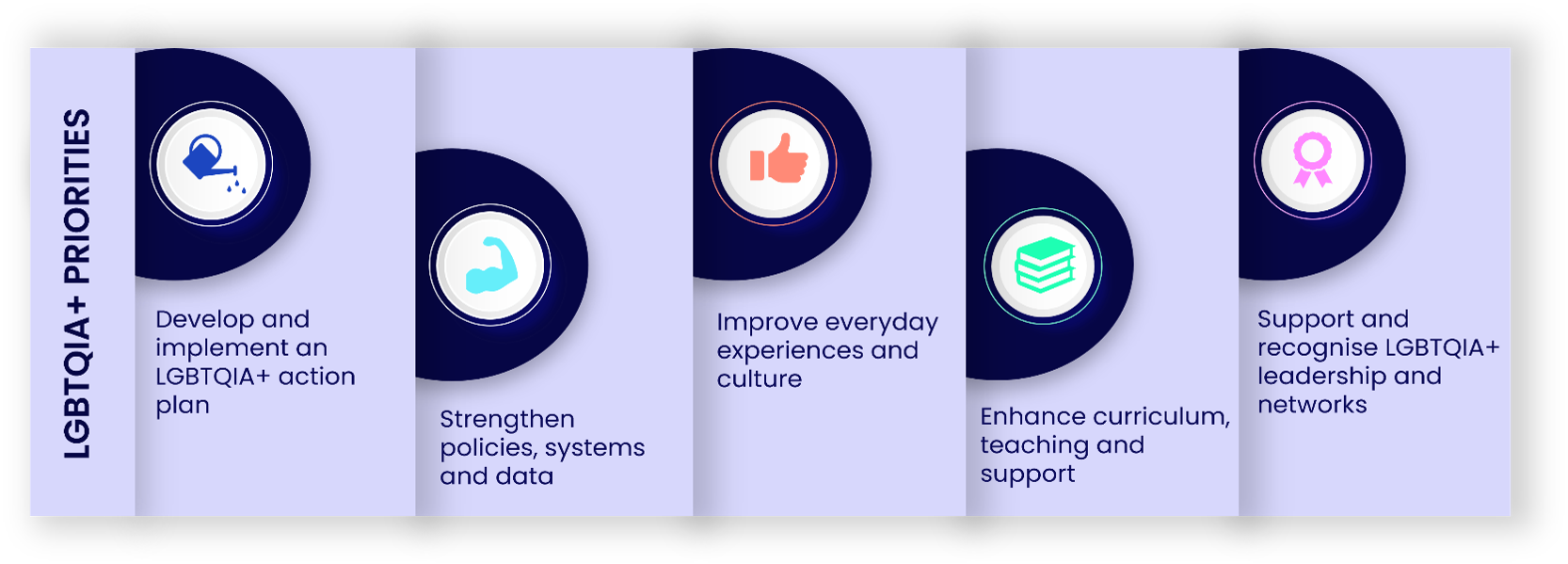
- Develop and implement an LGBTQIA+ Action Plan informed by the findings of the upcoming LGBTQIA+ Lived Experiences Report and the student research project to create a SMART Action Plan. Work in partnership with Athena Swan team so gender inclusion work reflects LGTBTQIA+ experiences, including trans, non-binary or gender diverse inclusion.
- Strengthen policies, systems and data. Review policies, systems and data t to ensure they are inclusive of diverse sexual orientations and gender identities, including trans, non-binary or gender diverse people. Improve how we collect and use data on LGBTQIA+ identities, so we can better understand outcomes and target interventions.
- Improve everyday experiences and culture. Equip managers, tutors and leaders with guidance and development on LGBTQIA+ inclusion, including trans, non-binary or gender diverse inclusive practice. Ensure reporting routes are visible, trusted and responsive to LGBTQIA+ issues.
- Enhance curriculum, teaching and support. Work in partnership to ensure that curriculum, teaching materials and student support reflect and affirm LGBTQIA+ identities. Improve supervision, pastoral support and community-building for LGBTQIA+ students.
- Support and recognise LGBTQIA+ leadership and networks including the Proud and Trans staff networks.
This work responds to concerns about safety, disclosure, belonging, bullying and harassment, policy and systems limitations, and reliance on small numbers of committed individuals rather than shared institutional responsibility.
3.3 Race 
Our race inclusion work is guided by our Race Equality Charter (REC) Bronze Award received in February 2026. We use the term “race equality” where it aligns with the REC, wider institutional and sector language. However, our work is equity-focused, ensuring that actions are designed, implemented and evaluated in response to identified barriers, needs and inequities.
Our objectives for 2026 - 31
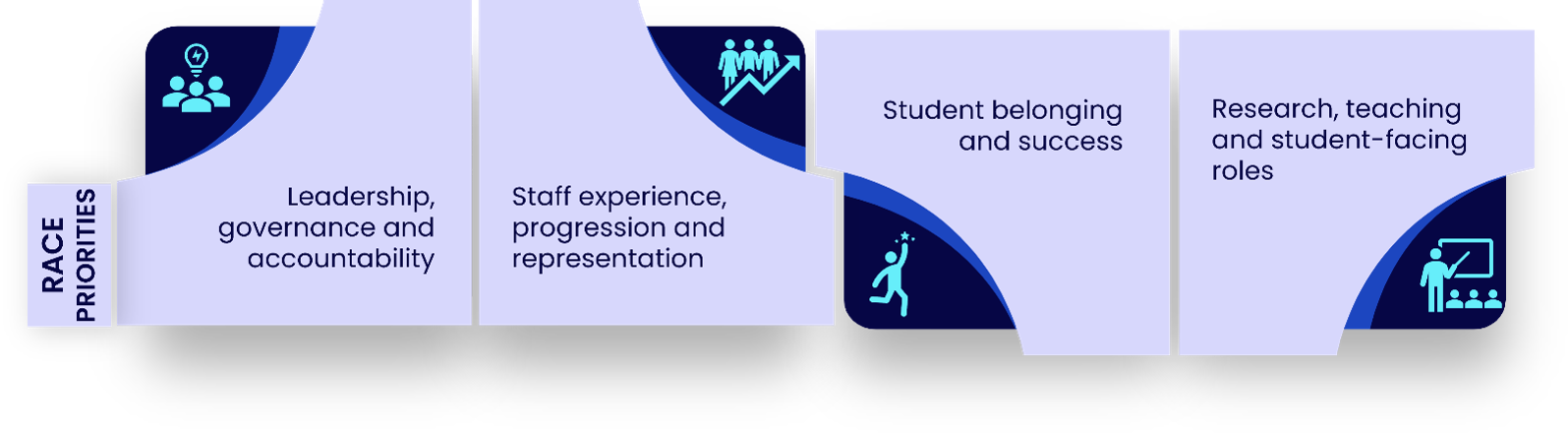
The REC Action Plan identified seven priority areas and for the purposes of this Strategic Plan we group our objectives under four themes:
- Leadership, governance and accountability. Increase racial diversity in governance and senior decision-making structures and equip leaders with the skills and confidence to make inclusive decisions and hold themselves accountable for race equality outcomes.
- Staff experience, progression and representation. Improve recruitment, retention, progression and cultural climate for racially minoritised (RM) staff, particularly Black staff, and address underrepresentation at senior grades. Strengthen reporting routes, support and protections so that RM staff can safely speak up about racism and see action taken.
- Student belonging and success. Work towards eliminating ethnicity awarding gaps, especially the Black-white awarding gap and improve belonging and cultural climate.
- Research, teaching and student-facing roles. Enhance support for racially minoritised research-only staff and postgraduate research students and increase the racial diversity and cultural competence of Associate Lecturers/Regional Academics and other student-facing staff.
In addition to the REC priority areas, we’ll work on Decolonisation, forming a dedicated working group to examine and address prioritised knowledge and perspectives within teaching, research and leadership; how institutional policies and processes may disadvantage particular student groups; whose voices are represented in governance and strategic decision-making; and how historical and contemporary inequities can shape experiences of belonging, success and progression.
The REC evidence base shows persistent inequities in senior representation, recruitment, confidence in responses to racism, student module outcomes and belonging. The Plan aims to move beyond documentation towards tangible change in lived experience.
Detailed actions for race inclusion are set out in the REC Action Plan (2026-31).
3.4 Gender
Gender inclusion has long been a focus at the OU through the Athena Swan Charter. The OU holds an institutional Bronze award and several School and unit awards which shows a commitment to promoting fairness, inclusion and opportunity for women, men and gender-diverse colleagues and students.
We use the term “gender equality” to align with the Athena Swan Charter and wider institutional and sector language. However, our work is equity-focused, ensuring that actions are designed, implemented and evaluated in response to identified barriers, needs and inequities.
The Plan uses Athena Swan as a framework for sustained change while recognising that gender inclusion must go beyond awards and compliance.
Our objectives for 2026 - 31
Over the lifetime of this Strategic Plan, we will:
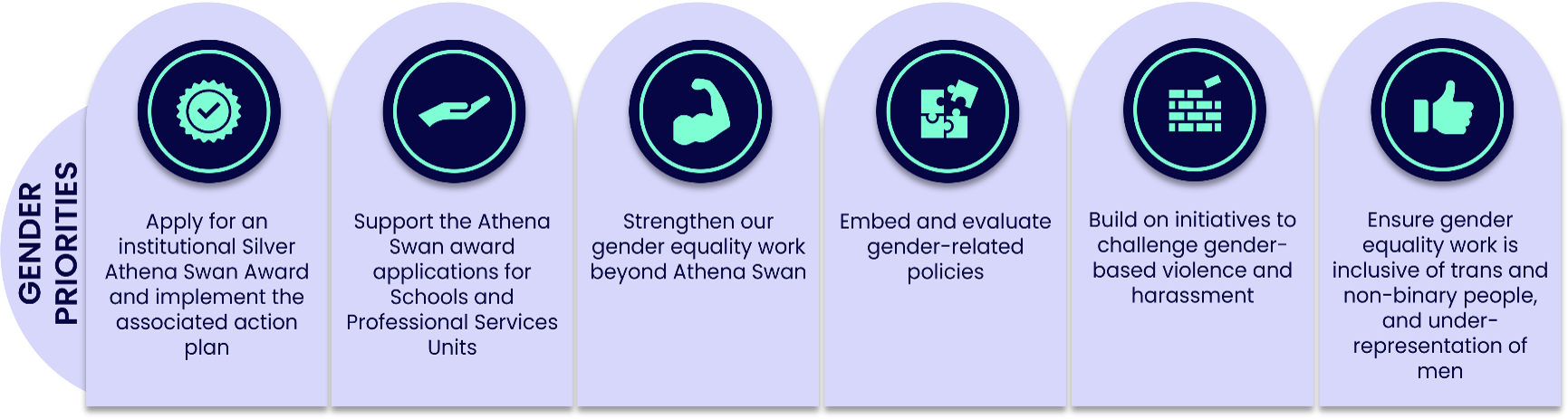
- Apply for an institutional Silver Athena Swan award, and, subject to approval, implement the associated action plan.
- Support the Athena Swan award applications for Digital Services and Learner Discovery Services (LDS), and for the Schools of Languages and Linguistics (LAL), Socials Sciences and Global Studies (SSGS), and Law School.
- Strengthen our gender equality work beyond Athena Swan, including action on gender pay gaps, progression and representation at senior levels.
- Embed and evaluate our Menopause Policy and other gender-related policies, ensuring line managers and leaders actively support staff through key life stages.
- Build on initiatives to challenge gender-based violence and harassment and promote safe, inclusive cultures.
- Ensure gender equality work is explicitly inclusive of trans, non-binary or gender diverse people, and responsive to under-representation of men in particular disciplines or roles.
This work responds to issues related to workplace culture, intersections between gender, race, disability, trans, non-binary or gender diverse identities, caring responsibilities, reproductive health, gender-based violence and harassment.
Detailed actions for gender inclusion are set out in the draft institutional Silver Athena Swan Action Plan. This is a live document that is reviewed and refined throughout the five-year cycle, informed by staff experiences and emerging evidence.
Contact us
Equality, Diversity and Inclusion
The Open University
Walton Hall
Milton Keynes
MK7 6AA
Email [email protected]


Explore

Undergraduate
Postgraduate
Policy
-
Follow us on Social media
-


