
Unlocking success: what taught postgraduate students really need to thrive in distance learning

The reality of postgraduate distance study
Postgraduate study is a significant commitment and poses unique challenges as many students undertake studies alongside full-time employment or family responsibilities, and often after a break from other studies (Bamber et al., 2017). For those studying at a distance, flexibility is one of the main attractions, but it can also intensify feelings of uncertainty, pressure or isolation (Mallon, 2024), which can require more tailored support strategies to overcome (Simpson, 2016).
Successful progression through a taught master’s qualification depends not only on academic ability or motivation, but on the availability, clarity, and consistency of support. Understanding what support most helps postgraduate distance learners succeed is critical for progression and completion.
Listening to students nearing the finish line
To better understand what helps students progress and succeed, this study focused on students in the final stages of their Master’s qualifications within the Open University Business School (OUBS). Nearing completion, these students were well placed to reflect on their learning experiences across an entire qualification.
Through in-depth semi-structured interviews, five students from across three different Master's qualifications were asked to reflect on
- the support available during their studies,
- what support they found most helpful, and
- what challenges emerged
The aim was to identify through thematic analysis (Kings and Brooks, 2018) the academic and pastoral scaffolding that most helps students to sustain momentum and achieve success.
What students told us about support
Students spoke positively about a range of institutional resources, including tutor support, online forums, library services, and both online and in-person structured teaching events, such as tutorials and residential schools.

Students described drawing selectively on different forms of support at different stages of their qualification, as their needs and circumstances changed. This sense of choice and autonomy was important when balancing study with work and personal commitments. Students demonstrated awareness of the range of support options available. Even when services were not used, simply knowing they existed was identified as reassuring.
Alongside formal support, students also described reliance on informal networks. Family members, friends, and peer networks played a significant role in providing support and encouragement, particularly during demanding periods of study.
Tutors are key
Tutors were most frequently identified as central to the learning and support experience. Beyond subject expertise, students emphasised the importance of responsiveness, visibility, and timely support from tutors. Students highlighted the value of tutors who replied promptly to emails, checked in proactively, or offered one-to-one conversations. These small but regular points of contact helped students maintain confidence and momentum during demanding periods.
“If you email him, he responds to you straight away.”
Students described difficulty in navigating information and systems when under pressure. Delays or inconsistencies in communication could disrupt momentum, leaving students unsure how to proceed. Whilst one-to-one conversations with tutors were valued, students noted that availability and arrangement processes were not always consistent across study experiences. Students described it as a matter of “luck”, and noting variations in accessibility and engagement.
“Some have been brilliant, but some have been harder to get support from.”
Continuity of tutor support across programmes was particularly valued. Students who worked with the same tutor across several modules described the value of these established relationships over time.
“She was there at the beginning; she was there at the end.”
Human connection and academic community
Students described using a range of communication channels to engage with support, such as email and online forums, alongside interactive learning events, such as online tutorials and residential schools. Flexibility in how and when to engage was widely valued.
Opportunities for synchronous interactions were particularly important. Students valued being able to ask questions in real time and clarify complex ideas through discussion. Breakout rooms in online tutorials were highlighted as useful spaces that facilitated engagement with their peers.
At the same time, students described university online forum engagement as variable, with levels of interaction differing across cohorts. Informal peer networks, often developed independently from the institution. These helped students feel connected but highlighted limitations of university communication spaces.
Several students expressed a desire for stronger academic community across their qualification, particularly during later stages of study. These gaps mattered because they shaped confidence, engagement, and the ability to sustain progress.
The Four Cs: turning insight into action
Four interconnected themes emerged that capture what matters most to students:
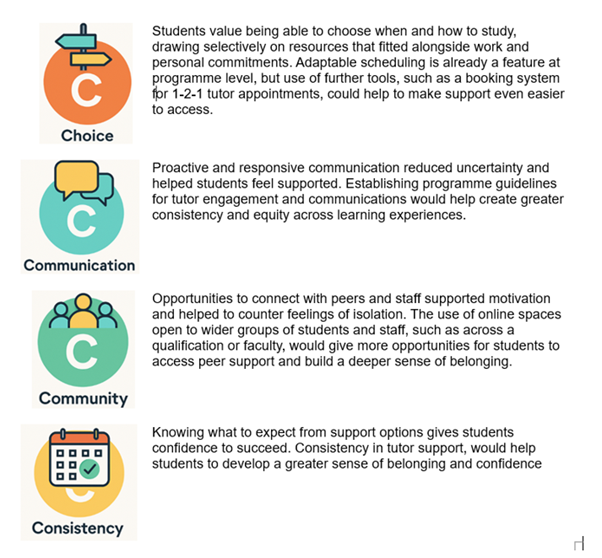
If you are considering implementing this approach in your programme, consider the following:
- Design for choice: Offer multimodal delivery and adaptable scheduling to accommodate diverse student needs.
- Prioritise communication: Establish guidelines for staff engagement and responsiveness.
- Invest in community: Create initiatives that foster belonging and build community
- Create consistency: Maintain continuity in academic support to build trust and confidence.
What this means for postgraduate distance learning
Taken together, these insights highlight the importance of understanding support not only in terms of what is provided, but how it is experienced over time. For postgraduate distance learners managing complex commitments, support that feels responsive, consistent, and easy to navigate can make a meaningful difference.
Join the conversation
How do these findings resonate with your experience? What strategies have you used to enhance taught postgraduate support?
Join the conversation - your insights can help shape the future of taught postgraduate experiences.
Have questions or insights? Reach out to us and share your experience.
The scholarship team consisted of Bernadett Dunn, Nicola McDowell, Emma Bassett and Sarah Alcock
This blog was written by Bernadett Dunn, Nicola McDowell and Emma Bassett.

Bernadett Dunn
Bernadett Dunn is a Lecturer and Student Experience Manager at the Open University Business School, where she is programme lead for the postgraduate taught Master’s in Management qualification. She has worked at the Open University since 2021 and brings over 15 years of experience in Higher Education, including earlier work at McGill University and Hult Ashridge.
Bernadett is a Senior Fellow of the Higher Education Academy (SFHEA) and holds an MBA and a BA (Hons) in Business Studies. Her scholarship interests span postgraduate learning, Young Adult Study Support (YASS), and inclusive teaching and learning with neurodivergent students, with a particular focus on how learners experience support and transition in distance education.

Nicola McDowell
Nicola McDowell is a Lecturer and a Student Experience Manager at the Open University Business School. With a MSc in HRM she is the Business School Lead for the Postgraduate Taught MSc in Human Resource Management qualification. Nicola is an active researcher in the final stages of a doctorate in education with a keen interest in student success.
Nicola is fully accredited as a Senior Fellow of the Higher Education Academy, Chartered Member of the Chartered Institute of Personnel and Development and Certified Management and Business Educator.

Emma Bassett
Emma Bassett is a Lecturer and Student Experience Manager at the Open University, Faculty of Business and Law and is Assistant Head of Student Experience in the Law School. With experience of teaching in both Further and Higher Education settings, Emma focuses on improving the distance learning journeys of students and developing understanding of the experiences of students entering Higher Education through diverse routes.
Emma holds an LLB (Hons), Postgraduate Certificate in Education (PGCE) in Post compulsory Education and Training (PcET) and a Master’s in Education (Inclusive Practice).
References
Bamber, V., Choudhary, C., Hislop, J. & Lane, J. (2017). Postgraduate taught students and preparedness for Master’s level study: polishing the facets of the Master’s diamond. Journal of Further and Higher Education. [Online] Available at: https://doi.org/10.1080/0309877X.2017.1359502 (Accessed: 25 August 2025).
King, N. and Brooks, J. (2018) ‘Thematic Analysis in Organisational Research’, in The SAGE handbook of Qualitative Business and Management Research Methods; Vol 2: Methods and Challenges. 2018, pp. 219–236.
Mallon, S. (2024) ‘A study exploring student experience of online tuition’. The Open University Scholarship Exchange. Available at: https://hdl.handle.net/10779/ou.se.26056543.v1 (Accessed: 25 August 2025).
Simpson, O. (2016) ‘Student support services for success in open and distance learning: The Simpson Distance Student Support Model’, in Olugbara, C.T., Letseka, M. and Akintolu, M. (eds.) Student Support as a Panacea for Enhancing Student Success in an Open Distance Learning Environment. UNESCO Chair on ODL, University of South Africa. Available at: https://files.eric.ed.gov/fulltext/EJ1393990.pdf (Accessed: 25 August 2025).
Declaration of use of GenerativeAI
CoPilot was used in April 2026 to develop the letter images in 'The Four C's'.
Images
- Runner at the finish line - https://pixabay.com/vectors/finish-line-sport-athlete-runner-7305708/
- Help button on keyboard - https://pixabay.com/illustrations/help-button-keyboard-button-help-66608/

Blog posts



Explore

Undergraduate
Postgraduate
Policy
-
Follow us on Social media
-


