
Unlocking criminal law: evaluating a virtual courtroom simulation to enhance our students’ understanding of criminal law

Virtual reality (VR) technologies are transforming possibilities for immersive, authentic learning in distance education, addressing challenges in replicating professional settings such as courtrooms.
The Open Justice Centre develops innovative pedagogy that provides students with the opportunity to enhance their practical and professional skills.
The Centre has developed a highly realistic virtual courtroom (VCR) where learners can explore a courtroom and come together to support the practice and development of skills.
The VCR was first built in 2021, and through a series of research projects has been further developed. It now consists of two criminal courts (Crown Court and Magistrates court), a civil court, tribunal room, judge’s chambers, meeting rooms, waiting area and prison cells (see Figures 1 and 2).
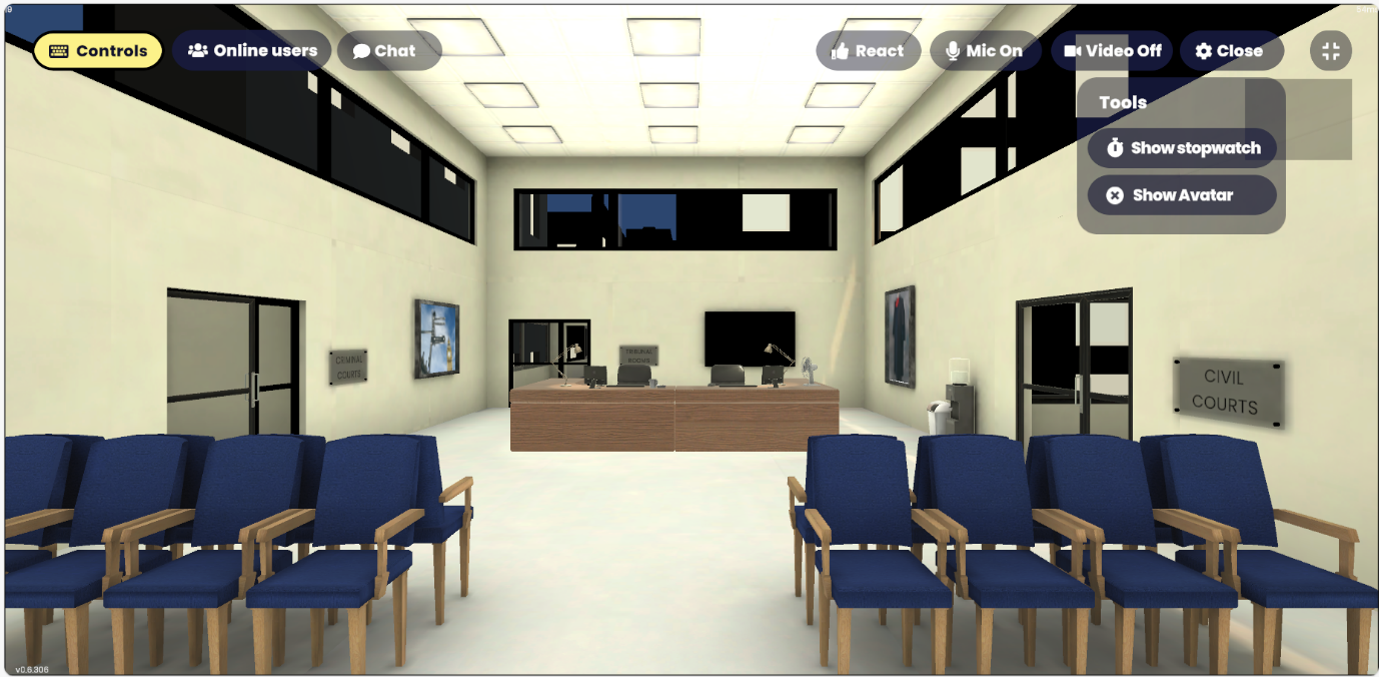
Fig 1: The waiting area of the virtual courtroom
SCiLAB funded the development of an innovative virtual courtroom simulation that incorporated interactive escape room challenges and quizzes to enhance first year criminal law students’ understanding and application of key concepts.
The project also sought to evaluate the effectiveness of the simulation in consolidating student learning and supporting engagement with criminal law.
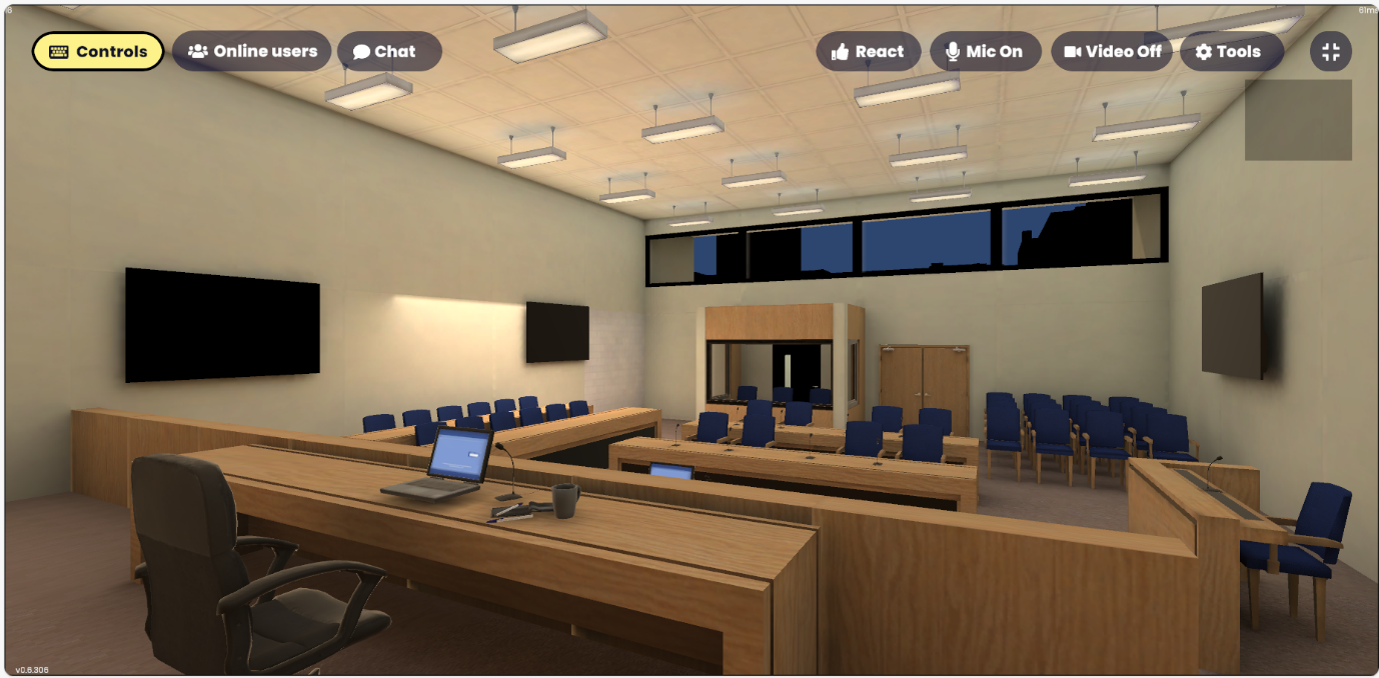
Fig 2: The Crown Court
Gerard, et al. (2025) suggests gamification is a powerful form of experiential learning and gamified experiences provide students with an opportunity to engage in innovative ways to enhance their learning experience. Simulated experiences can incorporate a range of learning outcomes which can test a students’ problem solving, initiative, and determination and expand the opportunity for students to develop a range of skills such as reasoning, knowledge of the law, and persistence.
Each challenge prompted students to apply their knowledge of criminal law to progress through the simulation. It required students to answer questions, solve problems and acquire further information to allow them to progress.
Simulated experiences can better engage students and make the development of knowledge and learning more enjoyable (Gerard, et al. 2025).
We devised three activities that took place in the VCR.
Activity 1: Meeting room
Students were asked to determine whether the fictional defendant, Alex Taylor, was guilty of a crime. They analysed evidence and witness statements to assess whether both actus reus and mens rea were present. The room contained virtual “evidence, including CCTV footage, witness statements, text messages, and a definition of theft, which students examined to identify the relevant legal components.
Activity 2: Judge’s chambers
Students searched for six objects related to cases and answered questions designed to test their knowledge of factual and legal causation.
Activity 3: Criminal courtroom
Students applied the legal problem-solving framework (IRAC) to determine whether the accused could rely on self-defence. They had to unlock each element of IRAC in sequence to work through the application of self-defence; successful completion provided them with a code to escape the room.
Once the students had completed all three activities, they successfully ‘escaped’ the simulation. This exercise was designed to take between 45 minutes to 60 minutes to complete. The escape room was sent to students on our first-year criminal law course. Thirty students completed the escape room and follow up survey.
The findings from the survey were analysed and are set out below:
Theme 1 - Learning outcomes: knowledge of criminal law
70% of students said the simulation moderately to considerably consolidated their understanding of criminal law with an additional 23% of students saying it slightly consolidated their understanding. Only 2% of students say not at all, with one of them commenting “they already had a good understanding of criminal law”.
45% of students said that it helped them understand an aspect of criminal law that they had previously found difficult. One student said that “the unique style of learning definitely felt more stimulating, which allowed for a better intake of knowledge.”
Theme 2 - Skills development
Students were asked to rate whether the simulation helped them develop the following legal skills: problem solving, legal reasoning, initiative and determination.
55% of students said it moderately or considerably helped and 17% said it slightly helped them improve their problem-solving skills.
- 48% said it considerably or significantly helped, 24% said it moderately helped and 10% said it slightly helped their legal reasoning (with 17% of students saying it did not help them improve)
- 35% said it significantly or considerably helped, 24% said it moderately helped and 17% said it slightly helped improve initiative (with 24% of students saying it did not help them improve)
- 42% said it significantly or considerably helped, 24% said it moderately helped and 10% said it slightly helped improve determination (with 24% of students saying it did not help them improve).
When asked in the free text question the most valuable skill students identified was legal reasoning (eight students out of twenty-three who commented).
Theme 3 - Engagement and immersion
Students were asked whether they found the activity enjoyable as compared to other types of online learning:
- 52% of students said it was slightly more or much more enjoyable than other types of online learning materials.
- 21% of students said it was less enjoyable and 17% said it was slightly less enjoyable
- 10% equated it as the same level of enjoyment with other types of online learning materials.
Student comments...
“The simulation is far more than engaging than simply reading e-textbooks or watching explanatory videos. It appeals to the adventurous mind, encouraging users to find the correct answer in order to progress to the next question.”
“I found the VCR to be a great way of interactively testing the students’ knowledge of criminal law and liked that it took the student through the procedural journey of the courtroom.”
71% of students said they would like to see more simulations incorporated into law modules. They identified other types of simulations they would find useful, including participating in a legal clinic, interviewing clients, taking on legal roles, and how to approach legal problem solving (IRAC) questions. They would like different levels of challenges covering more areas of law, teaching court procedure, engaging in a trial, advocacy, and law puzzles to teach legal principles.
Virtual reality simulations allow students to actively explore and ‘learn by doing’ in an environment that replicates real-world scenarios. Given the benefits for students’ learning, the Law School is exploring the potential of these types of activities to complement existing modes of delivery.

Francine Ryan
Francine is a qualified solicitor, Senior Lecturer in Law and Director of the Open Justice Centre at The Open University. Francine has worked to develop a range of innovative and technology-enhanced opportunities for Open University law students including the Open Justice Online Law Clinic. Francine’s research areas are in technology and the law.

Jon-Paul Knight
Jon-Paul is the manager of the Open Justice Centre and most recently worked as a Qualification Manager in Law and Business. He is responsible for coordinating the work of Open Justice, and supports the work of the Law Clinic and the Public Understanding of Law activities.
References
Gerard, F. J. et al. (2025) ‘Exploring Students’ Experiences in Using Virtual Simulation and Gamification Principles for Authentic Learning and Assessment in Criminal Psychology’, Journal of Criminal Justice Education, 36(4), pp. 622–640.



Explore

Undergraduate
Postgraduate
Policy
-
Follow us on Social media
-


