
Once I felt safe, I could focus on taking part

Have you ever been part of a collaborative activity where you felt uncomfortable? Unsure of what to say? Anxious about what other people might or might not do? Wanting to participate, but feeling the need to hold back?
Lots of people report feelings like this. If you're autistic, this may be because there is evidence that autistic people can experience difficulty and sensory overwhelm in some social situations (Bargiela, Steward and Mandy, 2016). There is also evidence that autistic people experience empathy with each other, yet there can be empathy barriers between people with and without autism (the Double Empathy Problem) (Milton, Gurbuz and López, 2022).
There is also evidence that learning together with others deepens the level of possible learning (Liu, Joy and Griffiths, 2010). The learning from these interactions can be very empowering and enabling both in our studies, workplaces and beyond. This raises an important question: how can we create collaborative learning experiences where autistic students feel able to participate and learn?
The National Autistic Society (2026) shares that “Autism influences how people experience and interact with the world”, that being autistic can mean that socialising with others can be confusing and that over one in 100 people are autistic. We know that there are rising numbers of people identifying as autistic in society (Horlin et al., 2024). So, it is really important to find ways to include autistic people more in collaborative activities that deepen learning. Education can not only be for learning but also offer a way of creating a fairer society (Hooks, 1994).
Researching together
We are a group of 4 autistic students who have been part of collaborative learning activities and 3 academics who are both autistic and non-autistic. We wanted to know how we can create collaborative learning environments where autistic (and other) students can have positive learning experiences. Together we participated in, and analysed, four focus group sessions.
Why do this research together? Well, as the United Nations says "Nothing about us, without us" (2004). We also were inspired by other research projects that have inclusive participation with autistic people (Pellicano et al., 2022; Williams et al., 2025).
What did we discover about collaborative activities?
The time before and beginning collaboration was important. Group members felt deep uncertainty of how things would work. We spoke of bringing bad memories of past experiences, preparing ourselves in case this one might be difficult too.
Working with other students in collaborative activities also brought difficulties. Even though our student co-researchers wanted to participate to learn, other group members would sometimes not turn up or do any work. Some brought their ability to be organised but sometimes found themselves alone or taking on the bulk of the work.
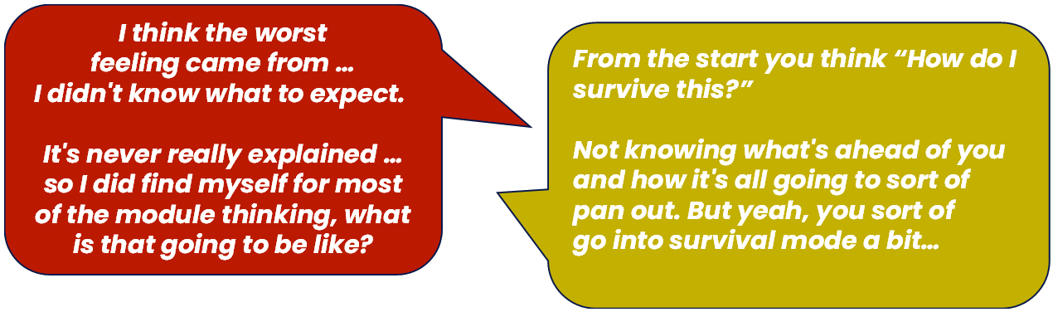
Group members discussed how important psychological safety was (Edmondson, 1999), questioning whether they could trust fellow students to be respectful and meet their commitments. If they could, that would help them focus on the learning.
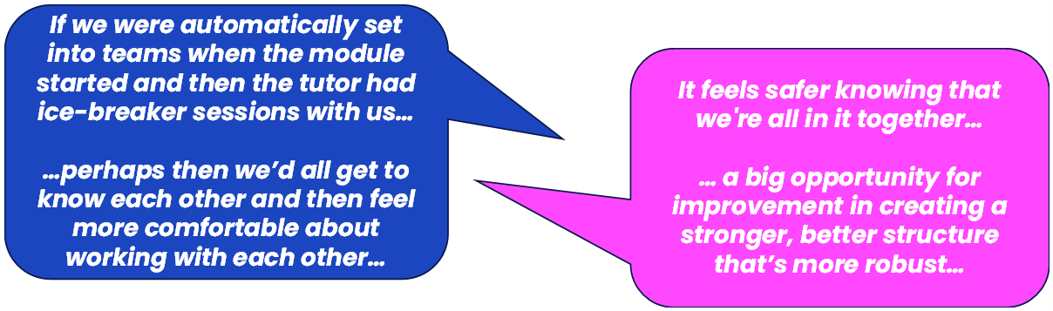
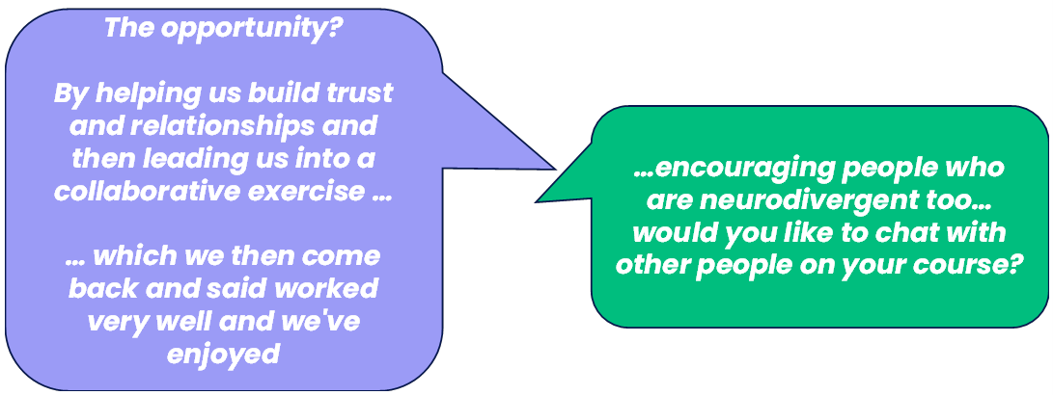
What else would help? Having greater focus on creating early relationships and sharing information about learning styles, strengths and needs in group working. Group members also shared their potential to bring strengths such as being organised, structured as well as being committed to shared tasks and timescales.
Working with tutors
Student co-researchers spoke of sometimes not getting much help from tutors or feeling like they shouldn’t ask for help. The academics also shared their learning from the group about opportunities to provide more group setup in advance and enable more relationship building. They talked about improving the balance between providing greater support and empowering students to find their own solutions.
Making sense of it all
- Based on this small group, it was clear that autistic students want to participate and learn.
- Feeling safe and relaxed can help with the ability of autistic students to engage in collaborative learning, but feeling unsafe gets in the way of learning.
- Factors influencing safety include collaboration activity setup, building relationship and trust and how collaborative working proceeds within groups.
- Existing tuition strategies and related research show there is awareness of this, but student experiences show that there are gaps in how inclusive tuition strategies are executed.
What do we recommend?
- For students, remember you can also play a role in creating safe spaces. You can share strengths you can bring to shared working and help others feel safe.
- For tutors, you can find out more about autism and be proactive in engaging with students who might need extra support. Enable early collaborative group setup and running to optimise safety, clarity and relationships.
- For institutions, consider how your tuition strategies and collaborative activity instructions might be improved or applied more. In design, optimise safety through relationship building and structured planning work. Finally, in the delivery stage ensure tutors regularly check in on progress and offer support where necessary.
- Consider creating opportunities for students to choose to be part of voluntary autistic shared learning groups just for us, to build on our mutual empathy.
You can find out more about the research and by contacting;
About the authors
This blog was written by Jean Gamester, Allan Mooney, Bernadett Dunn, Daniel Vile, David Burnett, Ryan De Sousa and Taylor Willbond.
Jean, Allan and Bernadett are the academic co-researchers in this project and are part of the Student Experience team in The Open University Business School. David, Daniel, Ryan and Taylor are the student co-researchers and have studied on a range of modules involving collaborative activities in The Open University Business School.
References
Bargiela, S., Steward, R. and Mandy, W. (2016) ‘The Experiences of Late-diagnosed Women with Autism Spectrum Conditions: An Investigation of the Female Autism Phenotype’, Journal of Autism and Developmental Disorders, 46(10), pp. 3281–3294. Available at: https://doi.org/10.1007/s10803-016-2872-8.
Edmondson, A. (1999) ‘Psychological Safety and Learning Behavior in Work Teams’, Administrative Science Quarterly, 44(2), pp. 350–383. Available at: https://doi.org/10.2307/2666999.
Hooks, Bell (1994) Teaching to transgress: education as the practice of freedom. New York: Routledge.
Horlin, C. et al. (2024) ‘Thriving… or Just Surviving? Autistic Journeys in Higher Education,’ Current Psychiatry Reports, 26(12), pp. 771–776. Available at: https://doi.org/10.1007/s11920-024-01560-x.
Liu, S., Joy, M. and Griffiths, N. (2010) ‘Students’ Perceptions of the Factors Leading to Unsuccessful Group Collaboration’, 2010 10th IEEE International Conference on Advanced Learning Technologies. 2010 IEEE 10th International Conference on Advanced Learning Technologies (ICALT), Sousse, Tunisia: IEEE, pp. 565–569. Available at: https://doi.org/10.1109/ICALT.2010.161.
Milton, D., Gurbuz, E. and López, B. (2022) ‘The “double empathy problem”: Ten years on’, Autism, 26(8), pp. 1901–1903. Available at: https://doi.org/10.1177/13623613221129123.
National Autistic Society (2026) What is Autism? National Autistic Society. Available at: https://www.autism.org.uk/advice-and-guidance/what-is-autism (Accessed: 7 July 2026).
Pellicano, E. et al. (2022) ‘“I Knew She’d Get It, and Get Me”: Participants’ Perspectives of a Participatory Autism Research Project’, Autism in Adulthood, 4(2), pp. 120–129. Available at: https://doi.org/10.1089/aut.2021.0039.
United Nations (2004) ‘Nothing about Us, Without Us’, United Nations Enable [Preprint]. Available at: https://www.un.org/esa/socdev/enable/iddp2004.htm
Williams, G.L. et al. (2025) ‘“Building our own house” as an insider-only Community-Partnered Participatory Research Council: Co-creating a safe space for Autistic knowledge production’, Autism, 29(9), pp. 2205–2215. Available at: https://doi.org/10.1177/13623613241253014.
Acknowledgements
Project supported and funded by SCiLAB – The OU Scholarship Centre for innovation in online Legal and Business education. Project Reference SCiLAB252602.

Blog posts



Explore

Undergraduate
Postgraduate
Policy
-
Follow us on Social media
-


