
Peer power: How mentoring transforms students, staff, and The Open University

Introduction
In peer mentoring, more experienced students (mentors) offer advice and support to less experienced students (mentees). It’s a well-established way to increase belonging, support transitions, and improve retention in higher education (Skaniakos et al., 2014). At The Open University (OU)’s Faculty of Business and Law (FBL), online peer mentoring schemes have run for over five years. The peer element is key - shared identity and experience foster empathy, relatability, and trust (Nuis et al., 2023). Students feel they belong because they see others like them succeeding.
While these schemes were funded to improve retention, my reflections from leading and researching two projects suggest their benefits extend far beyond that. Peer mentoring creates a ripple effect - benefiting mentees, mentors, tutors, and the institution. These wider impacts deserve equal consideration when evaluating a scheme.
My insights come from research in the Business School. In 2020–21 and 2022-23, I engaged with students, mentors, and tutors through training, forum discussions, surveys, and interviews. As part of a formal research process, in 2022–23, five mentees and three mentors participated in semi-structured interviews, and 178 students responded to a survey. Tutors also contributed reflections on how mentoring influenced their practice.
Mentee benefits
Mentees reported increased confidence and clarity in their studies.
Reading people's interaction, reading people's questions and the answers helped me learn about the culture.
Mentee 1, interview
They received encouragement from mentors and peers, learned where to seek help, and gained practical study tips - time management, summarising, referencing. They shared successes and discussed the nature of the feedback they had received. Peer mentoring created a safe space.
So, the peer mentoring is good because it feels like a non-threatening space, no judgement.
Mentee 1, interview
One-to-one mentoring offered tailored support. Mentees also felt part of a community, reassured that others shared their nerves and excitement.
Mentor benefits
Mentors reflected on their own learning, which strengthened their academic performance - every student mentor achieved a good pass. They commented on improved communication skills by distilling information clearly and they enjoyed teamwork with fellow mentors.
I got a lot of community spirit from working with the group… it was completely different being put with this group of people who volunteered to be part of the scheme.
Mentor 1
They practiced applying study skills, built resilience when posts went unanswered, and learned new technologies. Advising others boosted their confidence and gave them leadership experience. Above all, they valued the chance to help others and “give back”.
Project team benefits
Talking to tutors who supported the peer mentoring, I was struck by the impact they said that working on the peer mentoring scheme had had on them and their teaching practice. Tutors said that students shared difficulties on the forum more openly than on module forums, revealing aspects of study that they had previously been unaware of. One commented that they realised for the first time how terrified some students are of tutors.
Tutors also recognised how confused students can be about institutional processes and expectations. Assumptions about a student’s level of knowledge were often far from the reality. Basic information proved more helpful than anticipated.
From mentees, I gained insight into what it is like to be a new learner. From mentors, I saw what students need to do to succeed and gained tips that students have learned about studying successfully with the OU. From tutors I saw the impact of new understanding about their students on their practice from seeing this new side of their students. From all those participating in peer mentoring, I discovered resources I hadn’t known about - enhancing the support I can offer.
Institutional benefits
Mentoring forums provide real-time insight into student progress - through questions asked and answers given. Safe spaces allow students to share struggles, offering valuable data on common challenges like referencing, summarising, and knowing when to contact tutors.
These benefits ripple backwards and forwards from mentees and mentors to tutors and the wider OU. They are also mutually reinforcing as shown in Figure 1 below.
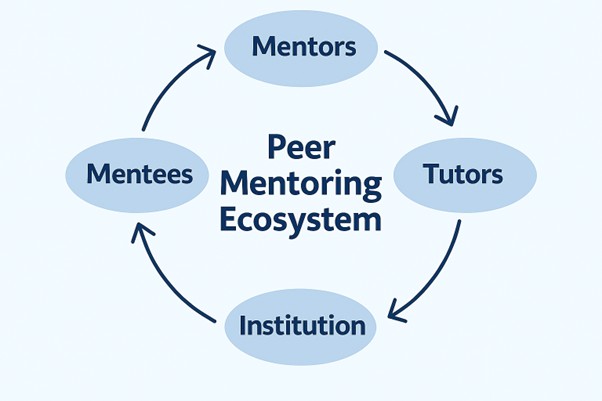
Figure 1: The Peer mentoring ecosystem (image generated by Copilot Microsoft Copilot: Your AI companion August 2025)
Conclusions
The pressure on institutions to achieve targets set internally or externally often seems to encourage a focus on measurable outcomes in evaluation. My experience is that this risks taking too narrow a view of whether a scheme has been successful. Even if measurable goals have not been achieved, longer term and broader benefits should be considered. For institutions looking for scalable ways of supporting students, online many-to-many peer mentoring can give helpful insights. Taking this a step further, a scheme is even more cost-effective if full advantage is taken of what is being learned, by incorporating this into what we teach our tutors and in ensuring curriculum design does not make assumptions about students’ understanding. I for one will continue to use this knowledge to enhance my teaching practices.
I would love to hear your views. Connect with me on (26) Dr. Catherine Comfort | LinkedIn
Declaration on Generative AI
Please note, Copilot Microsoft Copilot: Your AI companion was used 22/8/25 to reduce word count from the above article and to create the peer mentoring ecosystem as shown in Figure 1, August 2025.
References

Catherine Comfort
Catherine is lead for Access, Participation and Success and a Senior Lecturer in the Faculty of Business and Law. Her research interests focus on identifying the best methods and tools to help students and young people achieve their potential. This includes youth and peer mentoring as well as digital tools.

Blog posts



Explore

Undergraduate
Postgraduate
Policy
-
Follow us on Social media
-


