
The hidden aspects of TMA extensions for tutors: plumbing the depths of feelings and values in tutor decision making

Tutors routinely process extension requests, yet a professional development seminar revealed that extension decisions are anything but routine. Discussions became unexpectedly passionate and polarised, prompting us to ask:
Why do such seemingly administrative decisions evoke such strong emotions?
So, we devised a project to drill down further and identify the values and feelings underpinning the reasoning behind extension processing and exploring the wider impact on tutor wellbeing.
We presented tutors with four case studies of complex extension requests, and through a survey and focus groups, asked them to identify their feelings, initial reactions and values. We analysed the data to explore how extension requests were inflection points for emotional labour, emotional dissonance, emotional load and emotional management. We explored how tutors exercise professional judgement and discretion when confronted with competing priorities, such as the hybridity of students as customers versus a tutors’ own professional values.
Before we tell you what we found, we have to acknowledge that the notion of emotional labour in higher education is contested (Nixon and Scullion 2022). So, in our project we used the concept of emotional labour as a practical framework for discussing the emotional impact of processing extensions. We adopted Mann’s (1999) definition of ‘Emotional Labour’ as:
“a state that exists when there is a discrepancy between the emotional demeanour that an individual displays and the genuinely felt emotions that would be inappropriate to display”
For example, a tutor may feel irritated by a very demanding student’s repeated requests for extensions: however, in dealing with the student the tutor must remain calm and professional, subduing the irritation that they feel.
What was firstly evident was how dedicated and student focused our tutors are. This was seen particularly in the vast amount of actual, but hidden and unaccounted labour, that processing an extension request requires. Our data also demonstrated that decisions about extensions are shaped by strong emotions and professional values. Finally, navigating conflicting priorities and exercising discretion created tensions that can affect tutor wellbeing.
Hidden labour
Processing an extension request is not a quick, tick-box exercise, but is one that requires tutors to engage in a range of tasks that include coaching, tutoring, investigating, negotiating, advocating and referring. A substantial amount of hidden labour lies beneath an extension request. This aligned with what other researchers have found such as Abery and Gunson (2016).
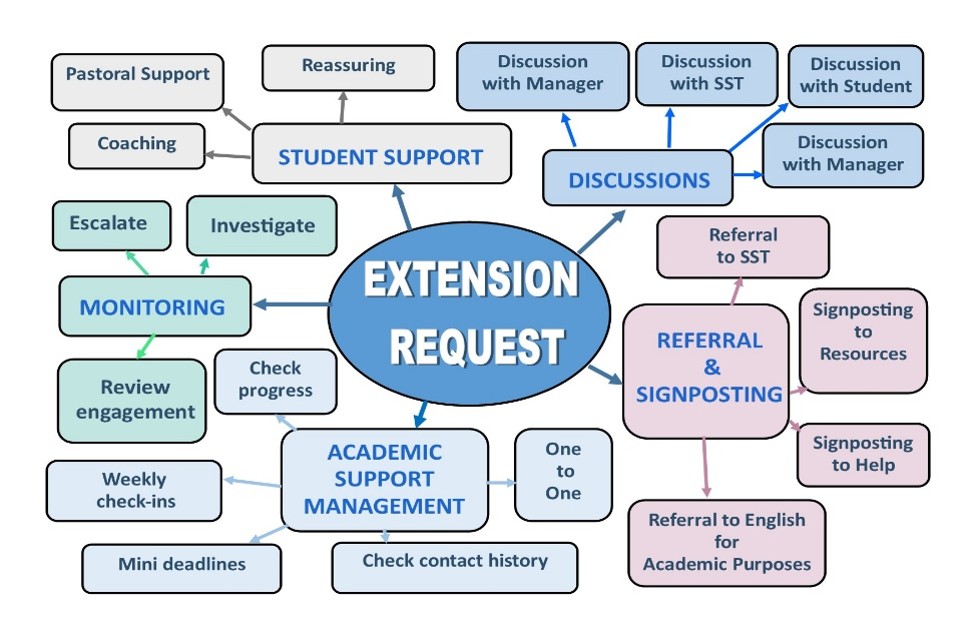
Not a mere administrative task
Next, and concurring with established scholarly thinking, we found that indeed, the decision making in extension requests does not happen in an emotional vacuum (Abery and Gunson 2016); extension processing engages values which trigger significant emotional responses. This could be empathy, or more oppositional feelings, such as this tutor who felt:
“I am underwhelmed and dismayed. This student does not take the process seriously. The salutation like the request is flippant. I feel I am being taken for a ride.” (Survey, Case Study 3)
These intense feelings have to be managed as tutors navigate multiple points of dissonance between their values, such as equality and fairness, and institutional priorities, such as retention, as expressed by these two tutors:
“I would like to deny the request, but would feel pressure because of the retention concerns.” (Survey, Case Study 3)
“My initial feeling is that the OU is more interested in "bums on seats" than the[sic] whether or not a person is suitable for a course. We have not done this person any favours by signing them up for a course that they are clearly struggling with.” (Survey, Case Study 2)
Sometimes tutors set aside their own feelings to respond professionally and politely and act in the student’s best interests. This occurs even when the communication from the student did not conform to traditionally expected norms, such as an email that is written in informal, colloquial terms. In such cases, these tutors identified ‘annoyance’ as their initial feeling, but:
“…this then mellows to trying to understand that this is potentially a younger student and they may not be experienced in understanding boundaries, respect, and formal professional language.”. (Survey, Case Study 4)
This provides a clear example of emotional labour in practice.
Perhaps one of the most striking findings was the disconnect between tutors' feelings and the factors that ultimately guided their decisions. While empathy and irritation were the emotions most often reported, decisions were more commonly shaped by values such as fairness and consistency. These values did align to the most frequent factors in decisions making, being rules (on extensions) and sufficiency of reasons. This clearly demonstrated that extension processing is not an administrative task, but one that involves significant emotional labour.
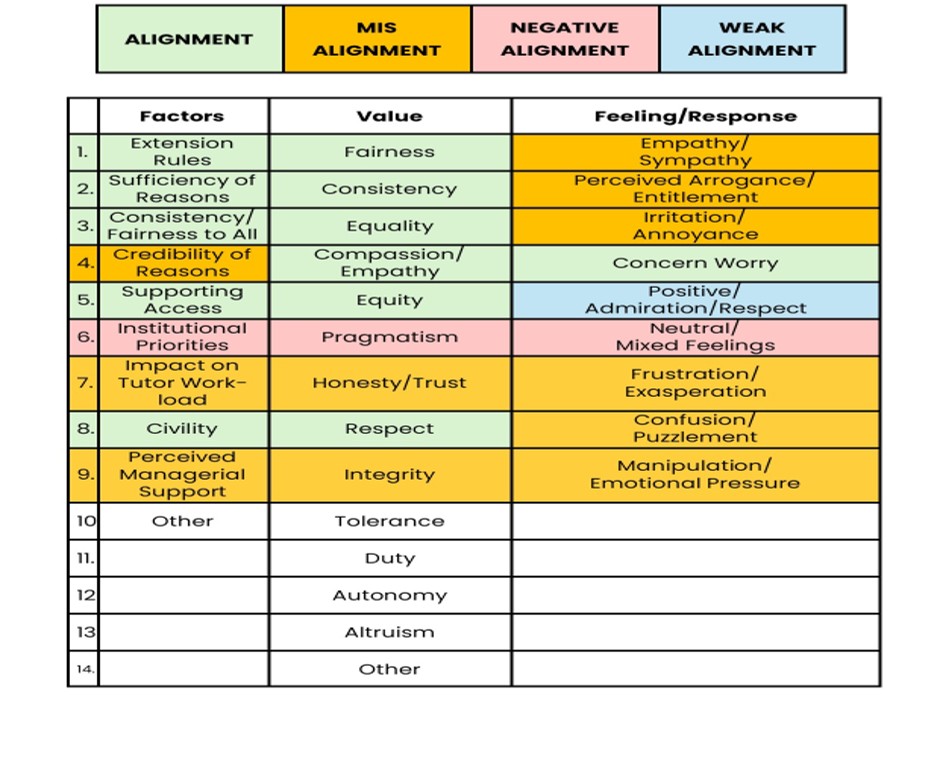
Contested territories: fairness and best interests
Fairness emerged as both a core value and a key decision-making factor, but fairness was also contested territory; it did not always mean the same thing. For some tutors, fairness meant responding compassionately to individual circumstances, like a student with unforeseen difficulties. For others, it meant ensuring equitable treatment across all students. Interestingly, fairness to tutors themselves, particularly regarding workload and emotional demands, was rarely discussed.
Extension processing requires the exercise of discretion and our findings clearly showed firstly that tutors often navigate this in isolation and alone; the decision to approve (or not) rests largely on the shoulders of an individual tutor. In navigating this discretion tutors prioritise unspoken norms that extensions should be granted, interpreting rules to facilitate this, for example:
“There is a role, I think, for me to help them get across the finish line.” (Focus Group #3, Participant 8)
The dissonance between ‘hard’ and ‘soft rules’ or institutional norms accompanied the intense exercise of discretion (Abery and Gunson (2016) and Armstrong and Byrom (2023)). Navigating conflicting understandings of a student’s ‘best interests' was a key inflection point that required considerable emotional and actual labour.
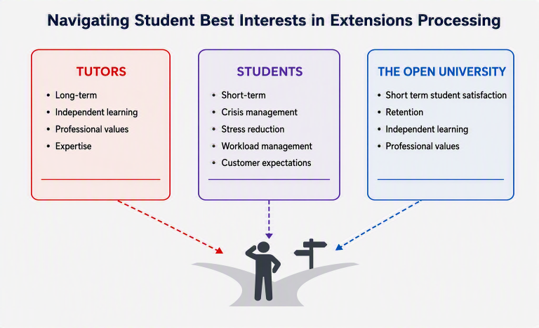
Nuances in emotional labour
The majority of tutors exhibited a welfare-based approach to extensions as they took ownership of exploring and developing student support strategies, which emerged in conjunction with deeply held values, such as empathy and equity. Tutors largely saw the extension request as an inflection point for developing tailored student support that demonstrated a positive type of emotional labour.
However, we also noted profound levels of ‘negative’ emotional labour. Some tutors approved extensions in order to avoid student complaints or to avoid further engagement with students’ complex, emotional needs. As they tried to navigate the dissonance of their strongly held core values, professional identity and the institutional priorities, a negative form of emotional labour was created.
Recognising our tutors
Like the participants in Armstrong and Byrom’s (2023) study, tutors wanted to express their views and vent their frustrations with a system that requires them to manage complex and competing priorities with what they saw as limited help, guidance and institutional support. Tutors participated vigorously in the case study exercises, providing richly detailed data, that both confirmed and energised the imperative of our project: Extension processing requires emotional labour.
Through the lens of extension processing, our findings confirm that OU tutors constitute a professional and uniquely committed workforce, that genuinely cares about students. They respond to the diverse and often complex needs of students by invoking a multidimensional skill set and engaging in emotional labour. However, the dissonance at multiple points creates emotional labour, (Ogbonna, E and Harris, L.C. 2004) which has a negative impact on tutor wellbeing.
Extension requests only appear to be minor administrative procedures. In fact, they reveal a great deal about the complexity of contemporary tutoring. Our findings demonstrate that tutors mobilise professional judgement, pastoral expertise, emotional intelligence and considerable goodwill when supporting students through extension decisions. If institutions wish to benefit fully from this expertise, the emotional labour involved must be recognised, supported and appropriately valued within the university's structures and culture.
Authors
This blog was written by Bryony Gilbert, previously a Student Experience Manager and Associate Lecturer at the Open University Law School and Dr. Wannette Van-Eg-Dom-Tuinstra, Head of EDIA at the Open University Faculty of Business and Law, and a Student Experience Manager and Associate Lecturer in the Open University Law School.
References
Abery, E. and Gunson, J.S. (2016) ‘The cycle of student and staff wellbeing: emotional labour and extension requests in Higher Education. A practice report,’ Student success, 7(1), pp. 65–71. Available at: https://doi.org/10.5204/ssj.v7i1.326.
Armstrong, N. and Byrom, N (2023) ’The Impact of Mitigating Circumstances Procedures: Student Satisfaction, Wellbeing and Structural Compassion on the Campus. Educ.Sci 13, 1230 available at https://doi.org/10.3390/edusci13121230
Mann,S., (2002) Hiding What We Feel. Faking What We Don’t. Vaga Publishing.
Nixon, E and Scullion, R. Academic Labour as professional service work? A psychosocial analysis of emotion in lecturer-student relations under marketizations. Human Relations 2022 Vol 75(9) 1798-1823
Ogbonna, E and Harris, L.C. (2004) ‘Work Intensification and Emotional Labour Among UK University Lecturers: An Exploratory Study’ Organisation Studies 25(7) 1185 DOI: 10.1177/0170840604046315
Project supported and funded by SCiLAB – The OU Scholarship Centre for innovation in online Legal and Business education. Project Reference SCiLAB252607.

Blog posts
- The hidden aspects of TMA extensions for tutors: plumbing the depths of feelings and values in tutor decision making
- From analytics to action: what The Open University's student-facing dashboard teaches us about inclusive assessment and tuition support
- Can a business school course become a force for social good?



Explore

Undergraduate
Postgraduate
Policy
-
Follow us on Social media
-


