
Enhancing student confidence through whole group feedback in virtual learning environments

Introduction
The Open University (OU) is a leading provider of distance education with delivery taking place totally in the virtual environment. Students benefit from online learning resources, a dedicated tutor and interactive tutorials. The tutor will mark student assessments providing comprehensive feedback to aid the students learning. While distance learning has many advantages, for example flexibility and accessibility for a wider range of individuals (Rush 2015), it does have drawbacks, not least of all the feelings of isolation and lack of a sense of belonging which can impact on students’ motivation, wellbeing and mental health (Jones and Strevens 2022).
Our project aimed to address these challenges and enhance student confidence by introducing online whole‑group tutor feedback, mirroring practices commonly used in face‑to‑face settings where tutors provide general comments to the cohort.
In the OU teaching model, feedback on assessments is seen as a key means by which tutors can develop a relationship with students. It serves as an effective means of initiating dialogue with students about their progress and the opportunities for their further development.
This dialogue, which can be in a written or verbal form, can help breakdown the imbalance of power particularly if linked to a shared goal, thereby allowing the student to move forward. It also can facilitate an understanding for the student that feedback is an evaluation of their work not them as people.
What is good feedback?
There has been a lot of research into feedback but for many, the work of Nicol & Macfarlane‐Dick (2006) has established what constitutes good feedback, as depicted below.
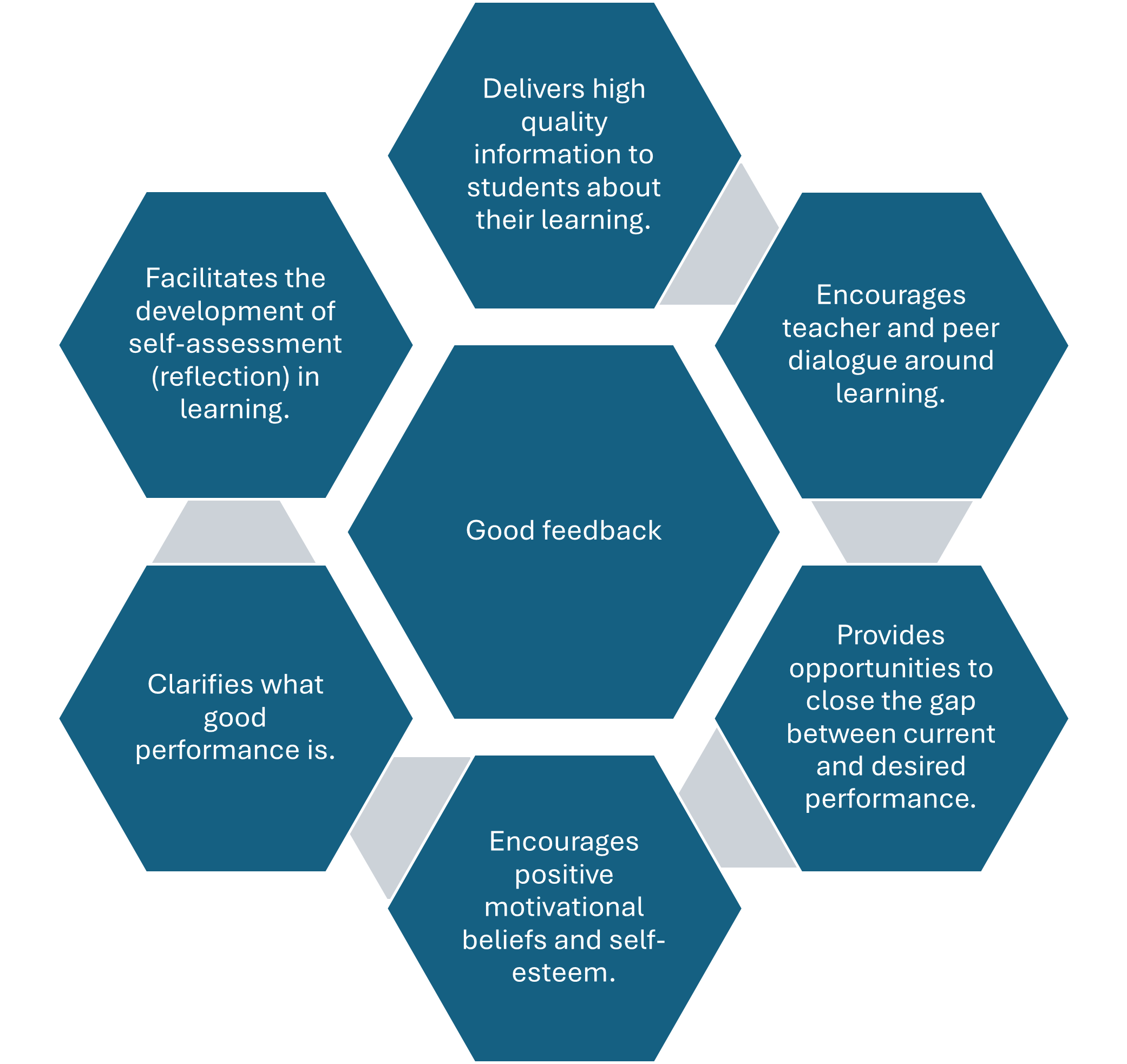
Figure one: What is good feedback.
This feedback model has been reaffirmed more recently by Mandhane et al 2015 who again identifies that good feedback will be clear and specific, focusing on performance, emphasising the positives and suggesting areas for development. This provides the educator with a clear guide as to what constitutes good feedback. But, as identified by Pitts and Norton (2017), these checklists do appear to be simplistic and omit the importance of emotion: students do not read the feedback in an emotional vacuum. Distance learning students typically receive feedback in isolation and must process the emotions it evokes alone, often without access to peers who understand their experience. Unlike face‑to‑face environments, opportunities to discuss feedback and normalise reactions are limited. This lack of opportunity to share reactions can lead the student to feelings of isolation.
Addressing isolation through group feedback
When an Open University student gets their feedback, they often do not have “a study friend” who they can turn to discuss the feedback and sense check their re-actions to the comments made. They may well read the positive comments, but for many, they focus on the negative and not the constructive feedback on how to improve.
One way in which to address this is to provide feedback in a group setting. The authors, having both worked in traditional educational settings prior to joining the OU, were used to returning marked work and giving some generic feedback to the whole group in the classroom. For example, what collectively was done well and areas that need to be worked upon. This provided an opportunity for students to see that other students had made the same mistakes as themselves and not feel so isolated. Reflecting on this we decided to pilot a project where tutors were asked to provide a short whole group, recorded presentation on completion of the whole group marking. The tutors were advised to ensure their recording covered the strengths and weakness of the groups assessment as a whole and included collective feedback and feed forward.
Evaluation
The initial pilot was conducted on a second‑year Law module and using three tutor groups. Students were accustomed to receiving written feedback via the computerised system and contacting their tutor if they wished to discuss it further. As this was a small‑scale pilot, three tutors were invited to participate, this approach was taken due to concerns about tutor workload. Tutors were briefed and provided with guidance by the project team. They were asked, after each TMA, to reflect on their marking, identify common strengths across the group, and highlight shared areas for development, before producing a recording to be shared with their tutor group covering these points. They were asked to ensure their cameras were on for the recording and that it lasted no more than five minutes.
The project was evaluated taking a mixed methods approach with the use of questionnaires (to allow us to reach the greatest number of students), followed up with individual interviews with students (to allow greater depth) and focus groups with tutors. A thematic approach, based on the work of Braun and Clarke (2006) was taken to analyse the questionnaires, interviews and focus groups. We also looked at the statistical data in terms of the number of times the recordings had been accessed.
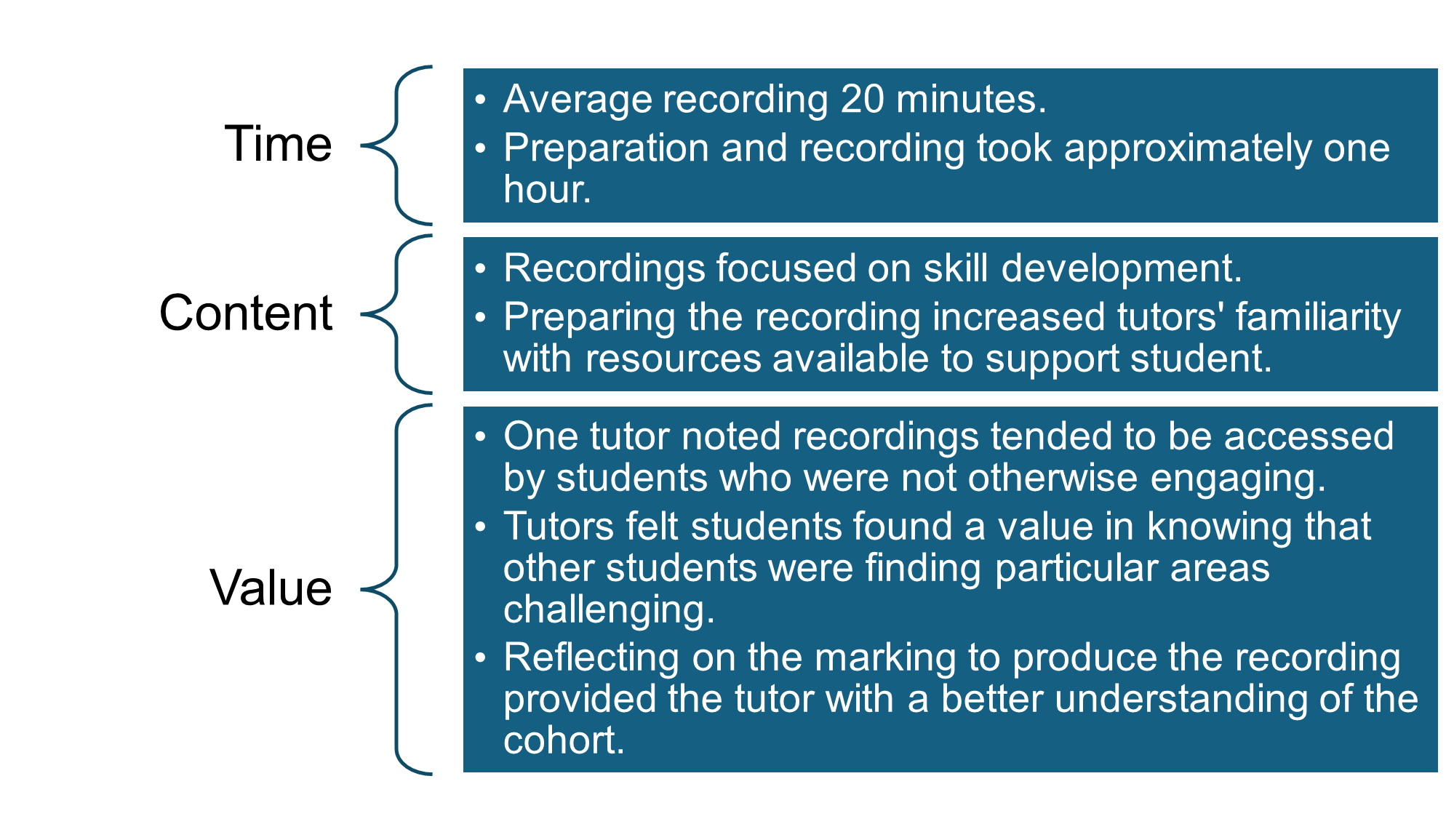
Unfortunately, due to tutor absence and student time commitments we were unable to fully conduct the evaluation as planned. We were, however, able to conduct the focus group with two tutors and two students agreed to be interviewed. While the small number of participants is a weakness, from both the tutor and student comments there does appear to be value in whole group feedback. Themes included whether belonging was developed, the content of recordings, the time commitment involved for tutors and the value of the recordings for both tutors and students.
Key points from the tutor evaluation included:
Key points from student evaluation included:
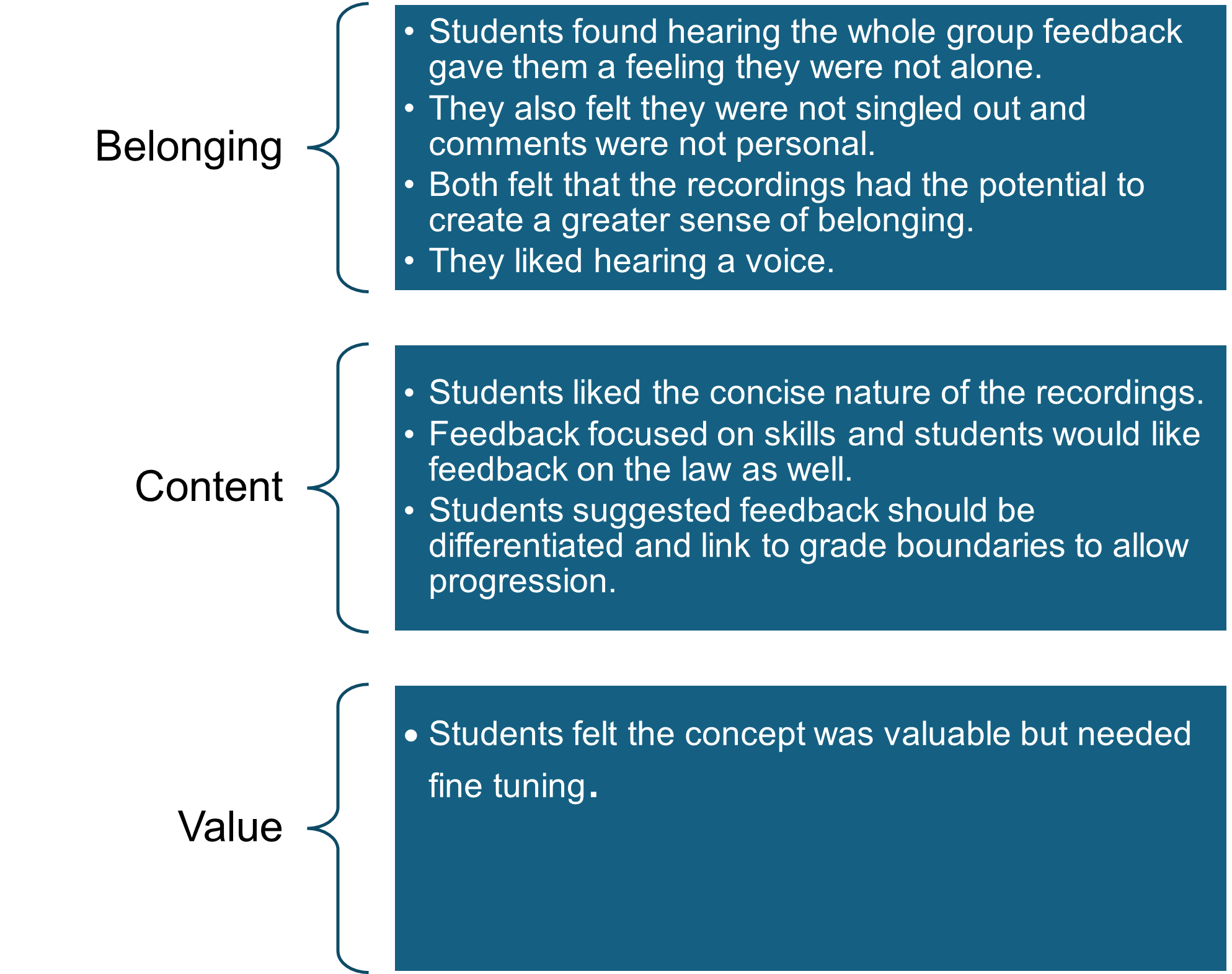
Over a quarter of students accessed at least one recording and this suggests there was some value in having the recording and providing the feedback. However, accessing the recording did drop off for the second assignment and this may suggest that the students were questioning the value of the information provided. This links with comments made by the students in the evaluation relating to wanting the feedback to include more law content and link to the grade boundaries.
From the interviews and focus groups it was identified that there was a mismatch between what the tutors provided in terms of feedback and what the students wanted. Tutors focused on skill development, while the students fed back, they wanted feedback on both skills and legal content. Students were also keen to have feedback that allowed them to move up the grade boundaries and felt the feedback should be differentiated to allow this to happen.
Challenges and considerations
A key issue around the up scaling of this project is tutor time. From the feedback provided it was evident that tutors had to spend approximately an additional hour preparing and delivering the recording. Tutors, quite rightly, questioned whether their time could be better spent on other support mechanisms for example one-to-one phone calls.
One of our aims with this project was to explore whether recorded whole group feedback helped individual students gain confidence from the realisation that other students are experiencing the same challenges in their learning and writing assessments and therefore reducing the feeling of isolation. Due to the low numbers of students who engaged in the evaluation we are currently unable to draw a conclusion with regards to this. One student stated they did find it reassuring to know that other students were experiencing the same challenges as themselves. Another student commented that it improved their sense of belonging by hearing the common feedback.
Going forward
Considering the student feedback we did receive, we have decided to upscale the project and run a larger pilot on a first-year module in order to gain a greater understanding of whether whole group feedback helps develop student confidence and improves the sense of belonging to the tutor group. The larger pilot is currently being run on a large first year module, and we are conducting a similar evaluation (again funded by SCiLAB). We are excited to build on this work and will be sharing the outcomes of the larger pilot in a future blog - so watch this space.

Carol Edwards
Carol is a Senior Lecturer in Legal Online Pedagogy, Lead for Retention and Outcomes (Law) and Student Experience Manager. She is actively involved in the scholarship relating to online teaching pedagogy and has presented and published on this area. She has a very keen interest in tackling student and staff isolation and is actively involved in several projects attempting to address this area. These include the online mentoring programme, and The Belonging Project, with particular focus on developing student confidence. She is part of a pan-university team exploring belonging across the Open University.

Emma Curryer
Emma Curryer is a Senior Lecturer in Law, Senior Fellow of Advanced HE and a solicitor with a current practising certificate. Emma specialises in criminal law, SQE, criminal justice, evidence, and public law and has written various materials that have been embedded in the law degree as well as developing and delivering mandatory tutorials and workshops to refresh students’ knowledge of criminal law and evidence. She is involved in scholarship relating to online teaching pedagogy, including employability and the importance of vicarious trauma training for students and legal professionals. She has presented and published articles and book chapters based on teaching pedagogy.
Prior to her work with the Open University, Emma worked as a Senior Crown Prosecutor with the Crown Prosecution Service, a defence solicitor, and is an accredited criminal litigation solicitor.
Her research interests consider criminal justice and the concept of justice through time and geographical space. Part of that involves considering criminal justice through the lens of twentieth century literature, particularly the Golden Age of Detective Fiction and Agatha Christie. This extends to research into criminal justice in Ancient Egypt and the Middle East as seen through interpretation of archaeology and literature.
This project was funded and supported by The Open University’s Centre for Scholarship and Innovation in the Faculty of Business and Law (FBL) Project Reference Number 242513
References
Braun, V. & Clarke, V. (2006). Using thematic analysis in psychology. Qualitative Research in Psychology, 3:2, 77-101. DOI: 10.1191/1478088706qp063oa
Jones, E. & Strevens, C. (2022). Legal education for wellbeing: design, delivery and evaluation. The Law Teacher, 56:1, 1-4. DOI: 10.1080/03069400.2022.2033494
Nicol D,J & Macfarlane‐Dick (2017) 006) Formative assessment and self‐regulated learning: a model and seven principles of good feedback practice, Studies in Higher Education, 31:2, 199-218
Pitt, E. & Norton, L. (2017) ‘Now that’s the feedback I want!’ Students’ reactions to feedback on graded work and what they do with it, Assessment & Evaluation in Higher Education, 42:4, 499-516
Mandhane, N., S. Ansari, T. P. Shaikh, and S. Deolekar. 2015. “Positive Feedback: A Tool for Quality Education in Field of Medicine.” International Journal of Research in Medical Sciences 3 (8): 1868–1873. doi:10.18203/2320-6012.ijrms20150293.
Rush P, 2015 ‘Isolation and Connection: The Experience of Distance Education’ International Journal of E-Learning & Distance Education Revue Internationale Du E-Learning Et La Formation à Distance, 30(2) <https://www.ijede.ca/index.php/jde/article/view/936> accessed 12 March 2025

Blog posts



Explore

Undergraduate
Postgraduate
Policy
-
Follow us on Social media
-


