
Democratising the Scholarship of Teaching and Learning: Why and how?

What is 'REF'?
If you work in a university, you’ve likely heard of ‘REF’, but you might not be clear on what it is. Well, the Research Excellence Framework (REF) is the UK’s system for assessing the quality of research in UK higher education institutions, and it informs the allocation of around £2 billion of public research funding each year. You might have thought that you could make a valuable contribution here, if only the definition of a ‘REF-able’ research output wasn’t so narrow - previously, the allocation was based solely on the number and quality of peer reviewed academic publications achieved by an institution. Well, it seems that REF agrees with you. For the next funding allocation exercise in 2029, REF is going to recognise a broader, more inclusive range of research outputs, activities and impacts beyond the traditional peer reviewed publication (REF, 2023). What exactly this will mean in practice is yet to be clarified. However, it provides an opportunity to draw on the skill sets of non-traditional academics, and further align HEIs with the democratisation of research trend (Jaeger et al, 2023).
Democratising Scholarship
The key to achieving this democratisation of research is to make the process of conducting Scholarship of Teaching and Learning (SoTL) more accessible to those who are not from traditional ‘research’ backgrounds. It requires mainstreaming research skills to form part of the toolkit of academics who come to teaching from a non-traditional route.
They, like many academic staff whose primary role is not research, still strive to understand how students learn best by engaging in SoTL. The operational impact of SoTL is well documented (Bennett et al., 2018; Hubball et al., 2013), but the challenge is to combine this with publishable academic output. Indeed, SoTL is most likely to achieve its goal of improving student learning if it is seen as ‘scholarly and inquiring’ and ‘made public and peer reviewed’ (Trigwell, 2013).
What we did
We investigated the experiences of a cohort of sixty teaching-focused academics in the Faculty of Business and Law, at The Open University (OU). We carried out a two-phased mixed methods study to investigate how to encourage and support such staff in conducting high quality SoTL with operational impact and publishable academic output. Phase 1 consisted of four focus groups with thirteen staff. We identified three main factors that influenced participation in SoTL: the occupational role, the resources available and relationships with others (Armstrong et al., 2024).
What we found
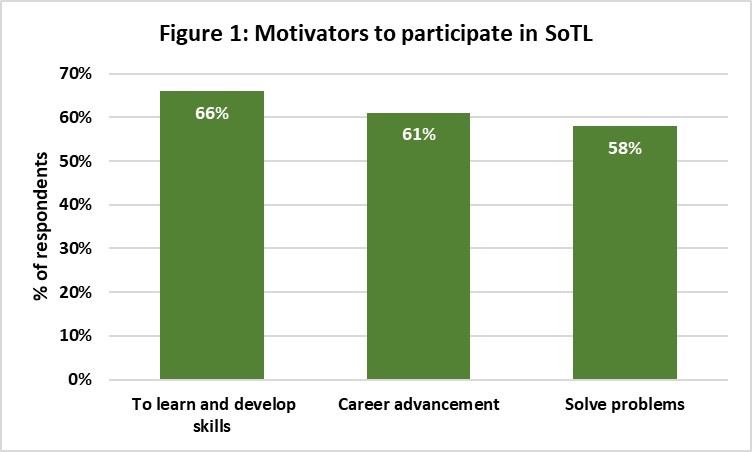
Our Phase 2 survey (which had a high response rate of 62%) revealed that over the previous two academic years, at least 84% of the respondents were involved in SoTL. When asked what motivated them to be SoTL-active, the top three responses were ‘to learn and develop skills’ (66%), ‘career advancement’ (61%), and ‘to solve problems that have been identified’ (58%). Fifty percent of participants also reported that participating in HE research/scholarship led to increased job satisfaction.
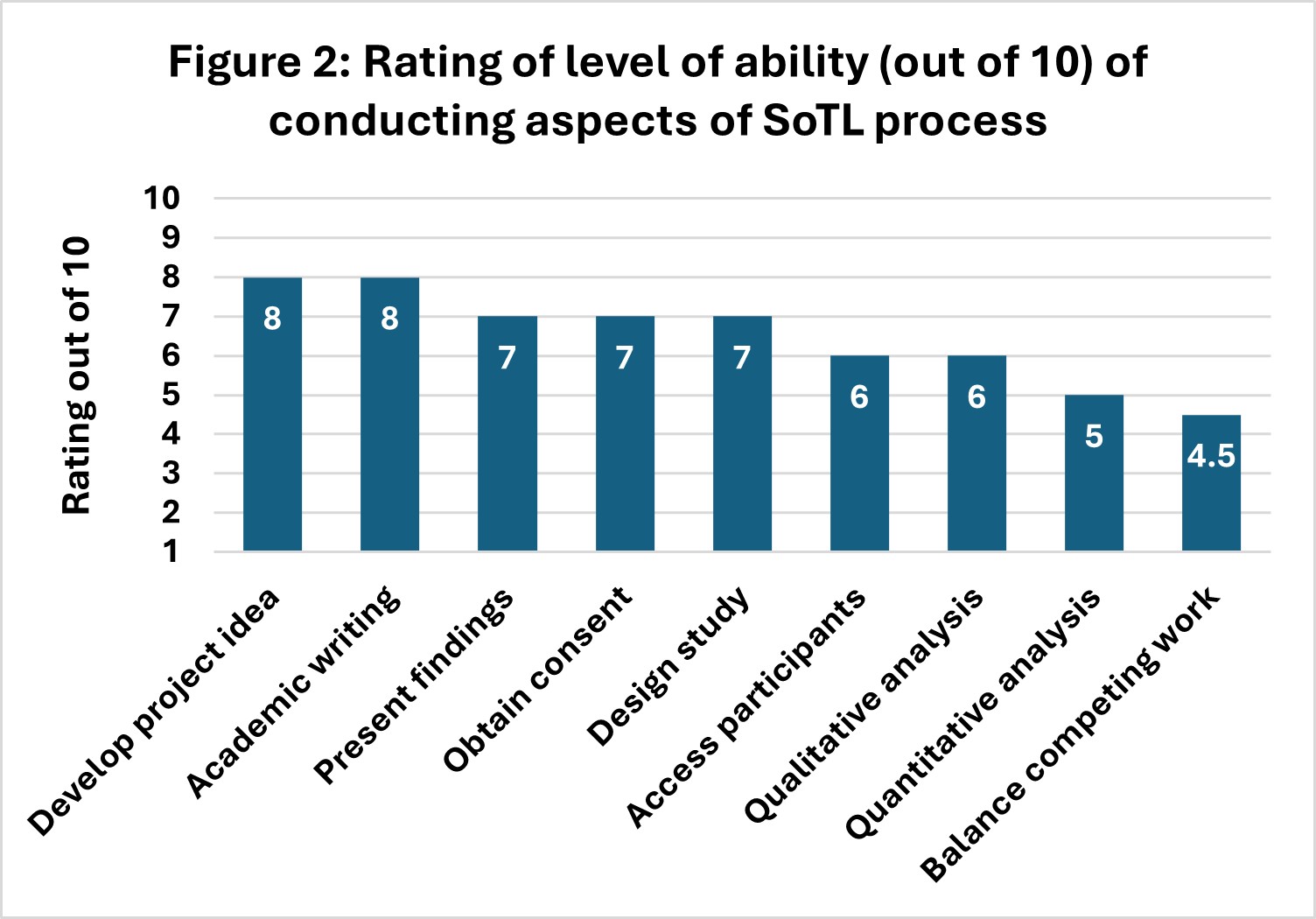
Our survey revealed high levels of ability in certain research skills, for example, developing ideas and academic writing (average score 8/10 for both). Technical research skills, such as presenting findings, were also areas where skill levels were high (average score 7/10). Many SoTL-active respondents (65%) were involved in data collection. However, only 44% of SoTL-active respondents were involved in quantitative data analysis and rated their ability in this aspect of the research process at only 5/10.
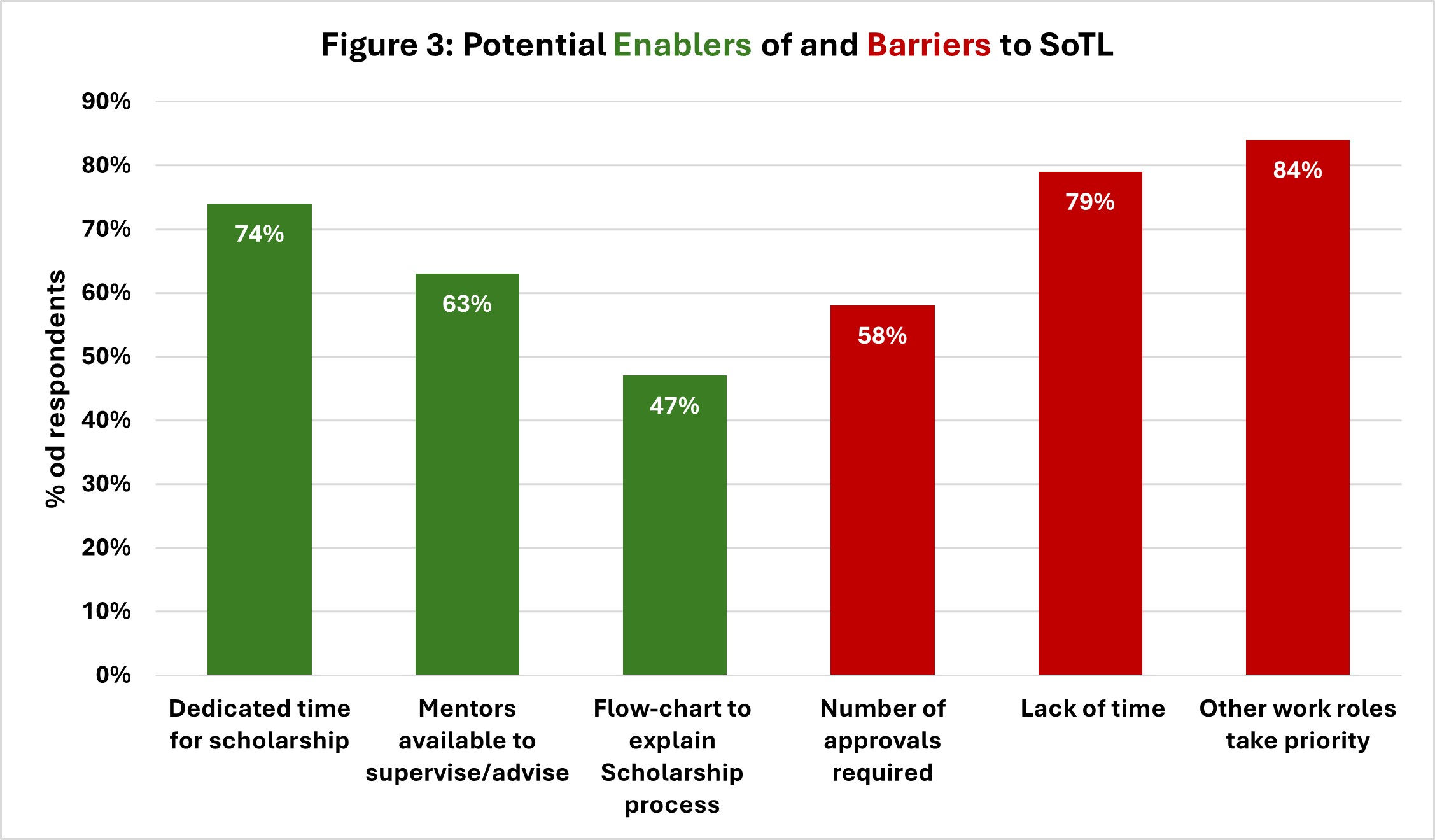
We also asked our participants to identify factors that enabled their participation in SoTL, and those that were barriers. Two key barriers to SoTL stood out in these results. The first of these is the process itself: of these teaching-focused academics, who do not engage with research approval processes as often as their research-focused counterparts, 58% felt discouraged from participating in SoTL due to the perceived arduous task of gaining ethical approval and access permissions. The second key barrier hinged on the role itself, such as ‘other work roles taking priority’, identified by 84% and general ‘lack of time’ as cited by 79% as hindering participation in SoTL. Tellingly, SoTL-active respondents rated their ability to balance SoTL with competing work at 4.5/10.
Unsurprisingly, when asked what would help them conduct more SoTL, respondents indicated that ‘dedicated time for scholarship’ was the most important factor (74%). Aligning to the barrier of the research approval processes, 63% of respondents identified that advice and supervision from more experienced colleagues would help. The third most important enabler of SoTL would be a flow chart, to better explain the steps in the scholarship process (47%).
What should HEIs do to democratise SoTL?
These results tell us that our teaching-focused academics certainly see the value in SoTL and want to fully participate in it. Equally, we know that institutions want and need academics to play an active role in developing high-quality SoTL. Therefore, we propose three recommendations to support these aims:
.png)
Firstly, more training opportunities are required to develop the skills and confidence to craft SoTL projects that deliver operational impact AND publishable (and REFable) output. Some headway has been made with this at the OU*, but the process remains complex and daunting for potential participants. As indicated in the findings, the appointment of a mentor would be invaluable support for staff early in their SoTL journey.
Secondly, HEIs should consider demystifying and streamlining approvals processes. Creating one form (and decision tree) that captures all the necessary information, which is then distributed appropriately, would reduce duplication, time-cost and complexity for staff, further encouraging participation in SoTL activities.
Thirdly, and most importantly, dedicated time for SoTL is vital to encourage meaningful participation. This must be genuine time, allocated within staff workloads and supported by line management and senior staff.
By democratising SoTL and opening the process to a wider pool of participants, pedagogical approaches will be developed and improved, and the ‘REF-able’ outputs might lead to greater quality-related research funding. This is a win for both those teaching-focused academics who want to undertake SoTL and institutions that take steps to more fully support them. The ultimate win however is the benefit of a quality learning experience delivered to students, that is underpinned by scholarly, peer-reviewed and publicly available research.
*Since this study was carried out, the Faculty of Business and Law has made a concerted effort to act on these recommendations with a dedicated resource being developed by SCiLAB (the Faculty’s Scholarship Centre) to provide support to teaching-focused staff, including a ‘Scholarship Process Flowchart’ and an informal mentoring scheme. Several new workshops have also been delivered, to clarify and demystify the process of obtaining the necessary access/ethical approvals.
The project team is led by Dr Claire Armstrong (Lecturer and Student Experience Manager) and other members are:
Emma Bassett (Lecturer and SEM), Dr Hayley Glover (Senior Lecturer and SEM), Suzanne Corcoran (Lecturer and SEM), Nicola McDowell (Lecturer and SEM), Carol Sherriff (Senior Lecturer), Teresa Sides (Research Student), Rob Tumilty (Lecturer and SEM) and Dr Wannette Van-Eg-Dom-Tuinstra (Lecturer and SEM).
Authors
The blog was written by Claire Armstrong, Rob Tumilty, Wannette Van-Eg-Dom-Tuinstra, Emma Bassett and Suzanne Corcoran.
References
- Armstrong, C., McDowell, N., Van-Eg-Dom-Tuinstra, W., Tumilty, R. Bassett, E., Corcoran, S., Glover, H., Sides, T. and Sherriff, C. (2024). The ‘Carousel of Scholarship’: how to ride its ups and downs. The Scholarship Centre for innovation in online Legal and Business education (SCiLAB). Available at: https://university.open.ac.uk/scholarship-and-innovation/scilab/blog/carousel-scholarship-ride-its-ups-and-downs. Last accessed 15/07/25.
- Bennett, D., Roberts, L., Ananthram, S., & Broughton, M. (2018). What is required to develop career pathways for teaching academics? Higher Education, 75, 271–286
- Hubball, H., Pearson, M. and Clarke, A. (2013). SoTL inquiry in broader curricular and institutional contexts: Theoretical underpinnings and emerging trends. Teaching and Learning Inquiry, 1(1), 41–57.
- Jaeger J., Masselot C., Greshake-Tzovaras B., Senabre-Hidalgo E., Haklay M. and Santolini M. (2023) An epistemology for democratic citizen science, Royal Society for Open Science. Available at: http://doi.org/10.1098/rsos.231100. Last accessed 15/07/25.
- REF (2023) Research Excellence Framework 2028: Initial decisions and issues for further consultation (REF 2028/23/01). Available at: https://repository.jisc.ac.uk/9148/1/research-excellence-framework-2028-initial-decisions-report.pdf. Last accessed 08/01/25.
- Trigwell, K. (2013). Evidence of the Impact of Scholarship of Teaching and Learning Purposes. Teaching & Learning Inquiry: The ISSOTL Journal, 1(1), 95–105.

Blog posts



Explore

Undergraduate
Postgraduate
Policy
-
Follow us on Social media
-


