
COP 30 From the Global South
November 2025
The 2025 United Nations Framework Convention on Climate Change Conference (COP-30 for short) taken place in Belém, Pará, Brazil from 10 to 21 November 2025. This global gathering at the heart of the Amazonian rainforest has unsurprisingly put climate finance for protecting forests high on the agenda.
Will the rich nations put their money where their mouth is and will the pledges turn to practice? Another key issue is Indigenous peoples, which Brazil is keen to amplify. Will their voices be heard by the global leaders? The panel reflected on the happenings at the conference over the previous two weeks and analysed what the decisions taken at COP-30 mean for countries in the Global South. Watch the recording below.
Alongside the on-the-ground discussions in Belém, colleagues from The Open University have been closely following COP-30 from afar, offering critical insights into the negotiations and their implications. Their articles explore themes such as climate education, food systems, and the role of Indigenous voices in shaping global climate policy. These perspectives provide valuable context and analysis for understanding what the outcomes of COP-30 mean for the Global South and beyond. Read their contributions:
COP30: glass half empty or half full? - by Shonil Bhagwat, The Open University
As I watch the closing ceremony of COP30, the thunderous tropical rain showers are beating down on the roof of the Plenary hall in Belem, Brazil. The rain is so loud at times that the delegates cannot hear even with sophisticated sound technology. The atmosphere in the Amazonas plenary hall is no less thunderous. As the COP30 President André Corrêa do Lago reads out the decisions and the gavel goes down, some decisions are met with loud applause, others are challenged vociferously.
When the conference started on 10th November, Brazilian President Lula promised, "COP30 will be the COP of truth" he said, challenging the climate sceptics. It was intended to promote “Global Mutirão” a term inspired by Indigenous philosophy of collective action. It was also dubbed “the COP of implementation”, moving beyond pledges and turning them into actions. Written in bold letters was the commitment to get the rich nations to commit a trillion dollars for less developed countries to adapt to the impacts of climate change. Another wish of COP30 was to solidify the global commitment to transition away from fossil fuels and invest in renewable energy technologies. To this end, Brazil had promised a roadmap to that transition and COP30 was to get the parties to agree to the roadmap.
So, has COP30 lived up to its expectations?
A global conference such as this can very rarely live to up to everyone’s expectations, but a consensus must be reached, nevertheless. In the closing plenary, when the negotiations looked to be on the brink of collapse, COP30 President managed to salvage it by suspending the discussions and settling disagreements through diplomacy. That counts as success!
The reason for a possible collapse was that several of Brazil’s South American neighbours including Argentina, Chile, Colombia, Paraguay, and Uruguay and also the Central American nation of Panama were not happy with the watered-down commitments from rich nations. There was no mention of transition away from fossil fuels in the final agreement. Saudi Arabia and other ‘petrostates’ fiercely fought to leave out any agreement on fossil fuels. And China, India, Russia, some of the largest emitters of greenhouse gases, didn’t object either. Several countries from the Global South – including those in Sub-Saharan Africa and South and Southeast Asia – were also left feeling disappointed. There was no agreement on how their climate change adaptation will be supported by rich nations.
If COP30 was successful, it was perhaps successful outside the UN process.
Brazil managed to launch the Tropical Forests Forever Facility to create a voluntary investment fund that will pay nations to keep trees standing. Another success was a roadmap to end deforestation backed by about 90 nations, so potentially good news for forests.
Another good news, welcomed by the civil society, was the agreement on a Just Transition Mechanism agreed by all nations. This will ensure that the move to a green economy takes place in a fair and just manner, and protects the rights of workers, women and Indigenous people.
So, overall, win some, lose some – that’s the nature of these complex global negotiations – now onwards to COP31 in Türkiye in 2026 where the political theatre of climate talks will continue.
A Global Mutirão - listening to mobilise beyond COP30 – by Michael Pryke, The Open University
‘Global Mutirão — a call for cooperation among peoples, sectors, and territories, to transform commitments into effective action against the climate crisis. The idea of the mutirão comes from the collective knowledge of Indigenous, Quilombola, and peripheral communities. An ancestral word originating from the Tupi-Guarani motirõ, mutirão represents a community action for the common good. (FIRST EDITION: COP30 - The Global South House)
A brief look back at the present
At COP26 Elizabeth Wathuti, then a youth climate activist from Kenya, addressed the assembled great and the good, with these words ‘I have asked myself over and over what words might move you. And then I realised that my truth will only land if you have the grace to fully listen…’.
In the years between COP26 and COP30 Wathuti might reasonably ask if the leaders of countries in the Global North have listened to powerful and urgent messages about the impact of the climate crisis on communities across the Global South. Indeed, have leaders and others learnt to listen to ‘flip the map’ of their understanding of the climate emergency, to reflect and to learn from the multiple contexts and knowledges across the global South? COP30, to be held in Belem, Brazil, would seem to have been a perfect opportunity for leaders and others to provide answers to these questions.
Action for Climate Empowerment
In the years since COP26, some progress has been made. Article 57 of the Sharm-el Sheikh Implementation Plan and Para 65 COP26 Global Climate Pact encouraged future COP Presidencies to organise annual climate forums contributing to implementation of Glasgow work programme on ‘action for climate empowerment’. These forums are intended to foster strong conversation between international youth and Parties. The COP30 Presidency was keen to continue this initiative (COP30 Task Force ).
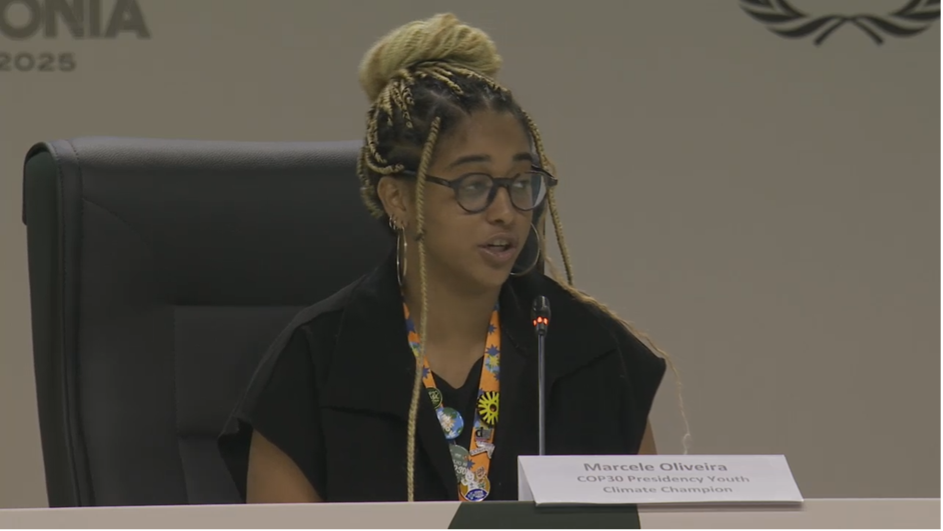
Marcele Oliveira, COP30 Presidency Youth Climate Champion
On International Youth Day, August 12, the COP30 Youth Climate Champion Marcele Oliveira launched an appeal to youth-led initiatives worldwide to engage with the COP30 Presidency’s Action Agenda.
“We know that COP30 has the potential to shift the global climate justice debate by strengthening solutions that come from the Global South. Our challenge, as the Youth Presidency, is to ensure that engagement spaces are accessible, meaningfully include youth participation, and make sense not only to those inside the technical processes of the Climate Conferences, but also to those outside of them. COP30 is for everyone!” said Marcele Oliveira (Youth mobilization connects local solutions with COP30 Action Agenda).
Fast forward to COP30
With a ‘room full of young people’ the third Youth-led Climate Forum took place at COP30 to provide an opportunity to discuss youth-led initiatives, knowledge transfer, and the chance to present ideas and projects to negotiators. Over three days the Forum in Belem was organised around three thematic sessions covering, first, the defence of intergenerational equity in just transition and climate finance and energy. The second session asked how future international cooperation can help us reach food and agricultural target under UAE framework for global climate resistance? The final theme boldly addressed climate justice for all: Mainstreaming children, youth, gender, and Indigenous rights in climate policies.
The themes and sessions were ambitious and urgent, and against the backdrop offered by the Brazilian Presidency’s shared vision for this COP as a Global Mutirão, a ‘global mobilisation against climate change’, the lively discussions in all three sessions offered some hope.
To take a few for instances from the first session addressing the just transition contributors were alert of to how the ‘just energy transition’, and the extractivism at the heart of that shift away from fossil fuels, needed to avoid turning into ‘extractive colonisation with green label’. And reminders of how and why that if ‘the transition isn’t just it just won’t last’; that the transition ‘won’t be given to us by markets and models’; that the ‘just transition has to be built through leadership with justice at its centre’. That there’s a need to ‘change how finance works so that it serves humanity’; that ‘financial markets need to be embedded in human rights and intergenerational equity…only then can there be a just transition’.
Rumbling through all sessions was a strong sense that action was needed, that youth and younger generations globally need to be given the opportunity for meaningful participation in policy making, not as ‘addons’ but central to processes of decision making well beyond COP30.
Access, voice…and listening
Reflecting on the workings of past COPs, Professor Farhana Sultana, reminds us that ‘Access and voice determine influence; the ability to be heard is fundamental’ (Farhana Sultana 2025, 6). The inclusion of Youth-led climate forums at COPs would seem to be a move in the right direction; the Youth-led Forums at COP30 were held in the ‘Blue Zone’ ‘the primary venue for negotiations’, no less.
Yet, as Elizabeth Wathuti would no doubt agree, to be fully effective then participation in such events, and in such venues requires, if not demands, that what younger generations say, is listened to not in some tokenistic fashion, but in the spirit being open to being challenged by imaginative ideas and proposals grounded in the lived experiences of participants from across the Global South and North. For as Marcele Oliveira, the Youth Climate Champion, reminded the COP30 Presidency in a pre-COP event
“Young people in Brazil and globally have demonstrated that solutions already exist—many of which are being led by children and youth. This was one of the key findings of our ‘Youth Mutirão’, which mapped over 230 youth-led initiatives worldwide. These projects address vital issues such as adaptation, climate justice, and racial equity. This event, during the Pre-COP, serves to consolidate an agenda that establishes Youth and Children as protagonists of Climate Action” (Youth movements present COP30 priorities to Conference Presidency)
If open, active and responsive listening is not central to the conduct of negotiations then that hopeful rallying call for a Global Mutirão will be subdued and its reach beyond Belem, and yet another COP, severely limited. The Youth-led Climate Forum at COP30 demonstrated wonderfully why younger generations have the ideas and energy to turn dialogue into action to address the climate crisis and its injustices, to ‘transform commitments into effective action against the climate crisis’.
Suggested links
Farhana Sultana 2025 ‘Repairing epistemic injustice and loss in the era of climate coloniality’ https://doi.org/10.1002/geo2.70029
Global South House is a platform for political articulation, mobilization, knowledge production and collaboration among philanthropic actors from the Global South FIRST EDITION: COP30 - The Global South House
COP27 Global Youth Statement Global Youth Statement – COY17
Youth movements present COP30 priorities to Conference Presidency
Reflecting on COP30: Amplifying Indigenous knowledge and perspectives through digital education – by Dr Leigh-Anne Perryman, The Open University
Education’s power to drive climate mitigation, support adaptation, and inspire meaningful action is now widely recognised. At the Open University’s Institute of Educational Technology (IET), we have spent recent years helping educators across sectors and disciplines respond to the climate crisis with confidence and creativity. This includes developing learning opportunities such as the popular OpenLearn course Supporting climate action through digital education and our CPD course Teaching climate action: empower students to tackle the climate crisis, launching in January 2026. Our Masters in Online Teaching programme also embeds climate-related themes throughout its modules.
A central message from COP30 was clear: the climate crisis cannot be addressed without the expertise of Indigenous knowledge keepers. Throughout the conference, Indigenous leaders, youth and educators reminded delegates that their communities have stewarded ecosystems for millennia, maintaining biodiversity and resilience through community governance, oral tradition and place-based science.
Yet, despite their importance, Indigenous perspectives remain marginal in mainstream education and policy. IET’s climate curriculum emphasises collaboration as a core driver of climate action, and COP30 underscored how digital education can be a powerful connector – a means of sharing, preserving and amplifying Indigenous knowledge across generations, geographies and disciplines. However, Indigenous knowledge and digital resources must be used with great care.
For many Indigenous communities, knowledge is carried through story, ceremony and lived practice on the land. Climate disruption, displacement and digital exclusion have increasingly threatened these pathways. However, COP30 highlighted new community-led digital initiatives working to protect and revitalise them. Indigenous youth from the Amazon, the Arctic and the Pacific showcased mobile apps, podcasts and virtual classrooms designed to document traditional ecological knowledge while maintaining community control and consent.
One compelling example was the expanding use of tools like Mapeo, developed in partnership with the Indigenous Mapping Workshops (IMW). Indigenous communities from the Amazon and the Arctic showcased how they had been using the offline, open-source platform to document land use, track biodiversity loss and monitor climate impacts – all while retaining full data sovereignty. This combination of geospatial mapping and community-led monitoring shows how digital education can strengthen environmental stewardship by turning community-gathered mapping data into learning resources that reflect Indigenous priorities and support culturally rooted climate education.
A particularly powerful aspect of COP30 was the Yaku Mama Amazon Flotilla – a 3,000-km, Indigenous-led boat journey through the Amazon River to COP30. Framed as an act of resistance against the colonial roots of the climate crisis, the flotilla generated a rich digital archive film, photography, podcasting and livestreamed dialogues. Owned and curated by Indigenous participants, these resources now support climate justice learning in areas such as climate resilience, cultural heritage and sustainable land stewardship. The Yaku Mama website and Instagram account, and the Caravana Yaku Mama YouTube collection, are just a few of the places where resources are shared.
These examples demonstrate how digital education can extend learning far beyond the classroom, linking Indigenous educators, students and allies across regions. Such connections can support intergenerational learning and the global exchange of local wisdom. Integrating Indigenous knowledge into digital education, COP30 speakers argued, also strengthens climate literacy for all learners. Indigenous perspectives foreground relationships – between humans, ecosystems and future generations – that conventional science education, and climate education extending beyond science, often overlooks. When shared through online platforms, podcasts and interactive storytelling, these perspectives can nurture empathy, systems thinking and responsibility—qualities essential for climate action and leadership.
However, a commonly voiced caution in COP30 sessions discussing how education might amplify Indigenous knowledge and perspectives was that digital education should not simply ‘digitise’ Indigenous content within existing curricula. Doing so risks replicating extractive patterns that have historically silenced Indigenous voices. True inclusion requires co-creation. Indigenous knowledge keepers must lead platform design, determine what is shared, and govern how their intellectual and cultural property is represented.
This principle aligns with the growing movement for data sovereignty – the right of Indigenous communities to own and govern the data and stories concerning them. In practice, this means co-developing curricula, prioritising local-languages, and offering offline or low-bandwidth formats suitable for rural learners. Above all, respect, reciprocity and consent must shape every layer of digital design. Within IET, we’re now considering how to achieve this level of co-creation in our own curriculum. We’ve made a start in the past, partnering with students and educators in Samoa, but could do much more.
As COP30 concluded, the digital transformation of education stood out as both a risk and a hope. It risks homogenising knowledge if it reduces diversity to standardised modules – but it also holds immense hope as a tool for connection, preservation and empowerment.
Living on the Edge: Tipping Points at COP30 – by Dr. Ivan Sudakow, STEM, The Open University
At COP30 in Belém, two sessions on tipping points cut through the diplomatic fog and posed a stark question: are we still steering the climate system, or only its damage control?
In the first, the University of Exeter team launched the Global Tipping Points Report 2025. Tim Lenton walked us through a now-familiar but still shocking picture: at about 1.4°C of warming, warm-water coral reefs are already crossing a catastrophic tipping point, with more than 80% experiencing unprecedented die-back, undermining the livelihoods and coastal protection of hundreds of millions of people. Several other systems – from Greenland and West Antarctica to permafrost and key ocean currents – are judged “likely” to tip around 1.5°C if warming continues. The message was painfully clear: every tenth of a degree, every year above 1.5°C, sharply raises the odds of irreversible change.
Yet the tone was not purely apocalyptic. Lenton emphasised “positive tipping points”: rapid, self-propelling shifts like Norway’s decade-long leap from fossil to electric cars, driven by reinforcing feedbacks of falling cost and rising adoption.
The report calls on COP30 to do three things: minimise overshoot of 1.5°C via a rapid fossil-fuel phase-out; embed tipping-point risk into finance, security and development planning; and deliberately trigger positive tipping points in clean energy, food systems and nature restoration.
Co-author Manjana Milkoreit then asked whether our institutions are even designed for such nonlinear, irreversible risks. Tipping points, she argued, elevate the precautionary principle and force us to link short-term decisions to consequences that echo for millennia. That implies anticipatory governance, new forms of risk assessment, and justice at the core – because those least responsible are first to be hit and least able to adapt.
The second session, on cryosphere tipping points “from Andes to Amazonia”, translated these abstractions into ice, water and people. IPCC-linked scientists showed how mountain glaciers from the Andes to the Himalaya, together with the Greenland and Antarctic ice sheets, are already losing ice at record rates, locking in metres of future sea-level rise and threatening water security for downstream communities. They warned that parts of the polar ice sheets, like coral reefs, may already be committed to long-term retreat at today’s temperatures, even if the full consequences unfold over centuries.
Across both rooms, one conclusion dominated my notebook: we are living in a world of cascading negative tipping points – and our only credible escape route is to engineer positive ones faster.
Creating transformative futures in a time of mass extinction – by Emma Dewberry, The Open University
Firstly, data insights from COP30
My journey of observing COP30 started with some glum, if not unexpected, news. I had tuned in to hear Prof. Johan Rockström, Director of the Potsdam Institute for Climate Impact Research, at a press conference on Day 1 of the summit, presenting 10 new insights in climate science:
Evidence, uncertainty, and questions around record warm years 2023/2024
Accelerating sea surface warming and intensifying marine heatwaves
Global land carbon sink under strain
Climate change and biodiversity loss amplify each other
Climate change is accelerating groundwater depletion
Observed and projected climate-driven increase in dengue
Climate change-related labour productivity and income loss
Safe scale-up of carbon dioxide removal is needed to tackle hard-to-abate emissions and climate risks
Carbon credit markets – integrity challenges and emergent responses
Policy mixes outperform stand-alone measures in advancing emissions reductions
These insights, based on peer reviewed literature, the work of 70 researchers, and insights from 150 global experts, broadly cluster into three areas. The first four insights raise concerns of accelerated global warming through observations of Earth system processes and deliver a stark reminder that the window for action to stabilise the climate and minimise temperature overshoot is ever narrowing. They also highlight new analyses that links biodiversity loss to increasing rates of climate change caused by a reduced efficacy of ecosystems to uptake and store carbon. The second cluster (insights 5-7) highlight the socio-economic consequences and health impacts felt through climate change, particularly impacting regions where the risks of climate change are highest. The last cluster (insights 8-10) focus on a range of mitigation approaches, highlighting the value of tailored policy mixes to achieve more robust emission cuts.
While this climate science update states that there is not yet a breach of the Paris Agreement goal to keep long-term global warming below 1.5oC, current global mitigation strategies fall unbelievably short of delivering on that goal. Nationally Determined Contributions (NDCs) to cut global emissions, if met, would only achieve a 5.9% reduction compared to the 42% necessary to deliver 1.5oC by the end of the century. So, the picture remains bleak without a turn to a much greater global momentum behind ambition and implementation, particularly from the large, fossil-fuel invested nations.
This point was further explored in a session presenting data on the Climate Change Performance Index (CCPI) 2026 by the organisation, Germanwatch supported by a large contingent of global experts. As a UK citizen I was admittedly surprised to see the UK listed in the 5th slot behind Denmark (with no countries awarded the highest ranking of 1-3). I was interested in the methodology employed to garner the data and how that is projected over time. Since 2005 the CCPI has annually compared 63 countries and the EU across four areas: climate policy (20% of overall ranking), energy use (20%), renewable energies (20%) and greenhouse gas emissions (40%). This 20-year period provides a useful window to track patterns of progress and to analyse how efforts of individual nations are progressing in relation to climate targets. The methodology favours countries who have a consistent and coherent approach to climate facing policy and actions where, we should note, that in the context of scoring on policy, this is a relative measure against other countries rather than an indication that policies will result in a specific outcome. The methods are complex, but the broad picture is that too few industrially rich countries score well. The UK is only one of two G20 countries among the high performers which is extremely frustrating given G20 members account for 75% of global emissions. At the bottom of the CCPI ranking table, in the very low rating category, we find Russia (64th), the United States (65th) and Saudi Arabia (66th). That says it all!
Secondly, how to respond
I think it’s easy to go on a bit of a downward spiral, listening to some of the climate science data and developing a deep sense that we are doing far too little, far too late. However, as a mother I really need to try and find the positives - the ways forward – the interesting things that I might have scope to do something about. The ‘bigness’ of the issues at stake here can become so overwhelming and frustrating (especially if you feel your lifework has been about tackling these issues without the positive feedback of seeing the tide turn). Also, as an educator, my horizon of influence circles around how I act, what and to whom I speak, and how I create opportunities for sustainable learning through my education practice. I was therefore really interested to come across the session on Capacities for the Future. This session aimed ‘to integrate diverse knowledge systems, including cultural, artistic and scientific perspectives, to co-create regenerative and equitable futures through knowledge sharing, imagination and open dialogue.’ The agenda revolved around the vitalness of imagining different futures where creativity and technology help facilitate co-operation and shared visions of the future.
The importance of adopting innovative approaches to empower people, develop new visions, and build transformative solutions all resonate with my own subject expertise in Design, and the power of creativity to bridge and navigate change. Linked to this session was a podcast series focused on Futures Literacy. The episode I listened to was recorded prior to COP30 in October and was titled Climate Action 101. This was a conversation between Dr Prof. Shen Xiaomeng, Director of UNU-EHS and Dr. Isabell Kempf, Director of UNESCO Institute for Lifelong Learning, focused on how we build capacities for climate resilience and why Futures Literacy is an important part of this process. It was an interesting discussion ranging from how not to fall into the trap of despair when we hear that 7 out of 9 planetary boundaries have been breached, to the things we need more of such as imagination, overcoming linear thinking, back-casting strategies, and participatory, collective spaces of dialogue and exchange. Their focus, not only on the tools for navigating change, but also the social and emotional resilience we need to evolve to deal with climate anxiety and to work with others more sceptical of climate change realities, was refreshing to hear. Futures literacy is about building a systemic understanding of the change underway and helping societies to navigate uncertainty and think critically and imaginatively, acquiring cross-cutting skills along the way. Everyone is a stakeholder; everyone needs to be involved. Futures literacy is about the capacity to imagine the present differently to picture the future in a different way. Each one of us needs to break out of our traditional thought patterns. Dr Prof. Shen Xiaomeng ended the episode by quoting John Maynard Keynes – it’s a quote I’ve used many times too - “The difficulty lies not so much in developing new ideas but escaping the old ones.”
This session usefully profiled some ingredients of futures literacy in response to crises. As a design educator my take-away is to be more mindful of climate / mass extinction anxiety in the teaching of sustainability, and to further explore how to build capacities of creativity and imagination in supporting the futures literacy practices of transformation.
Is our food system killing our planet? – by Carla Pereira, The Open University
I’m passionate about exploring and learning things about food supply chains, as we all need food to survive. Food loss and waste is one of my main research topics, and I’m generally aware of how much food could be saved and could save people’s lives and dignity. By attending a few sessions of COP30 in Belém/Brazil, I realised that fossil fuels are not the only bad guys in the current climate crisis; the food system plays a key role in it.
Globally, food systems account for one-third of all greenhouse gas (GHG) emissions, and the IPCC says that emissions from food systems alone will jeopardise the goals of the Paris Agreement (1.5°C target), even if fossil fuels are phased out immediately. This is astonishing information, and I’m glad that COP30 placed food systems prominently in its agenda, with a major focus on transforming agriculture and embedding food systems into national plans.
Looking at this data, Brazil is responsible for one-third of all GHG emissions. This means that about 74% of GHG emissions are due to the way it produces and consumes food. Livestock production is the largest source of emissions, accounting for about 80% of total emissions. In terms of consumption, only one in five Brazilians consumes the amount of vegetables recommended by the World Health Organisation (WHO). In fact, the Brazilian diet exceeds 25% in animal protein consumption. Due to livestock production, particularly as Brazil is the world's second-largest beef producer and the largest exporter, deforestation in the Amazon and surrounding areas has increased significantly in recent years.
Even though this is sad news, especially for the Brazilian context, many solutions have been discussed to change this scenario and mitigate its impacts.
In terms of consumption, campaigns have begun shifting the Brazilian diet from meat-based to a more flexitarian (semi-vegetarian) diet. Trase Institution conducted a mapping of the beef supply chain in Brazil and discovered that three major beef processing facilities (Brazil beef - Supply chain - Explore the data - Trase) account for 63% of the country's beef exports in 2023. Notably, these facilities are also responsible for 52% of GHG emissions. Additionally, they source cattle from municipalities near the Amazon, which contributes to deforestation. They hope that showing this data will make organisations aware of their impact and encourage changes to their operations, thereby cutting emissions considerably. Non-profit organisations, such as Global Canopy, have developed a roadmap (Roadmap – Deforestation-Free Finance) that recommends five phases for financial institutions (the key organisations that drive change within supply chains) to mitigate deforestation and environmental impacts. Another session focused on Regenerative Agriculture, which promotes conservation and rehabilitation approaches to farming, minimising soil disturbance, maximising crop diversity, maintaining living root year-round, keeping soil covered, and integrating livestock.
Although these are all excellent solutions, one key point was missing in my view: the integrated approach to the food system. Gladly, I learnt in another session about a tool called the Food System NDC Scorecard, which assesses countries’ policies across the food chain. Countries receive an overall score (up to 12 points) for the quality of their food system integration in their NDCs. Switzerland is a country with one of the highest scores. They published a few results on the website (Assessments - The Food Systems NDC Scorecard). Overall, they found that most countries are still focusing their policies on specific parts of the supply chain and fail to consider the food supply chain as a whole. Brazil, for instance, has a clear focus on the farmer stage. The expectation is that countries use this roadmap to support and guide their efforts to improve towards a more integrated food SC, thereby helping them tackle climate change.
One of the biggest takeaways for me was that we can’t fix climate change without improving our food system, and for that, all stakeholders have a part to play, including us as consumers.
Let’s change the world together!
Expanding the scope of climate education: Environmental migration and extremism - Dr Leigh-Anne Perryman, The Open university
With COP30 now concluded in Belém, one of the clearest messages emerging from its negotiations and side events is that climate education must rapidly expand its scope. Launched at the summit, UNHCR’s No Escape report set a defining tone by highlighting one of the climate crisis’s most pressing human consequences: the increasing rates of displacement affecting people situated at the intersection of conflict, fragility and environmental stress. The report provides a detailed account of millions of refugees and internally displaced people whose lives are shaped by extreme weather, resource scarcity and ecosystem degradation. Climate change does not function as an isolated driver but as a multiplier, intensifying existing tensions, destabilising communities and narrowing viable options for those already living in extremely vulnerable circumstances.
The report’s significance lies not only in its analysis but also in its call for systems that can support vulnerable populations to adapt and maintain continuity amid repeated shocks. This brings digital education sharply into focus. When floods, heatwaves or conflict disrupt physical schooling, digital platforms can often serve as critical channels for maintaining access to lessons, skills development and peer or teacher connection. They also create space for the development of climate literacy, digital resilience and critical thinking — capabilities that are increasingly essential in a world where environmental migration, social disruption and political extremism intersect.
These themes were echoed in the COP30 session Political issues of environmental migration in the era of the rise of extremist parties, which examined how climate impacts, human mobility and political polarisation are becoming deeply interlinked. Speakers emphasised that environmental migration is no longer a future scenario but a present and ongoing reality. Nevertheless, many national curricula still treat migration as separate from climate change. Integrating climate-driven mobility into climate education enables learners to understand the drivers of displacement, the differences between internal and cross-border movement, the role of planned relocation, and the ways in which mobility can function as an adaptation strategy. Such an approach helps move public and educational narratives beyond crisis framing toward a more comprehensive understanding of adaptation.
The session also highlighted the political narratives surrounding environmental migration. Extremist parties in several countries are increasingly using climate-related mobility to reinforce fear-based messages and portray migration as a threat to national cohesion. The example of Reform’s activities in Hemsby, Norfolk — a coastal community experiencing rapid coastal erosion — illustrated how environmental stress can be strategically exploited within local political discourse. This dynamic suggests an expanding civic responsibility for climate education: alongside enhancing media literacy related to climate science, it must also help learners recognise how climate and migration issues can be framed for political purposes. Strengthening analytical skills in this area may reduce susceptibility to polarisation and radicalisation.
Another prominent theme concerned climate justice. Environmental migration is closely tied to global inequality: communities least responsible for greenhouse gas emissions are often the most exposed to climate impacts and frequently lack adequate legal protection when displaced. Many climate-displaced people experience significant governance gaps, as no internationally recognised ‘climate refugee’ status exists. Meanwhile, some governments, often influenced by or aligned with extremist parties, are externalising migration controls and weakening established protection norms. Climate education can address these issues by examining the unequal distribution of climate impacts, historical responsibility, and human rights implications, and by exploring the global governance frameworks (including discussions on loss and damage) designed to respond to these disparities.
Across COP30, a broader message emerged: climate education can play a central role in supporting resilience, solidarity and constructive futures. Fear-based narratives around climate migration tend to reinforce polarisation, while educational approaches that encourage empathy, present examples of community-led relocation, explore inclusive planning for future mobility and highlight opportunities for cooperation can support more cohesive and informed public understanding. Participants were encouraged to draw on openly licensed resources such as Connecting climate justice & migrant justice: A guide to countering dangerous narratives, which offer practical tools for approaching these topics in classrooms and community settings.
Preparing learners for a world shaped by both climate impacts and political contestation requires more than scientific knowledge alone. It involves cultivating critical thinkers, empathetic citizens and resilient communities capable of navigating a future increasingly defined by mobility and the political debates that surround it.
COP30 Engagement for climate advocacy - by Ziadah Nakabiri, student, The Open University
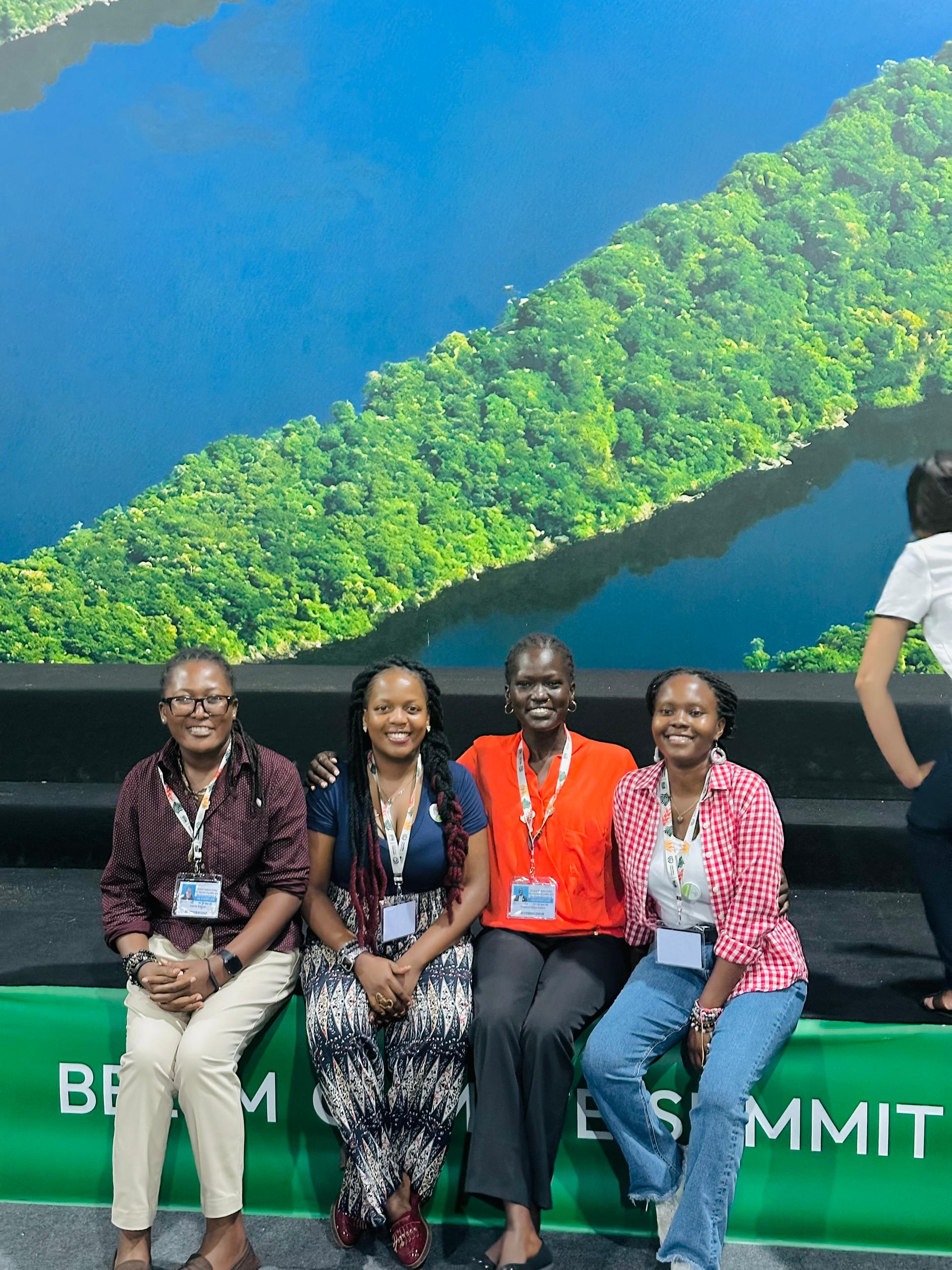
Participating in COP30 was one of the most transformative experiences of my life. As a young Ugandan deeply committed to environmental stewardship, standing on a global stage where climate decisions are shaped reminded me of both the weight of our challenges and the power of youth voices in creating real change.
Coming from Uganda a country already feeling the sharp edges of climate impacts through floods, erratic rainfall, food insecurity, and shrinking wetlands I arrived at COP30 determined to ensure that the realities of African communities were neither overlooked nor generalized. What struck me most was how strongly the stories of vulnerable nations resonated with others across the globe. Despite our different backgrounds, we shared a common desire to push for climate justice, resilience, and meaningful action rather than promises.
I engaged in moderating sessions but also was a panelist for several side events with an aim of amplifying the voices of the youths and women specifically, I saw firsthand how complex and slow global climate diplomacy can be. Yet I also witnessed moments of hope: youth-led sessions influencing policy discussions, Indigenous groups shaping biodiversity commitments, and grassroots activists offering practical solutions rooted in lived experience. I felt proud to represent girls for climate action—a movement that is innovative, resilient, and unwilling to stay silent on climate justice.
COP30 also reinforced an important truth for me: climate action is not only about governments. It is about communities, young entrepreneurs, researchers, farmers, and students who turn ideas into action. I returned home inspired to strengthen environmental advocacy engage more young people in climate literacy, and contribute to sustainable initiatives that reflect Uganda’s priorities—renewable energy, resilient agriculture, wetland protection, and green innovation.
Above all, COP30 reminded me that although Uganda contributes little to global emissions, our voice matters. My participation was not just personal growth but a responsibility to carry home the momentum, knowledge, and networks that can help shape local solutions.
As I reflect on my journey, I am filled with gratitude, determination, and a renewed sense of purpose. The climate crisis is overwhelming, but so is our collective potential. I left COP30 believing more than ever that young Africans are not the leaders of tomorrow—we are leaders now.
I extend my sincere gratitude to the Open University for all the support rendered to ensure that I participate meaningfully.
Youth and COP30: At the negotiating table or in the ante room? – by Alison Fox, The Open University
“We are going to bear the brunt, so we need to stay at the forefront of leading the world in thriving not just surviving.” (Saher Rashid, youth moderator, Youth-led climate forum session, 12th November 2025.
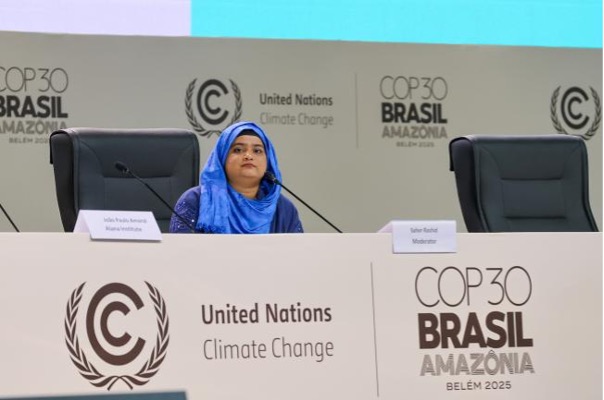
Youth-led forum moderator Saher Rashid. Photo by IISD/ENB | Mike Muzurakis (https://enb.iisd.org/belem-un-climate-change-conference-cop30-18Nov2025)
Children and young people formed an undisclosed portion of over 56,000 delegates registered as attending the 30th Climate Change Conference Of Parties (COP30) in November 2025. This was declared by the President of the hosts Brazil as the People’s COP, due to its broad participation across different sectors of society (https://cop30.br/en/news-about-cop30/lula-calls-for-stronger-greenhouse-gas-reductions-and-emphasizes-broad-social-participation-at-cop30).
Young people included in the run up to COP30
Opportunities for youth voice to inform intergenerational conversations about climate action started even before the formal proceedings of COP30 through the ‘Youth Speak to the World: Road to COP30’ program (https://cop30.br/en/news-about-cop30/youth-movements-present-cop30-priorities-to-conference-presidency) coordinated by Brazil’s National Secretariat for Youth and COP30 Youth Climate Champion, Marcele Oliveira. The aim was to include youth as part of the people included in COP30’s call for a Global Mutirão, a collective effort, against climate change.
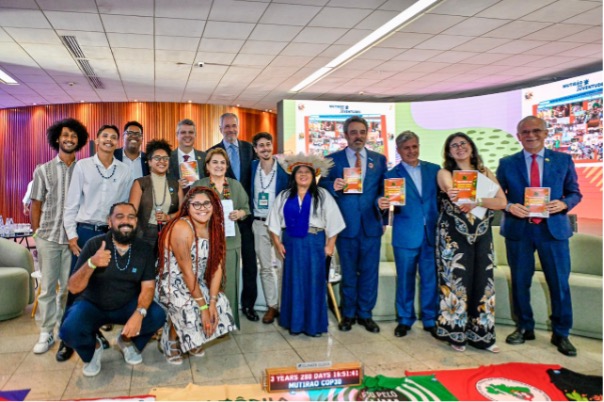
The Pre-COP meeting promoted intergenerational dialogue. Photo by Mateus Fernandes https://cop30.br/en/news-about-cop30/youth-movements-present-cop30-priorities-to-conference-presidency
Marcele explained that “Young people in Brazil and globally have demonstrated that solutions already exist—many of which are being led by children and youth. This was one of the key findings of our ‘Youth Mutirão’, which mapped over 230 youth-led initiatives worldwide. These projects address vital issues such as adaptation, climate justice, and racial equity.” (https://cop30.br/en/news-about-cop30/youth-movements-present-cop30-priorities-to-conference-presidency )
Leadership from an appointed youth champion
The role of ‘Presidency Youth Climate Champion’ was created during COP28 to strengthen the participation of young people in climate policy making. It is offered to a young person from the nation of that year’s COP, who are then mandated with a year’s activities to advocate for and mainstream young people's perspectives and voices in climate action and decision-making internationally. This COP saw a handover from Leyla Hassanova, from Azerbaijan, to Marcele Oliveira from Brazil
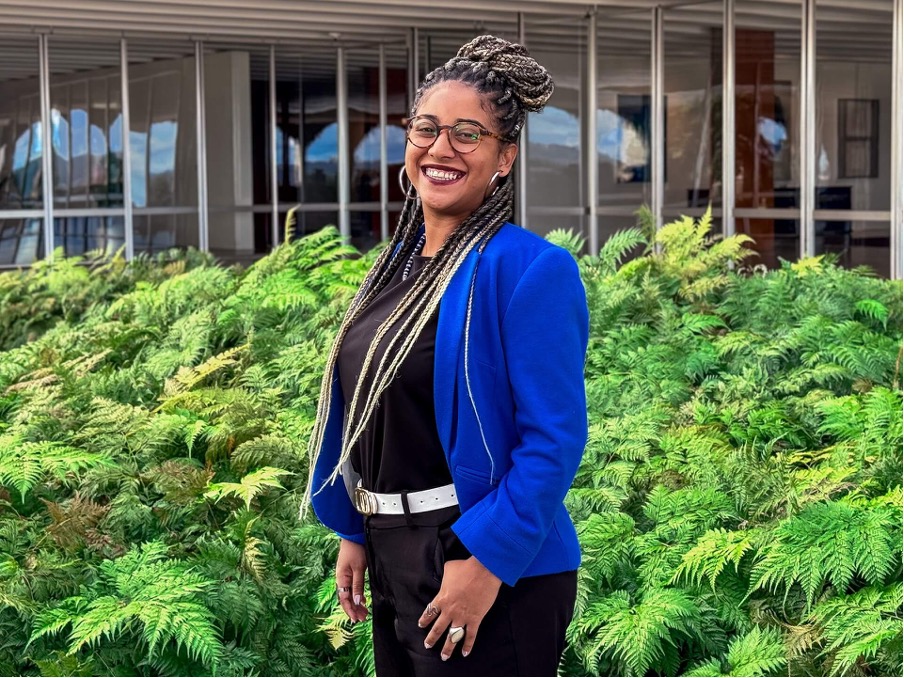
Photo by Gabriel Della Giustina / COP30 https://cop30.br/en/news-about-cop30/marcele-oliveira-the-mutirao-for-climate-change-is-a-shift-in-mindset
Marcele is a 26-year-old climate activist, appointed in April 2025 from 154 young people who responded to the call of Brazil’s National Youth Secretariat. She has attended COP 27, 28 and 29 and describes herself as a cultural producer and climate activist. Marcele identifies as a black woman who was born in Rio de Janeiro, Brazil. Her activism started with joining indigenous peoples in establishing the Parque Realengo Susana Naspolini in Rio De Janeiro (https://www.archdaily.com/1019058/realengo-park-susana-naspolini-ecomimesis-solucoes-ecologicas ), and moved on to becoming a member of the Climate Youth Negotiators program, and co-founding the coalition ‘O Clima é de Mudança’ (https://www.outlab.rio/cases/coalizao-o-clima-e-de-mudanca ).
Opportunities for youth engagement in UN decision-making
Between and during COPs, YOUNGO (https://unfccc.int/topics/action-for-climate-empowerment-children-and-youth/youth/youngo ) is a key vehicle for youth voice into climate decision-making as the official children and youth body of the United Nations Framework Convention on Climate Change (UNFCCC); one of nine constituencies. Established in 2009 this global network of young activists and over 200 youth Non-Governmental Organisations represents children and youth up to 35 years of age in climate policy decision-making through UNFCCC processes. YOUNGO representatives make official statements, provide technical and policy inputs to negotiations and engage with decision-makers at UN COPs, and promote local and national child and youth participation in climate change projects. This includes making contributions to key documents being considered at COP30: Nationally Determined Contributions (NDCs), a country’s commitment to meeting the goals of the COP26 Paris Agreement (https://unfccc.int/process-and-meetings/the-paris-agreement) , and National Adaptation Plans (NAPs), to prepare for and adapt to the impacts of climate change https://www.adaptationcommunity.net/nap-ndc/). As part of the COP29 Baku Adaptation Roadmap, 68 developing countries and 144 countries in total, now have some form of adaptation plan. At COP30 young people called for these to be operationalised at a sub-country-level identifying relevant stakeholders, ensuring youth, women, indigenous and marginalised communities are centrally consulted.
Youth engagement in COP30
Baked into the structure of COP30 there were four mandated youth-led climate forum sessions and an intergenerational dialogue meeting, as well as side events which focused on young people’s rights and contributions to socially just climate action through mobilising finance, and innovation through agroecology and sport. Attendees included young people from across the globe, with a particular emphasis on participation from indigenous peoples in Brazil and members of YOUNGO organisations. From the UK representatives travelled from the University of Birmingham (https://www.bbc.co.uk/news/articles/ckg1xjz419lo). Pupils from two schools in Monmouth, Wales joined by livestream as part of a global event for a deforestation-free future (https://www.hmc.org.uk/case-studies/monmouth-pupils-inspire-global-action-at-cop30/) and two Open University students - Liz Atherton and Sophie McCool. participated as official COP30 virtual observers.
Meanwhile, mock COPs were being held locally, simulating COP activities in Brazil, such as 80 pupils across nine schools in South Wales meeting at the Temple of Peace in Cardiff https://wales.britishcouncil.org/en/about/press/pupils-across-south-wales-lead-climate-crisis-talks-cardiff-cop30-negotiations and, supported by the OU Scotland, schools across the Highlands and Islands region of Scotland culminating in an event at the Inverness Highland Council https://highlandoneworld.org.uk/projects/mock-cop-27/
Young people’s demands at COP30
COP30 was particularly focused on moving on adaptation and the strong and clear voice from young people was how this needs to be locally driven, funded and co-created. So, what did the youth representatives at COP30 call for? In the youth-led forum sessions, they were heard to call for:
- International, multi-lateral collaboration
- Resilience as a moral and cultural, as well as technical skill
- Drawing on local knowledge and wisdom, alongside modern mechanisms and innovations
- Co-creation across peoples and generations
- Aspiring to harmony
- Moving from policies to sustainable crops and livelihoods
The intergenerational session moderator on 13th November 2025 began by explaining how ‘youth continue to shape what this transition must look like, including through activism, renewal and support for reclaiming identities and lost practices’. In conclusion the adult moderator called for elders to train the youth on conservation and natural cultural approaches, helping them to protect local languages to retain communication across generations and link the traditional with eco-cultural and agro-enterprise which can be taken forward with the energy and vision of young people in communities.
If we listen hard, what do we hear from young people?
However, if we have the privilege of hearing the voice of youth from across the globe, and we listen to all that they say not just what we want to hear, it is not as shiny and hopeful as we are led to believe from the structures in place. They are angry, nay furious, frustrated and indignant about the roles they play between and during COPs. In the intergenerational meeting, the floor was given to a first nation, two-spirit young person who called the audience to acknowledge the youth suicide epidemic as an indicator of the disconnectedness of youth - whether queer, black, indigenous or otherwise disenfranchised. They wanted us to recognise that youth, not only by inheriting the problems of prior generations but also by experiencing its impacts particularly severely, are in a time of despair. Even when given the structures to ‘speak’ the young people are accusing their elders of tokenism. This has become termed “youth washing”, whereby their presence at globally important meetings is celebrated, whilst their demands are minimised or ignored. “Young people are being shown but not heard. At least in the decisions that matter.” (https://www.climaterealityproject.org/blog/youve-heard-greenwashing-what-youthwashing) The Conversation interviewed 22 children and youth climate advocates from different countries, aged 11 to 29 at the time they attended (or tried to attend) a COP meeting. A 23-year-old reflected ‘I was given a ticket and a place to stay, but no one really prepared me for the labyrinth of negotiations and bureaucratic hurdles inside COP.’ (https://theconversation.com/cop30-children-and-young-people-at-climate-talks-seen-photographed-but-not-allowed-to-decide-anything-266832).
In the Conversation’s research young people explained how they felt constantly photographed, sidelined to events which were not the decision-making spaces, and unreasonably expected to represent all youth from their community or nation (https://theconversation.com/cop30-children-and-young-people-at-climate-talks-seen-photographed-but-not-allowed-to-decide-anything-266832).
Young people haven’t given up: We shouldn’t give up on them
We should not lose hope. Young people are already the hope of the future and already innovating and driving change. Examples were given again and again during the sessions in which they were represented or represented themselves as inspirational young people, driving positive innovations for climate adaptation in their communities and joining with their peers and other partners to protest and demand changes for climate justice. In the climate empowerment session on 15th November 2025, Felix Finkbeider, founder of Plant for the Planet Foundation (https://www.plant-for-the-planet.org/about-us/) , began his opening statement by referring to a young person in Germany, present at COP30, who started to plant trees, decided to study a law degree, and then joined a group approaching Pacific Island State governments and then African governments mobilising youth which resulted in a landmark International Court of Justice ruling – Plan for the Planet (https://issafrica.org/iss-today/icj-climate-opinion-shows-the-power-of-youth-and-global-south-solidarity).
Using the platform of COP30, the outcomes of Youth-led climate forums were heralded. For example, from forum session I about their contributions to a just transition were to advocate for stronger political inclusion so that young people could play their role in: being able to help close Africa’s major energy access gaps through shaping people-centred practices; helping decision-makers turn concepts to concrete actions for those communities impacted by fossil fuel combustion, yet under-represented, such as in Chile and leveraging finances to help with its equitable distribution to front-line communities and helping negotiators show courage and fairness for long-term, inclusive resilience.
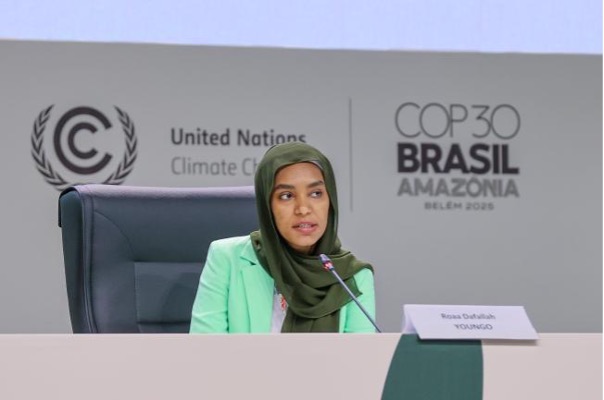
Roaa Dafaallah, YOUNGO. Photo by IISD/ENN: Mike Muzurakis (https://enb.iisd.org/belem-un-climate-change-conference-cop30-18Nov2025)
Roaa Dafallah, representative for YOUNGO, called everyone to get behind the new presidency youth champion, to join YOUNGO and to make a difference: “We are here to convey your voices. We are today and tomorrow leaders. We are outside planting, inside adding our voices to planning our future. Youngo represents youth voices and celebrates their role in UNCFCC processes over the last 15 years. We appreciate this is a space of privilege but also those here are showing the depth of their commitment.” The protests led by young people at COP30 convey their own messages.
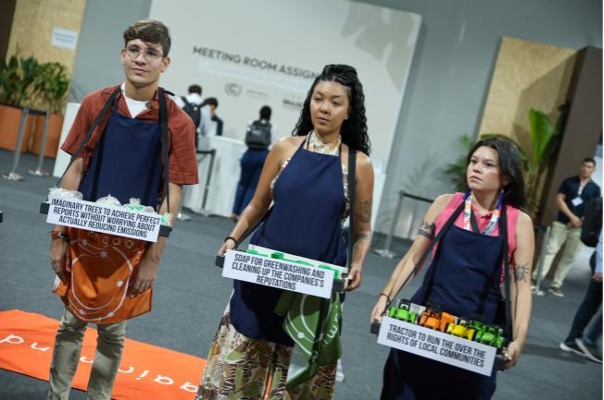
Youth protests at COP30. Photo by IISD/ENN: Mike Muzurakis (https://enb.iisd.org/belem-un-climate-change-conference-cop30-18Nov2025)
Contact our sustainability team
For more information contact our sustainability team.


Explore

Undergraduate
Postgraduate
Policy
-
Follow us on Social media
-


