
The virtual courtroom
Technology is transforming the administration and practice of law. In response, the Open Justice Centre has developed a virtual courtroom using virtual reality technology that allows students to enter an immersive environment designed to look and feel like a real courtroom.

Unlike a standard video call, the virtual courtroom recreates the physical and procedural features of court, including the layout of the room, virtual seating, the judge’s bench, and the experience of standing to address the court. These elements are deliberately designed to simulate the formality and atmosphere of real court proceedings as closely as possible.
Even relatively simple forms of virtual reality technology, such as interactive 3D environments accessed through a computer, can effectively communicate complex information and generate a strong sense of presence. By enabling users to experience court processes first-hand, the virtual courtroom can improve understanding of the function of courts and increase awareness of legal procedures. This has particular value in supporting public legal education and access to justice.
SCiLAB has supported several research projects involving the virtual courtroom. In 2022/2023, a project enabled law students to participate in a virtual moot, which is a simulated court hearing and demonstrated that the environment was effective in allowing students to interact and operate within a simulated courtroom setting. The findings generated valuable student feedback, identifying areas for improvement and suggesting changes to enhance the virtual courtroom experience for future users. Building on this work, colleagues in policing explored the effectiveness of the virtual courtroom with police officers during the 2023/2024 academic year. This project found that the virtual courtroom supported police officers in developing and enhancing their evidence-giving skills, highlighting its potential value as a professional training and development tool. The team have also been involved in a Pan University project with colleagues in WELS and LDS, building on findings from these projects, a research project involving social work students alongside policing and law students participated in a series of mock trials that demonstrated the value of the virtual courtroom in supporting interdisciplinary teaching methodologies.
As part of the development of the virtual courtroom project, SCiLAB supported the team to develop an interactive simulation incorporating escape-room-style challenges and quizzes designed to enhance first year criminal law students’ understanding and application of key legal concepts. The project explored whether a simulation-based approach could help consolidate student learning while increasing engagement with criminal law. By situating students within a virtual courtroom environment, the simulation effectively linked legal theory with practice, enabling students to engage with the subject matter in a more meaningful and contextualised way.
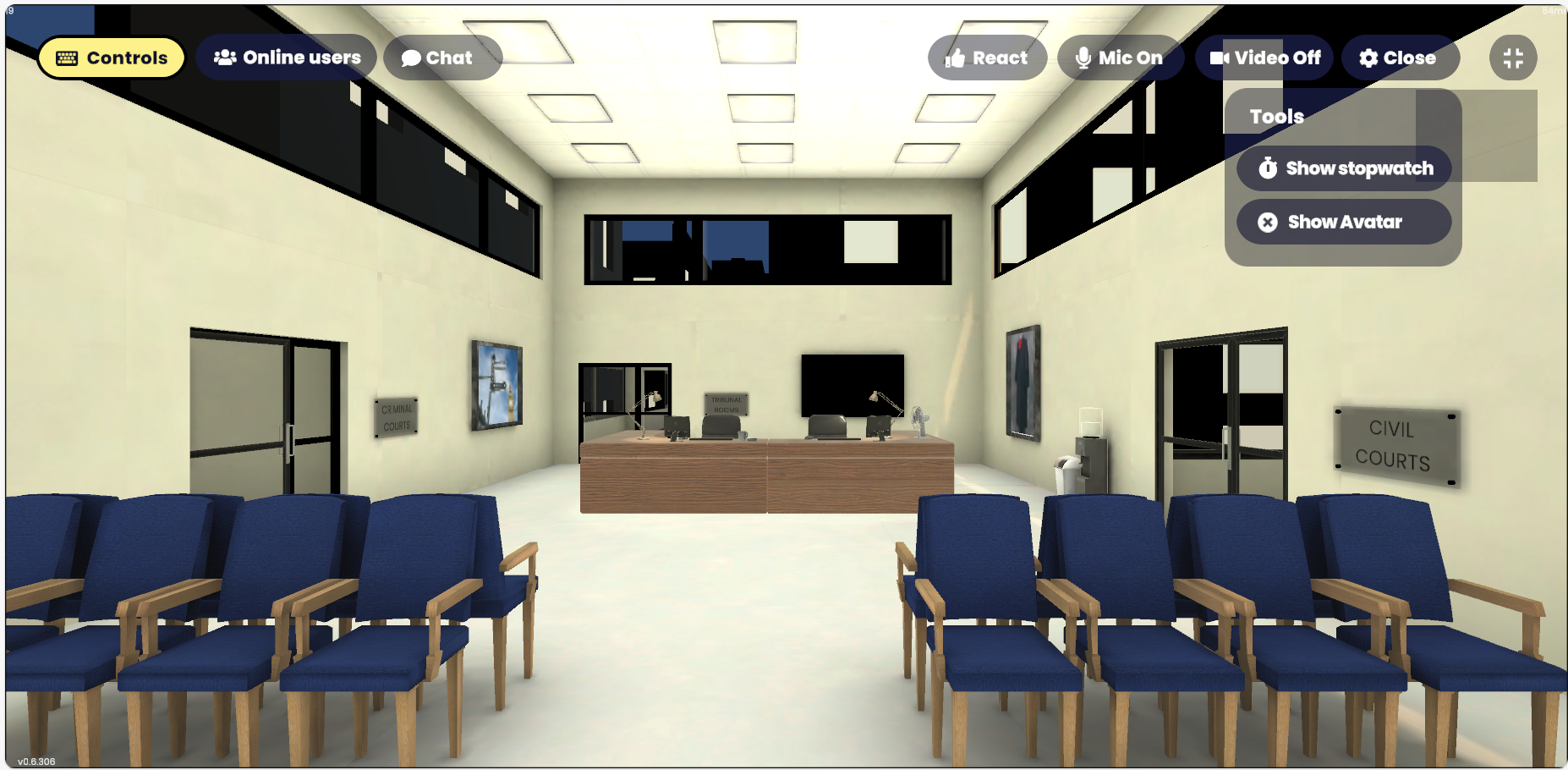
Gamification offers a powerful form of experiential learning, providing students with opportunities to engage with legal concepts through innovative and interactive methods. Simulated experiences can be designed to address multiple learning outcomes, allowing students to test and develop problem-solving abilities, initiative, and determination. In doing so, the findings from the project suggested that simulation expanded opportunities for students to build a range of essential skills, including legal reasoning, substantive knowledge of criminal law, persistence, and confidence in applying the law in practice.
The findings from the research projects have been disseminated both nationally and internationally with plans to embed the virtual courtroom within curriculum and explore its use to support professional training.
For more information you can watch a short video about the team’s vision for the virtual courtroom or visit The Virtual Courtroom homepage. .
Outputs
Books
- Jones, E., Ryan, F., McFaul, H., Vince, D., Kizilkaya, L., and Daniels, J. (2023) Using Virtual Reality to Enhance the Law School Curriculum, in Teaching Legal Education in the Digital Age, Edited by Thanaraj, A and Gledhill, K. Routledge
- Jones, E., Ryan, F., Thanjari, A. and Wong, T. (2026) ‘Technology and Legal Practice: Becoming a Digital Lawyer. Second Edition, Routledge
Conferences
- ‘An exploration of the virtual courtroom for professional training’ at the Cyber-Justice Europe Conference organised in partnership with Institute Robert Badinter, University of Montreal’s Cyberjustice Laboratory, at the Council of Europe, European Commission for the Efficiency of Justice (CEPEJ) Strasbourg, December 2025.
- “Utilising a virtual courtroom to facilitate simulated court hearings to enhance the teaching and learning for law, policing, and social work students, In: 16th International Conference on Education Technology and Computers, 19 Sep 2024, Porto, Portugal.
‘It's a moot point: exploring the use of a virtual courtroom in legal education.’ Global Alliance of Justice Education and International Clinical Legal Education Conference, University of Stellenbosch, South Africa, December 2022.
Meet the team

Dr Francine Ryan
Francine is a Senior Lecturer in Law and Director of the Open Justice Centre, she is a qualified lawyer and legal academic and is Module Team Chair of W360: Justice in Action.
Her work focuses on bridging legal education and practice, with an emphasis on advancing access to justice through innovative teaching and research.

Dr Ahmed Kadry
Ahmed is a Senior Lecturer in Policing Organisation and Practice and the Qualification Lead for the Police Constable Degree Apprenticeship where he works closely with police partner forces to ensure new officers reach full operational competency.
His research and scholarship interests are centred on education technology tools that facilitate learning and skill acquisition for police officers.
.jpg)
Simon Hull
Simon is a Senior Lecturer in Work Based Learning and works in the Department for Policing. He is the Qualification Lead for the Police Community Support Officer Apprenticeship, and the Module Team Chair of modules across the policing programme.
Simon is a Senior Fellow of the Higher Education Academy and a Certified Member of the Association of Learning Technology. His research interests are focused upon educational technology, and he is pursuing a Doctorate of Education exploring Preparing to give evidence: Experiencing a virtual reality courtroom in support of police learning.

Jon-Paul Knight
Jon-Paul is the manager of the Open Justice Centre. He is an experienced project manager and senior administrator specialising in curriculum production across law, social justice, and business education.




Explore

Undergraduate
Postgraduate
Policy
-
Follow us on Social media
-


