
The contribution of the MBA to meaningful work: how purpose and professional development shape leadership trajectories

In a world marked by rapid change, complex organisational challenges, and growing public expectations of responsible leadership, the notion of ‘meaningful work’ has come to occupy a central place in management and higher education. Across industries, professionals increasingly seek careers that not only offer advancement but provide a deeper sense of purpose, authenticity, and contribution to society.
MBA programmes - long positioned as career accelerators - are being re-evaluated through this lens. Beyond skills and strategy frameworks, can they help leaders cultivate meaning in their work? Can postgraduate business education shape identity, values, and purpose in ways that influence how individuals lead?
A multi-stage research project explored precisely these questions, examining how 15 MBA students understood meaningful work and how the programme contributed to their sense of purpose, leadership capabilities, and professional development. The findings offer valuable insights not only for one institution, but for the wider higher education landscape as it considers how to prepare leaders for an uncertain and ethically demanding world.
The rising demand for purpose in leadership
Management research increasingly points to meaningful work as a crucial predictor of engagement, well-being, professional fulfilment, and ethical decision-making. Studies suggest that individuals who perceive their work as meaningful are more likely to demonstrate resilience, innovation, and leadership effectiveness (Van Wingerden and Poell, 2019). In the context of postgraduate education, this raises a compelling question: ‘what role should universities play in helping professionals find and cultivate meaning in their career trajectories?’
MBA students in this study articulated meaningful work as work that “makes a difference”, aligns with personal values, and contributes to broader organisational or societal goals. For many, meaningfulness was linked with self-awareness, ethical practice, and clarity of impact - qualities central to modern leadership.
How an MBA shapes professional capability and identity
The research found that the MBA significantly enhanced students’ confidence, strategic thinking, and ability to engage with complex organisational decisions. Participants consistently described a shift in how they perceived themselves professionally.
Many noted that the MBA provided them with ‘legitimacy’ - a sense of credibility that enabled them to contribute more effectively in senior discussions. This aligns with wider scholarship highlighting how postgraduate study can strengthen professional identity and agency.
One participant explained that the programme “broadened my voice in cross-functional settings”, highlighting the connection between theoretical insight and practical confidence. These experiences suggest that MBAs do more than transfer knowledge - they enable identity formation, supporting students in reframing their roles and capacities as leaders.
Purpose, values, and ethical reflection
One of the most significant findings of the project was the role of reflection. Structured reflective activities, such as case analysis, leadership self-assessments, and professional journals, encouraged students to examine their values, ethical dilemmas, and the societal implications of their work.
This aligns with literature emphasising that meaningful work is not solely a function of job tasks but emerges from an ongoing internal dialogue around identity and purpose. Several participants described a heightened awareness of whether their current organisation aligned with their values, sometimes prompting contemplation of career or sector transitions. Such reflections reveal an important dimension of MBA education: it can serve as a catalyst for purposeful career realignment, not simply progression.
Leadership development beyond technical skills
The study highlighted that students saw leadership as increasingly relational, values-driven, and impact-oriented. MBA learning strengthened their sense of autonomy, competence, and ability to navigate cross-functional challenges. Importantly, participants did not conceptualise leadership only in hierarchical terms. Many embraced inclusive, collaborative, or purpose-led approaches, reflecting the evolving expectations placed upon leaders in contemporary organisations. This suggests that MBA programmes can play a vital role in promoting multidimensional leadership models aligned with meaningful work, particularly when they integrate reflective practice, experiential learning, and societal considerations into the curriculum.
From classroom to practice: the importance of applied learning
Participants consistently praised opportunities to apply theory in real organisational settings. Whether through leadership simulations, change projects, or workplace initiatives, experiential learning helped translate abstract concepts into lived professional growth. These experiences not only reinforced academic insights but enabled students to see their impact more clearly, strengthening their sense of purpose and capability. For many, these applied projects provided turning points in their leadership journey, demonstrating the importance of embedding experiential pedagogies in postgraduate business education.
Implications for higher education
The findings of this project speak to a broader shift in postgraduate education. As universities consider how programmes can prepare learners for an unpredictable world, several recommendations emerge:
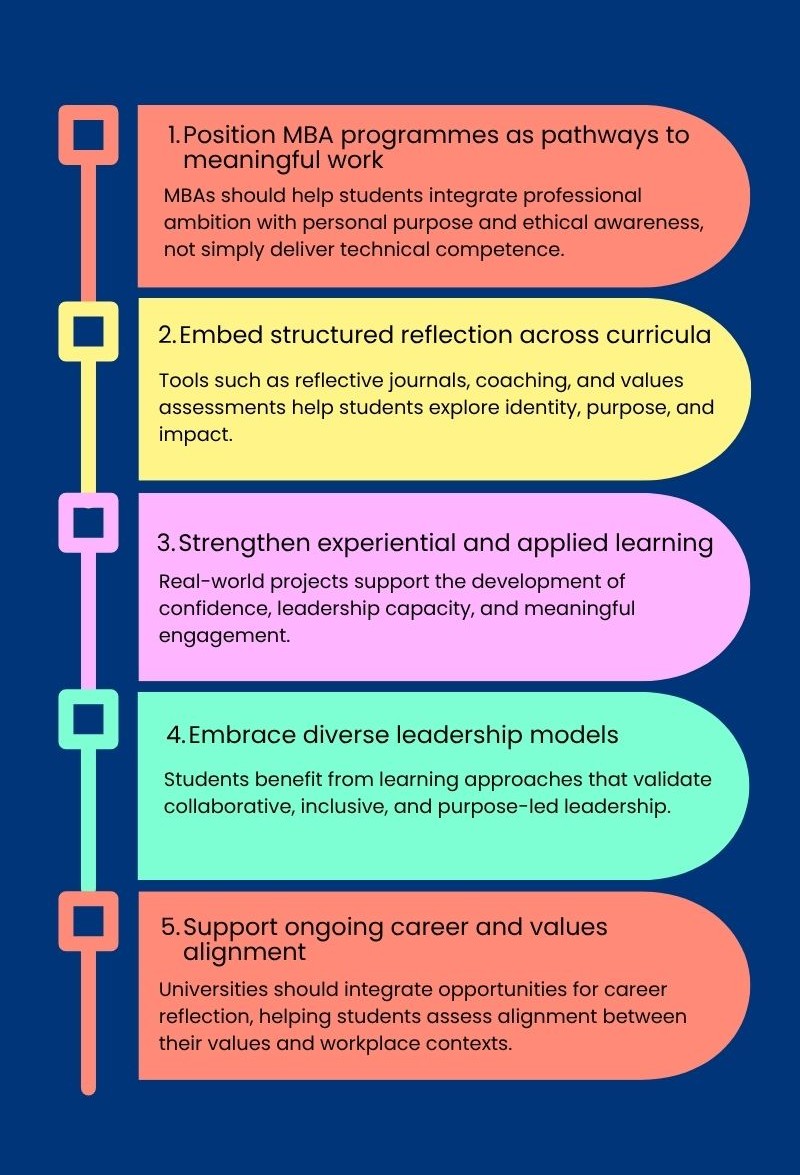
In an era where business schools are reimagining their purpose, these insights highlight the growing expectation that postgraduate learning should foster not just competence, but meaningfulness, authenticity, and societal contribution.

Dr Sara Calvo Martinez
Sara is Senior Lecturer with the Department for Public Leadership and Social Enterprise (PULSE), working in the area of sustainability, leadership development, social enterprises, and social innovation. Her research examines how education can foster purpose-driven organisations and sustainable leaders capable of navigating societal challenges.

Professor Jacqueline Baxter
Jacqueline is Professor of Public Leadership and Management with expertise in governance, digital education, and professional identity transformation. Her work explores how learning environments shape leadership practice in complex public and organisational settings.
Declaration on Generative AI
Please note, ChatGPT has been used as a support tool to enhance the writing and language quality of this blog article, originally created December 2025.
References
Van Wingerden, J., & Poell, R. F. (2019). Meaningful work and resilience among teachers: The mediating role of work engagement and job crafting. PloS one, 14(9),1-24.


Explore

Undergraduate
Postgraduate
Policy
-
Follow us on Social media
-


