
News
AstrobiologyOU 2024-2025 Annual Report
We are excited to share the release of our 2024-2025 Annual Report!
It's been an incredible year and we cannot wait to see what 2026 will bring.
Once Upon a Time in Space
A new 4 part BBC/OU co-production, Once Upon a Time in Space, started last night (Monday 27th).
The series tells the human story behind the space race and was created with insights from AstrobiologyOU's Dr Victoria Pearson and Dr Marjan AjevskI, as well as Professor Mahesh Anand from the School of Physical Sciences.

PhD vacancies now open!
Four PhD vacancies are now open in AstrobiologyOU for October 2026 start.
These project are offered via the Central England NERC Training Alliance (CENTA).
You can find more information about the projects and how to apply on our 'PhDs' webpage, or on the CENTA website.
Come and work with us!
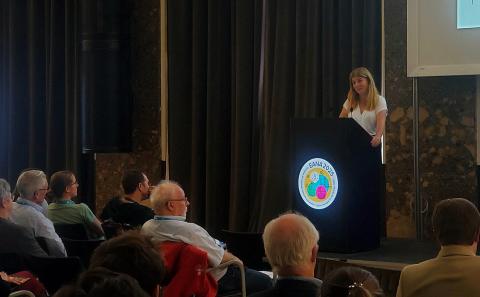
Prof Olsson-Francis elected EANA President
We’re proud to announce our Director, Prof Karen Olsson-Francis, has been elected President of the European Astrobiology Network Association (EANA).
Since its founding in 2001, EANA has coordinated astrobiology research in Europe, bringing together researchers from multiple disciplines.
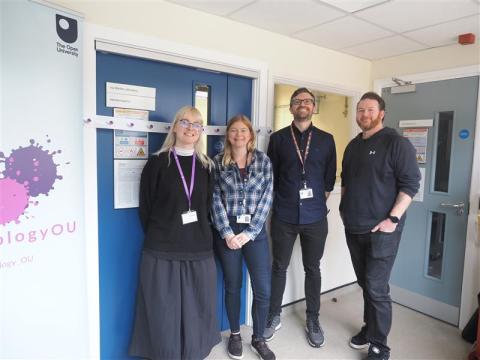
New Icy Worlds Laboratory open!
We are excited to have officially opened the new Icy Worlds Laboratory here as part of AstrobiologyOU! In this lab, we will conduct experiments at extremely low temperatures to help understand processes at our Solar System's icy worlds including Jupiter's moon Europa and Saturn's moon Enceladus.
A major focus of the team's work is on how liquid water originating from the deep subsurface oceans of these worlds is transformed as it freezes, and how any dissolved salts or organic compounds might be affected by this process.
Mars came to Campus
In late July, the International Festival: Milton Keynes came to campus for three days, welcoming visitors for an inspiring space-themed experience.
The Open University hosted Luke Jerram’s Mars in the courtyard of Berrill, from the 18th to 20th July. The breathtaking 7-metre installation was open and free for all to view, including many of our own staff, students and stakeholders.
New paper unveils key insights into the crust dynamics and recycling mechanisms of Venus
Dr. Julia Semprich and a team of researchers have published a paper in Nature Communications exploring the composition and behaviour of Venus’s crust to better understand its geological evolution. The team examines how mineral transitions, rock density, and melting processes shape the planet's basaltic crust, providing details about its thickness, recycling mechanisms, and tectonic activity.
Congratulations Professor Geraint (Taff) Morgan!
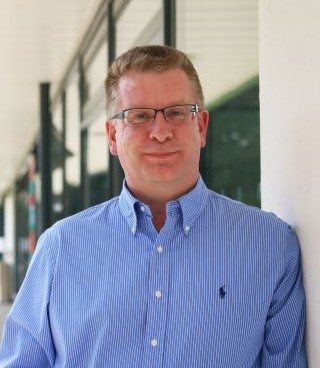 After an incredible career packed with achievements, Taff (Geraint Morgan) will be leaving AstrobiologyOU to head off to new adventures as Professor of Analytical Chemistry at the University of Southampton. Known for his talent in analytical chemistry, Taff has spent years cracking tough problems, both in space and here on Earth.
AstrobiologyOU 5 Year Report
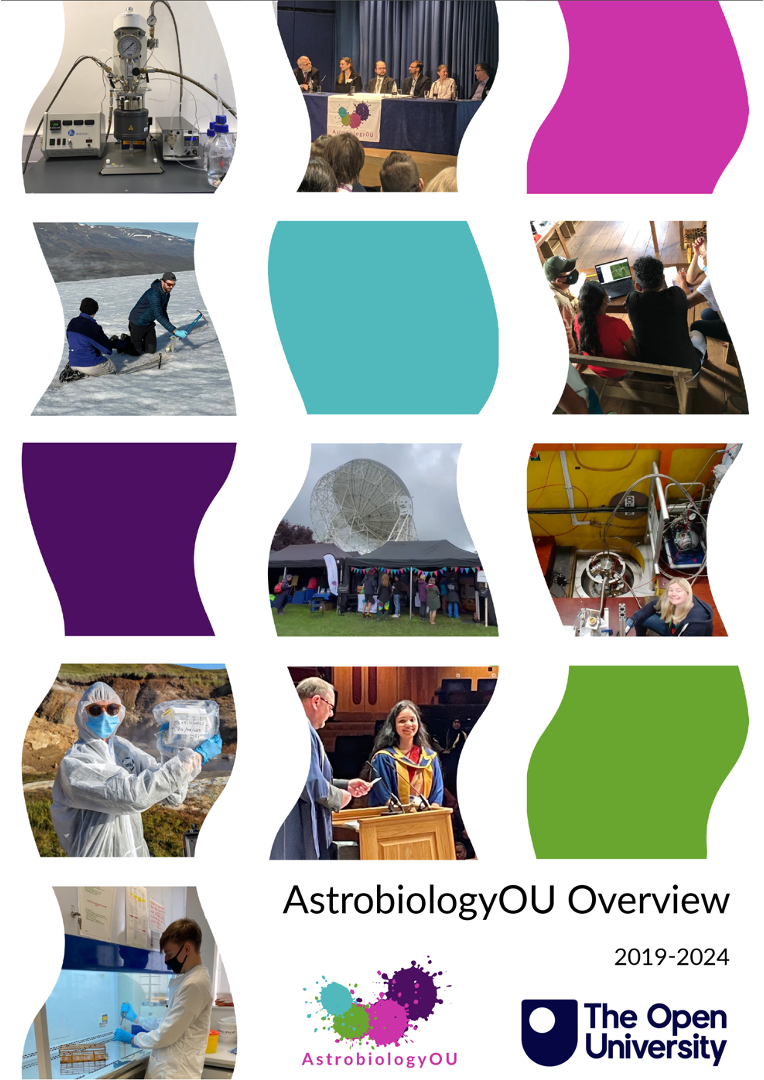
To mark the five year anniversary of our launch, we are thrilled to share with you the AstrobiologyOU 5 Year Report.
https://bit.ly/AstrobiologyOU19-24
Congratulations and thank you to everyone who’s collaborated, contributed, participated, funded, helped and supported the group!
PhD Opportunities Open For Applications
We have new PhD opportunities open for application with members of AstrobiologyOU.
For the details on the project and to find out where the information to make an application can be found visit our "Work With Us - PhD" page


Explore

Undergraduate
Postgraduate
Policy
-
Follow us on Social media
-


