
My Summer Internship Researching Mars
Hello, my name is Keeret! I have just completed my first year at the University of Warwick, studying Chemistry. This year helped me recognise my passion for astrochemistry and planetary science, through a lecture slide on astrochemistry and radiation, and through watching Project Hail Mary at the student cinema! I also attended some lectures on the Global Astrochemistry Lecture Series (GALS), so I knew I had to apply for this internship when I saw the opportunity come up. Being able to conduct real research to support future missions to Mars and the prospect of learning more about martian mineral compositions sounded incredibly exciting- a chance to step into fields such as geology, physics, and planetary science. I was eager to see how this research would be different to what I had been doing during labs in my first year of studying Chemistry.
My internship started in July - I am lucky that I was able to personalise the project to my interests in learning more about Mars and understanding data from the rovers currently exploring it. The overall goal of this project was to use a field spectrometer to take measurements of analogue samples at the Open University Mars Rover Simulation, and to analyse this data to identify the type of rocks and minerals present. This spectral dataset will be used in training simulations for doctoral researchers within the Exodocs programme, supporting the ESA’s ExoMars Rosalind Franklin rover. The students will be able to control the training rover, take measurements, and compare their results to this dataset. Simulations are so important because, in missions such as the ExoMars mission, time cannot be taken for granted due to the rover’s limited energy supply. Being able to be a small part of the preparation for the ExoMars mission has been such an interesting and eye-opening experience.
My first week consisted of reading relevant introductory book chapters and writing a literature review on the use of VNIR spectroscopy for identifying mineral compositions on Mars. I am very grateful for my supervisor, Dr. Julia Semprich, for helping me to adapt to this project as a Chemistry student and for providing me with extensive background reading. Julia not only explained the background of this project to me but also guided me through some basic geology principles. This was very helpful and made this geology-based project seem less daunting as a Chemistry student. I learnt a lot about the different types of rocks and minerals, the advantages and limitations of spectral data from rovers, and how to analyse and identify key spectral features. This was highly useful for the following weeks of the project.
In the second week, I travelled to The Open University campus in Milton Keynes- I was shocked to see the wide variety of facilities and was also surprised by the large size of the campus. Here, I met Julia and my co-supervisor, Susanne Schwenzer, in person. One key moment was when Susanne handed me a heavy lump of metal and later revealed that it was 4.6 billion years old!
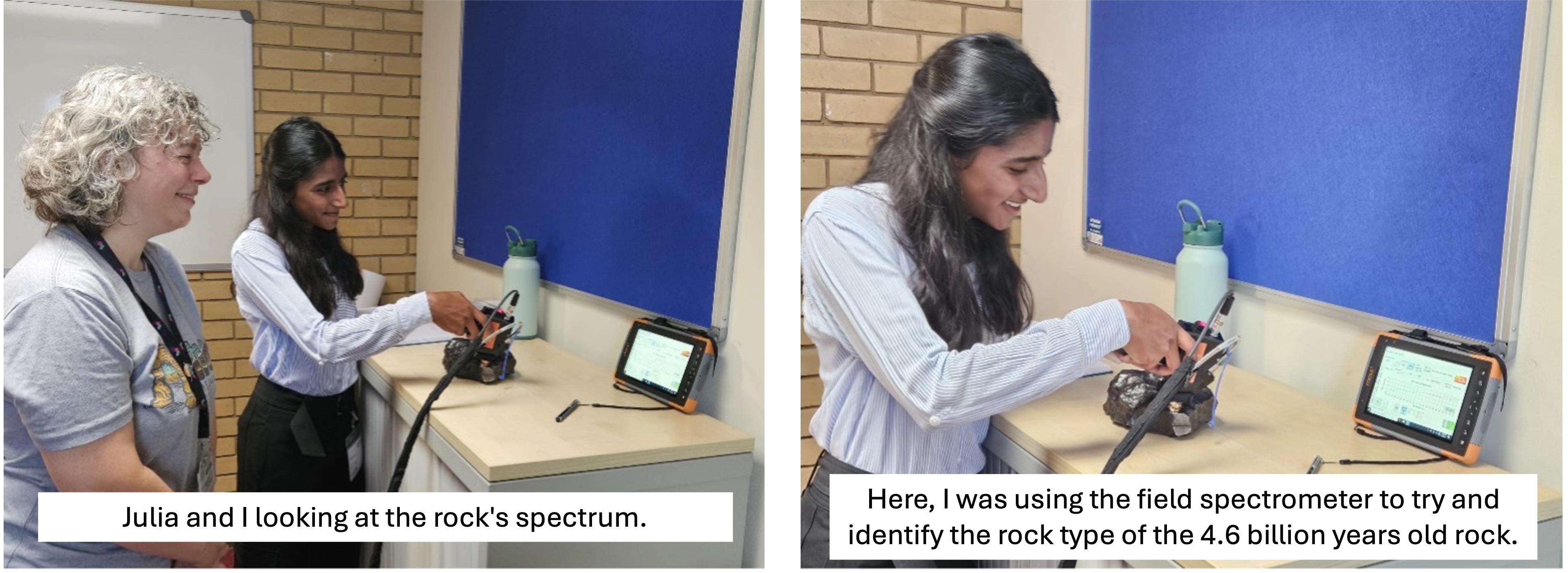
he day consisted of going to the Mars Yard and taking measurements of all the analogue samples there. I learnt how to use the field spectrometer and how it works- I can understand why it is used on rovers due to its simplicity and efficacy. I was also able to talk to a few PhD students and researchers about their career paths and research projects, which was highly inspiring and useful. For the next part of this project, I analysed all this data by plotting spectra, identifying trends, and finding reference spectra. This felt a bit like solving a puzzle- I had to use the image of the rock, its spectrum, and reference spectra to identify the types of rock present in the Mars Yard.
I managed to finish this part of the project earlier than expected, so Julia gave me the opportunity to use Perple_X to do some thermodynamic modelling using different mineral compositions. More specifically, I investigated garnet, a mineral recently found on Mars, to see under which conditions it forms on Mars. This was interesting, as it allowed me to learn how to use a completely new software and to further expand my Python skills. Despite there being a lot of trial and error, I found modelling to be rewarding, especially after obtaining P-T graphs showing garnet present! I am grateful for being able to learn how to use Perple_X, and for Julia’s extensive guidance.
Overall, I am incredibly thankful for the support and guidance I received at The Open University. My supervisor and co-supervisor, Julia and Susanne, made this experience enjoyable and tailored the project to my own interests. I have gained many skills, including field spectroscopy, data analysis, and thermodynamic modelling. I have finished this internship with much greater knowledge of the mineral compositions on Mars and the importance of spectroscopy. This placement has confirmed my interest in planetary science, and I’m excited to continue learning more about these fields and to further develop the skills I have gained. I will never simply just look at a rock again, now that I have learnt so much about rock types and mineral compositions. I am looking forward to keeping up with the ExoMars mission!
Written by Keeret Somel
Latest News
My Summer Internship Researching Mars
Hello, my name is Keeret! I have just completed my first year at the University of Warwick, studying Chemistry. This year helped me recognise my passion for astrochemistry and planetary science
- New publication from AstrobiologyOU
- Icy Worlds Research Featured on BBC's The Sky at Night
- Digital PCR: A Sensitive Approach for Measuring Microbial Contamination for Planetary Protection
- AstrobiologyOU academics reveal the hidden information in icy moon surface salts
- MoonRISE: OU receives grant to unite experts to protect the Moon through sustainable governance


Explore

Undergraduate
Postgraduate
Policy
-
Follow us on Social media
-


