
From Golden Retriever to Ghostbuster: My Summer Internship with AstrobiologyOU
During the summer of 2026 I’ve had the good fortune of joining AstrobiologyOU for a 6-week CENTA-funded Research Experience Placement (REP) under the guidance of Dr. Julia Semprich. In the best way, this internship brought out my inner Golden Retriever, particularly on the days I spent at the OU campus in Milton Keynes.
I started as a lost puppy - afraid to let Julia out of my sight, but fear quickly gave way to unshakeable enthusiasm and an eager excitement to get involved in anything and everything I could. I also had the sincere belief that everyone I met was a wonderful new friend. (Incidentally, much like a Golden Retriever I also shed quite a lot of blonde hair – but that isn’t particularly relevant here.)
The Project
The scope of the REP project Julia defined involved using a field spectrometer to collect data from basalt samples originating within Geitafell, an extinct 5-6 Ma Icelandic volcano bearing a fossilised hydrothermal system, then using said spectral data to determine the mineral composition and level of fluid-rock alteration experienced by different zones in the region. Given Mars’s principally basaltic crust and penchant for ancient volcanism and impact cratering, the results might then be applied to orbital spectrometer data to support identification and categorisation of similar hydrothermal processes where they may have occurred on the red planet.
6 weeks was allotted, which was ostensibly enough time to review some relevant papers, learn to use the field spec, categorise the collected data, and analyse the results. If lucky, maybe we’d even have a little time for some microscopy of a few sample thin sections.
That seemed like plenty – I’d used a real cross-polarising microscope only once and had never even heard of a field spectrometer, but I don’t think either Julia or I realised the insatiable joy-beast this project would unleash.
Red Boi
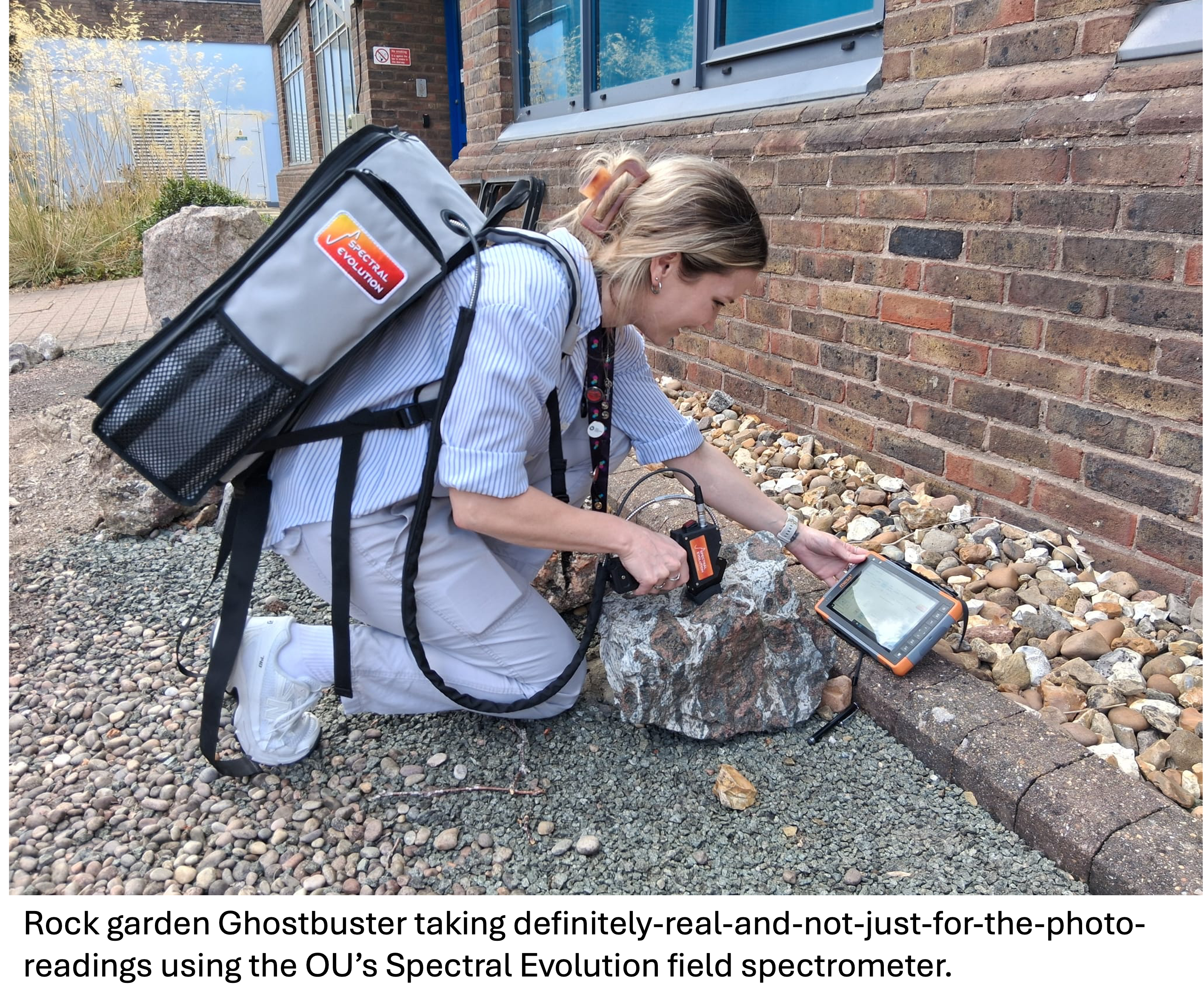
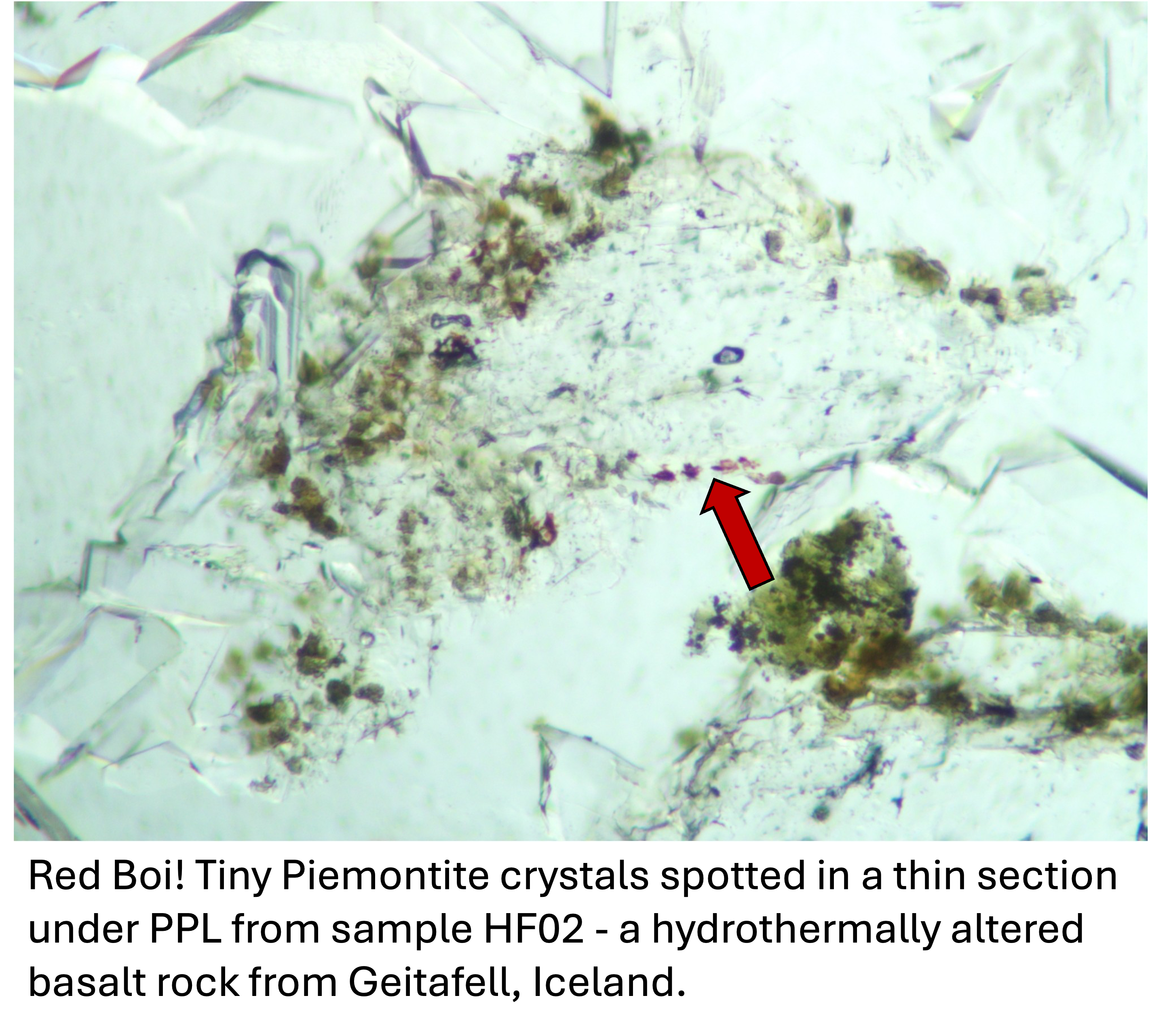
I quickly burned through most of the literature review in the first few days meaning we were able to complete the spectroscopic data collection and spend a day looking at some thin sections in my second week. The spectroscopy culminated in a definitely-not-staged photo of me looking like a slightly misguided ghostbuster trying to capture the spirits of the OU rock garden, and the microscopy resulted in my staunch determination to prove the existence of a tiny maybe-mineral, maybe-smudge-of-nothingness we dubbed “Red Boi”.
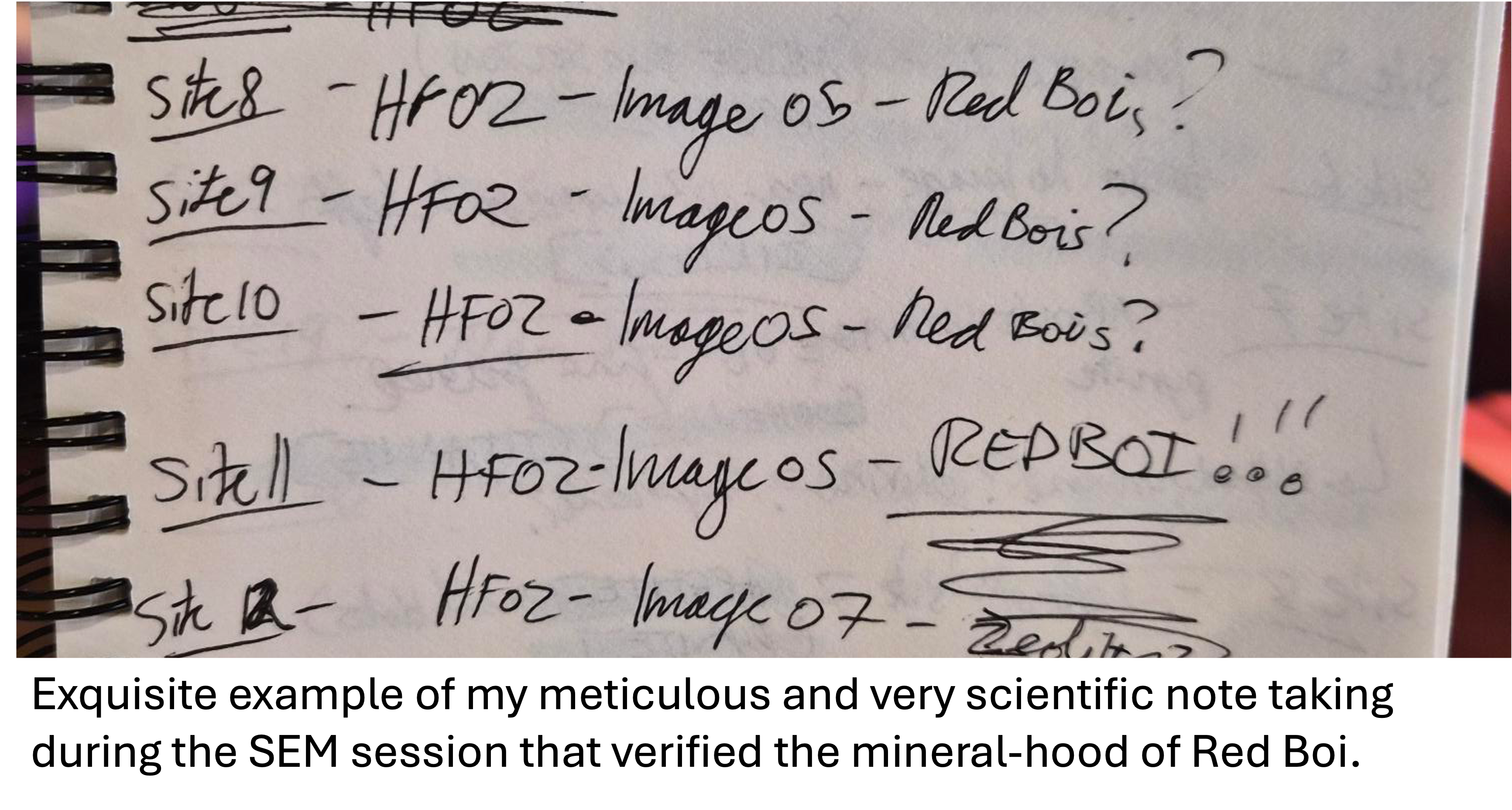
Realising I would jump at the chance to learn-see-do anything I might reasonably be permitted access to, Julia arranged some time with Dr. Lee White who graciously provided training and permitted use of the Scanning Electron Microscopy (SEM) to further analyse some of the samples down to the level of their elemental composition – including an attempted identification of Red Boi.
After three readings from the area around our tiny target revealed nothing of note we finally got a lock on the exact position of Red Boi, and to my excitement he was indeed his own little crystal. Red Boi was an epidote family mineral; expected in the samples as it commonly forms through the hydrothermal alteration of igneous minerals, with Julia having identified the green-coloured variety in a few thin sections already. But Red Boi, as the name may suggest, was red.
Again, despite my insistence that this Red Boi was special, he wasn’t unexpected. Piemontite, a red variant of epidote, is associated with low-temperature hydrothermal fluids such as those which would have permeated the Geitafell basalt. Regardless of his mundanity in the grand scheme of things, to me, his existence was a most exciting and important scientific discovery. My joy at confirming Red Boi was no mere smudge even overshadowed the later SEM identification of Vanadium Titano-magnetite in another sample; an arguably more interesting and inarguably more badass-sounding iron mineral.
The Tool
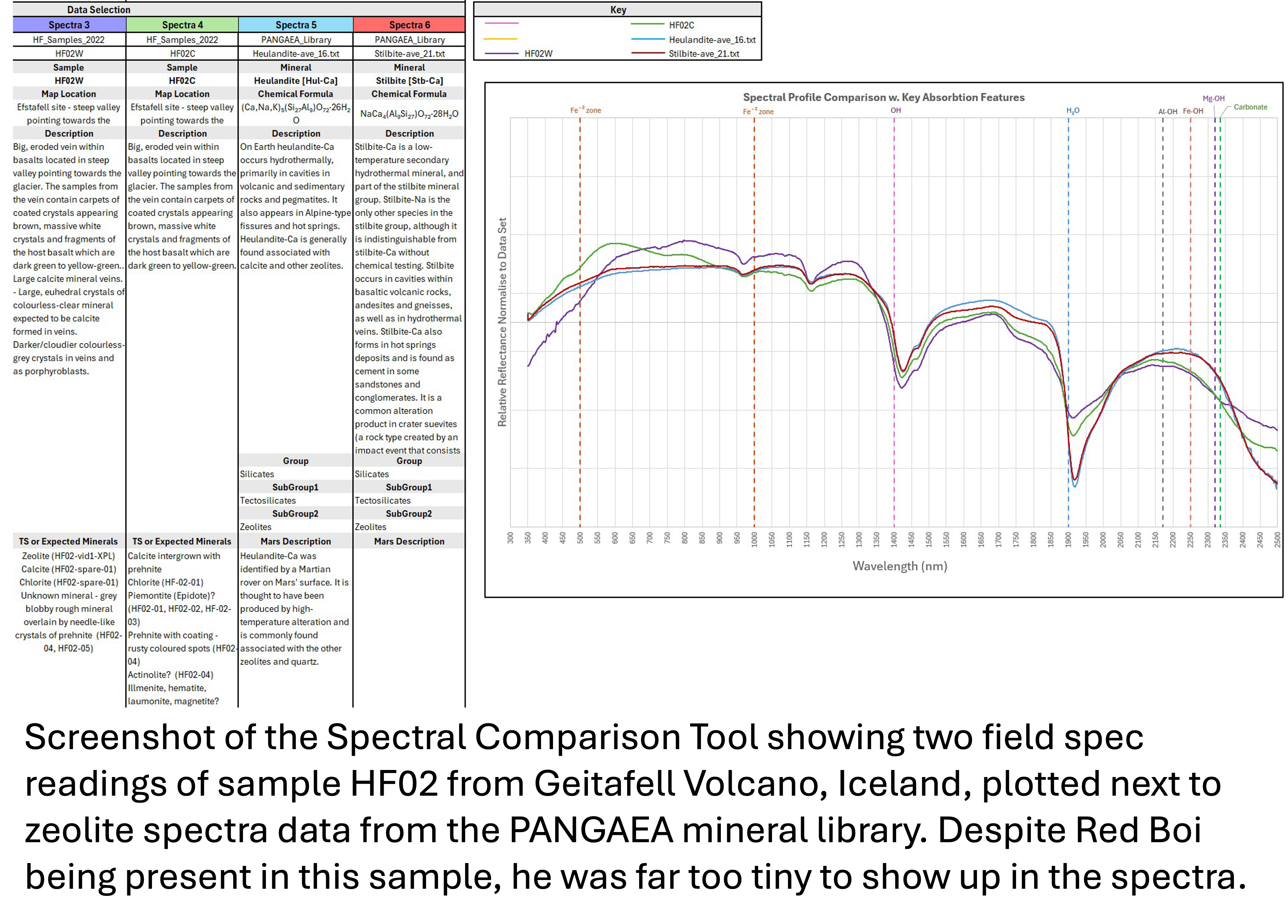
The days I worked remotely on the project were focused on processing sample spectral data so that it could be compared to publicly available mineral spectral libraries. This involved transforming and normalising both sample and index data sets using python so they could be imported to excel for analysis.
To make the comparison part easier I set up a dynamic scatterplot where any library mineral and any sample could be selected and automatically overlain on a graph showing their spectral absorption features. Many minerals have characteristic patterns of energy absorption different wavelengths of light, so plotting the spectra from a Geitafell sample alongside the spectra of a known mineral is a simple way to check for similarities between the two. We had a lot of sample data and a lot of library minerals to compare though, so rather than plot them all individually a flexible tool that let you choose anything seemed like a nice way to handle it.
What began as an effort to make things easier quickly spiralled by way of what I call my “too-much gene” into a “this probably isn’t necessary” behemoth of a thing. The tool lets you compare any combination of up to 6 spectra from sample data sets, spectral libraries, or on-site field data, and pulls through a description of the sample or mineral, its source, thin section or field photos, and a list of possible spectral matches determined by the Pearson correlation coefficient of each full spectra.
It’s far from perfect – for example, the correlation of a gabbro sample’s spectra with that of omphacite, a mineral which forms at much higher pressures than would be expected of the Geitafell rocks, prompted the response from Julia, “You’re not going to convince me there’s a subduction zone beneath Iceland”.
Win some, lose some.
I’ve yet to compare the results to any Martian spectral data (that’s next on my project to-do list) so who knows, maybe I’ll convince Julia there’s a subduction zone hidden under an extinct volcano on Mars instead.
Belonging
As I enter the final few days of my placement I want to express how grateful I am for the kindness and welcoming atmosphere of AstrobiologyOU and the wider School of Environment, Earth & Ecosystem Science. Those who shared their valuable time and knowledge (such as Josh Oakley for demoing the ICP OES, Igor Figueiredo for explaining his research using the LA-ICPMS, Jessie Hogan for kindly dissuading my imposter syndrome, Lee White for trusting me not to break the SEM, Tanvi Chopra for answering my PhD questions, plus far too many more to name here), offered words of encouragement, or even just gave a friendly smile in passing all made this experience one of absolute joy and immense personal growth, on top of its intended aim to impart practical research skills.
Above all, my heartfelt thanks to Julia who has endured hours of my rabbit-hole research rants, answered my endless questions, introduced me to the science of metasomatism, indulged my quest for Red Boi, offered opportunities for me to listen and talk to a wide variety of other interesting people, and patiently waited for me to remember the word ‘eclogite’ on more occasions than I’ll willingly admit.
Before I started my REP, I made a passing comment to Julia about feeling like an outsider at scientific conferences and events. Her response stuck with me and sums-up the sense of belonging I found during my short time here:
“One thing you need to know: with this research placement, you are automatically a member of AstrobiologyOU and that means you are one of us now and never out of place.”
Written by Alexandra Evenson
Latest News
From Golden Retriever to Ghostbuster: My Summer Internship with AstrobiologyOU
During the summer of 2026 I’ve had the good fortune of joining AstrobiologyOU for a 6-week CENTA-funded Research Experience Placement (REP) under the guidance of Dr. Julia Semprich. In the best way, this internship brought out my inner Golden Retriever, particularly on the days I spent at the OU campus in Milton Keynes.
- New publication from AstrobiologyOU
- Icy Worlds Research Featured on BBC's The Sky at Night
- Digital PCR: A Sensitive Approach for Measuring Microbial Contamination for Planetary Protection
- AstrobiologyOU academics reveal the hidden information in icy moon surface salts
- MoonRISE: OU receives grant to unite experts to protect the Moon through sustainable governance


Explore

Undergraduate
Postgraduate
Policy
-
Follow us on Social media
-


