
Student research bursaries
Applications are now closed and bursaries have been awarded for 2026. The 2027 program will open for applications in Autumn 2026.
Applications for bursaries in 2026
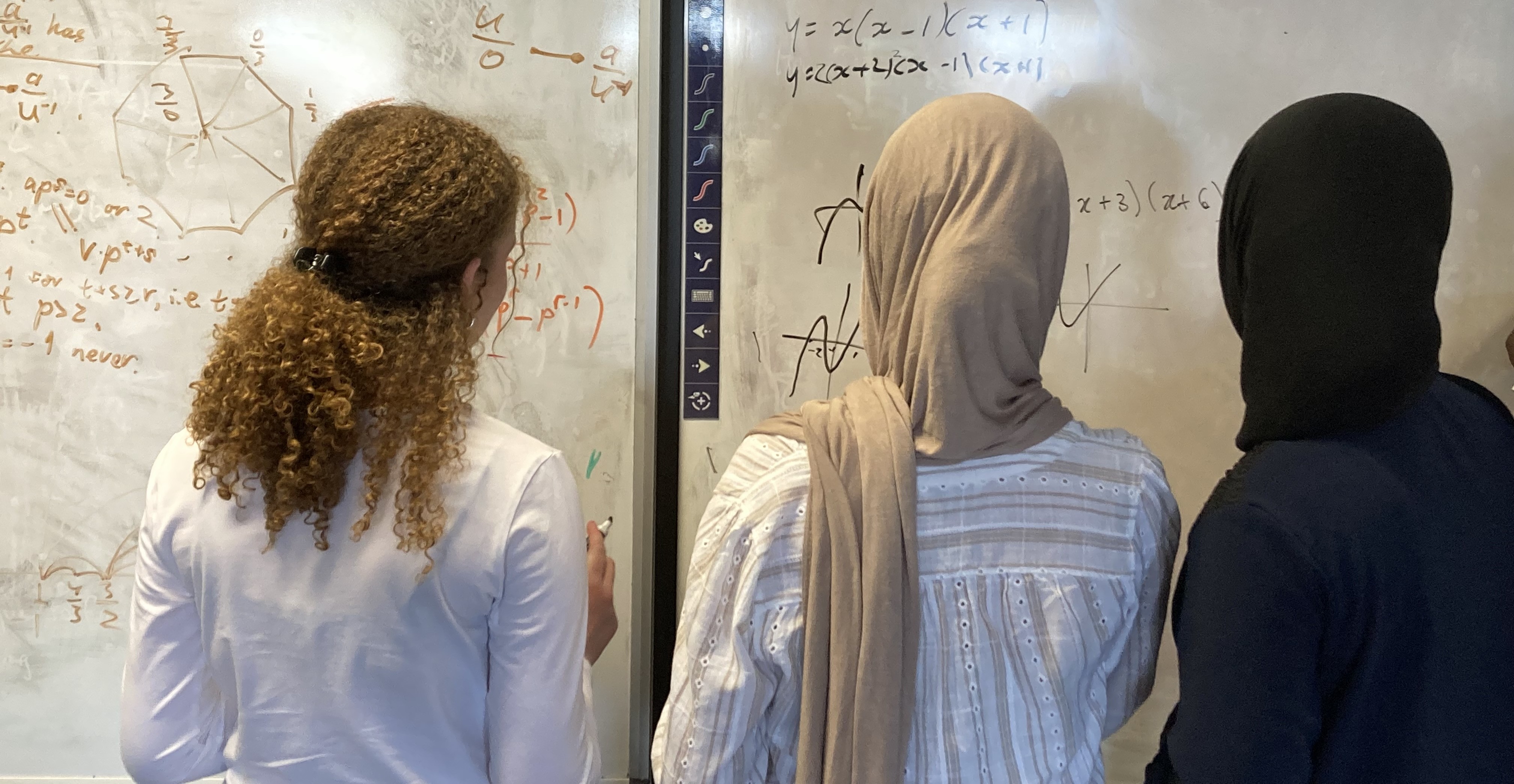
Applications are invited from Open University undergraduate and master's students in mathematical sciences for research bursaries in the School of Mathematics and Statistics at the Open University in summer 2026.
Application deadline: 21 November 2025
Four bursaries available (with the possibility of additional external funding)
What is the Mathematics student research bursary scheme?
The scheme offers students the opportunity to conduct research in mathematics, statistics or the history of mathematics. For those considering future PhD study, the scheme offers a taster of what research life is like. Each successful bursary holder will be supervised by an experienced researcher from the School of Mathematics and Statistics. They will be expected to give a short presentation of their findings at the end of the project.
The work can be carried out on campus in Milton Keynes with face-to-face meetings, or it can be carried out remotely from home with online meetings (or some combination of the two). The bursary holders will interact with each other as well as with their supervisor(s) and others in the School, including academics, postdocs and PhD students.
Past bursary holders
Students that have taken part in previous bursary projects have gone on to have their project work presented at academic conferences, published as blog posts for scholarly societies and presented on posters at international meetings. In some cases, bursary holders have gone on to study PhDs in mathematics. Some of their stories have appeared in our school's newsletter, Open Interval, where past bursary holders have detailed their experiences with taking part in the scheme: see the Nov 2023 issue, the Nov 2024 issue and the Nov 2025 Issue.
Dates, duration and stipend
The placements will take place between July and September 2026, inclusive. Each project is expected to require 6 to 8 weeks full time study (12 to 16 weeks part time), depending on the successful applicant’s and the project supervisor’s availability. The weeks of study need not be consecutive.
The value of the bursary is £1300 to support you with the cost of your studies. This rate corresponds to that of the London Mathematical Society Undergraduate Research Bursaries scheme. The bursary will be paid after one week of the project start. No further expenses or allowances are available in conjunction with this bursary.
If eligible, most successful applicants (depending on suitability of the project) will be asked to help their supervisor in writing a short application for the above LMS bursary scheme. The deadline for this application is 1 February 2026. If successful, this will increase the awarded bursary amount by an additional £900-£1200 (depending on project duration). Part of the application involves a statement of support from an academic reference, and so it is a good idea to notify one of your tutors in advance that this may be required from them at short notice.
Eligibility criteria
Bursaries will be awarded to student applicants based on the following criteria.
- Current Open University student, studying a qualification with substantial mathematical content (may be based in the UK or outside of the UK)
- Completed (or expected completion of) Levels 1 and 2 by July 2026
- Will continue undergraduate or master’s studies at the OU or another Higher Education institution after September 2026
- Grade 1 or Grade 2 passes at most Open University modules studied so far, or evidence of similar levels of achievement at another Higher Education institution
- Evidence of enthusiasm for one of the research projects listed below, and evidence of meeting the essential prerequisites of that project
- Ability to work independently to agreed timescales
- Ability to keep in regular contact with your supervisor, by email, phone, face-to-face or video conferencing
- Excellent written communication skills
The Open University is committed to supporting the rights, responsibilities, dignity, health and wellbeing of staff and students through our commitment to equality, diversity and inclusion. We value diversity and we recognise that different people bring different perspectives, ideas, knowledge, and culture, and that this difference brings great strength. We encourage and welcome applications from all sections of the community, irrespective of background, belief or identity, recognising the benefits that a diverse organisation can bring.
Application procedure
Choose from the list of research projects for 2026 listed below and then submit an Expression of Interest to Frances Gill using the subject heading "STUDENT RESEARCH BURSARY APPLICATION" in capitals by 21 November 2025.
Your Expression of Interest should be no longer than 500 words and should contain:
- your name, Personal Identifier and preferred email address
- your choice of projects, in order of preference (at most two)
- a list of grades for all university modules taken at the Open University (a screenshot of your academic transcript is acceptable)
- a summary of how you meet the eligibility criteria above and why you are suitable for your project choice(s)
- a brief statement on how you will benefit from taking part in the scheme
Successful and unsuccessful applicants will be informed in early January 2026. Sorry but we will not provide feedback on applications. There are no interviews in the application process.
Research projects for 2026
Title: Hydrodynamic interactions of colloidal particles under wedge-like confinement
Supervisor: Dr. Abdallah Daddi-Moussa-Ider
Summary:
The goal of this project is to investigate how wedge-like confinement influences fluid-mediated hydrodynamic interactions between colloidal particles. Understanding such effects is important for advancing our knowledge of transport and collective behaviour in complex micro- and nanoscale systems. We aim to solve the Stokes equations, which govern fluid dynamics in the regime where viscous effects dominate over inertial effects. To this end, we will employ the Fourier–Kontorovich–Lebedev integral transform technique to determine the hydrodynamic pair mobility functions, linking the translational and rotational velocities of suspended particles to the forces and torques applied to their surfaces. For simplicity, we will focus on the leading-order behaviour relevant for very small particles in the dilute limit. The results of this study may find applications in microfluidics, targeted drug delivery, and the design of advanced colloidal materials.
Prerequisite knowledge
Essential:
Calculus, fluid mechanics, differential equations.
Desirable:
Basic knowledge of computer algebra systems like Mathematica or Maple, as well as LaTeX, is helpful.
Availability:
Remote July to September with a two-week gap in the middle (negotiable with the successful student)
Title: Free communication and secret sharing in graphs
Supervisor: Dr. James Tuite
Summary:
In this project we will investigate subsets of nodes in graphs that allow for free communication and sharing information without interception. Two such types of subsets include general position sets and mutual visibility sets. We will consider new variations on these problems, including versions in which the agents must move through the graph, colouring problems and adversarial games to construct such sets, one of which can be viewed as a generalised version of the popular games Connect Four and Gomoku. Some background can be found in the paper ‘The General Position Problem: A Survey’. The successful candidate would become part of a collaboration that includes researchers in Slovenia, Spain, Italy and Iran.
Prerequisite knowledge
Essential:
Experience constructing proofs.
Desirable:
Programming with Python, C, GAP, knowledge of group theory or number theory.
Availability:
Remote July to September with a two-week gap in the middle (negotiable with the successful student)
Title: Fake news cascades through the lens of the Feedback Ising Model.
Supervisor: Dr. Ivan Sudakow
Summary:
This project applies the theory developed for the linear Feedback Ising Model (FIM) to a controlled simulation of fake-news diffusion on social networks. In the FIM, coupling strength grows with the fraction of “up” spins (agreement). This effective strengthening of interactions leads to new bifurcations, unexplored universality classes, significantly altered critical exponents, and hysteresis that are absent in classical spin-like models—an increase in network “patternization.” We map these ingredients to a social-interaction setting: social influence (peers align), an external message (a global nudge that injects or counters misinformation), and social feedback (algorithmic amplification that boosts like-minded ties). In this language, rapid opinion shifts correspond to cascades, while persistence of false narratives appears as hysteresis and re-entrant polarization.
The student will implement a FIM simulator, then use the theory to: (i) locate and visualize the transcritical, fold, and cusp bifurcations; (ii) run data-driven “policy” tests (reducing amplification, adding counter-messaging) to see which regimes suppress fake-news lock-in.
Prerequisite knowledge
Essential:
Differential equations, statistics and probabilities, and programming.
Desirable:
Dynamical systems, computational mathematics, and stochastic processes.
Availability:
Remote August to September
Student research bursaries coordinator
 | Dan Rust |


Follow us


Explore

Undergraduate
Postgraduate
Policy
-
Follow us on Social media
-


