
Robin Wilson publishes two more books
Professor Robin Wilson has published two more books: 'Sum Stories: Equations and their Origins' , which is his 16th book published with Oxford University Press, and 'Milestones in Graph Theory: A Century of Progress' with the American Mathematical Society/Mathematical Association of America, which was written in collaboration with Lowell Beineke and Bjarne Toft.
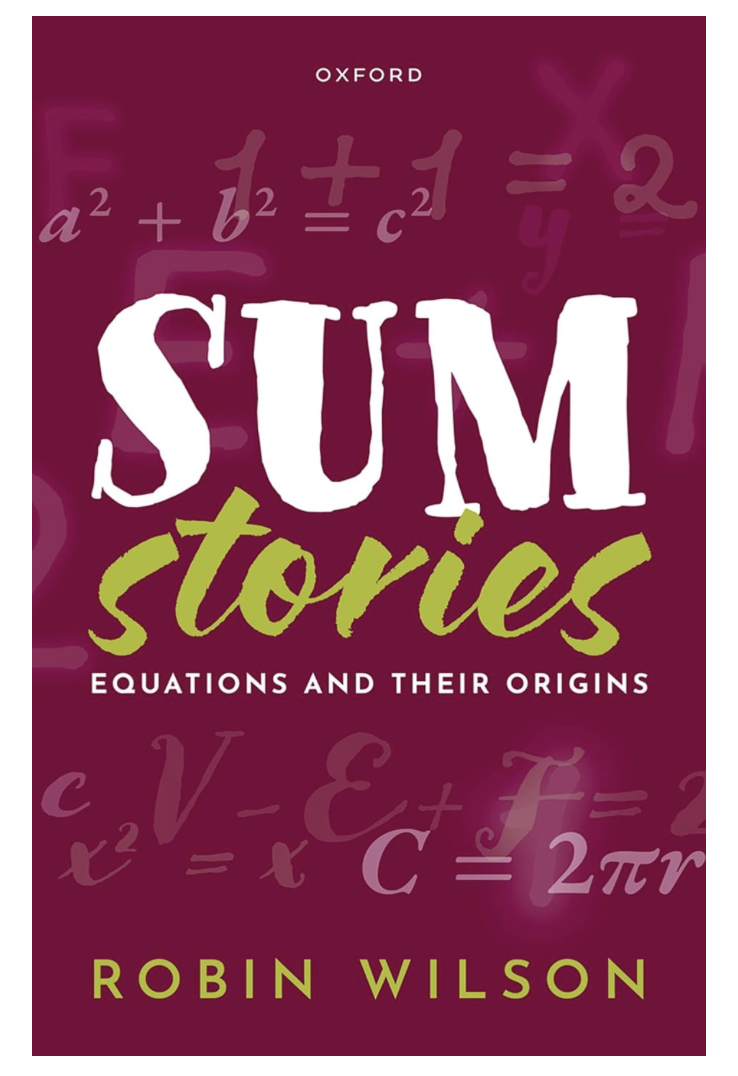
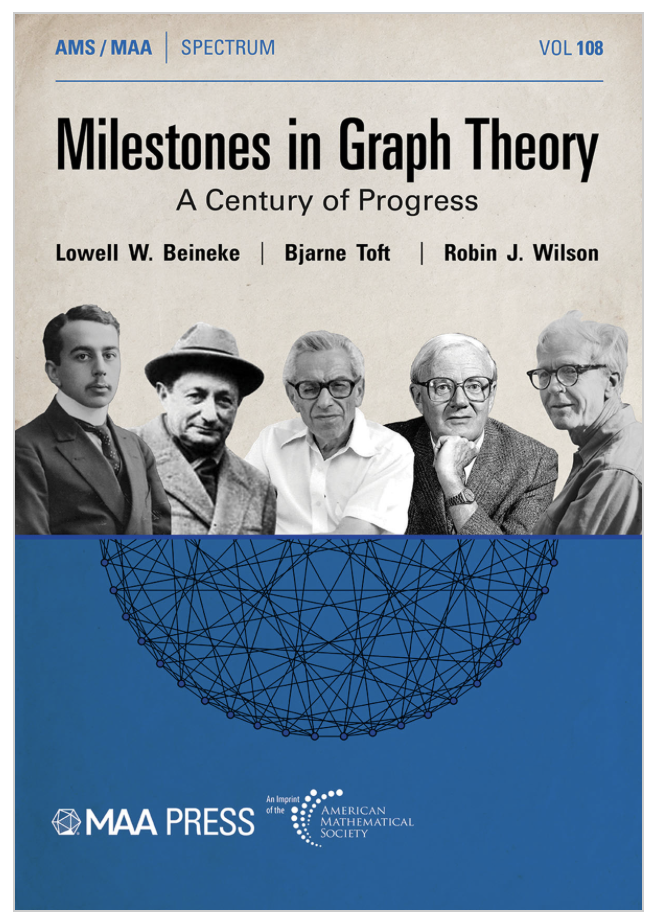
The description of 'Sum Stories: Equations and their Origins' reads as follows.
Where do mathematical equations come from? Can one prove that 1 + 1 = 2? Which US president proved the theorem of Pythagoras? How long is the coastline of Britain? Who was the witch of Agnesi? How often are two winning lottery numbers consecutive? Who scratched mathematical equations on a bridge in Ireland? Must all infinities be the same size? These, and many other questions, are answered in the 18 chapters (or ‘stories’) of this book on mathematical equations and their historical development. These equations come from arithmetic, geometry, algebra, number theory, calculus, combinatorics, mathematical logic, and other areas of ‘pure’ mathematics, and range over 4000 years from early counting to Boolean algebra and from prime numbers to fractals. Throughout this book the treatment has been kept as simple as possible, with each story introduced from the beginning, and with much historical information and many pictorial images. More technical or peripheral results are separated into ‘boxes’ along the way and can be omitted if preferred. Most of the book should be accessible to anyone with high-school mathematics.
The description of 'Milestones in Graph Theory: A Century of Progress' reads as follows.
This book gives an engaging overview of the advances in graph theory during the 20th century. The authors, all subject experts, considered hundreds of original papers, picking out key developments and some of the notable milestones in the subject. This carefully researched volume leads the reader from the struggles of the early pioneers, through the rapid expansion of the subject in the 1960s and 1970s, up to the present day, with graph theory now a part of mainstream mathematics.


Follow us


Explore

Undergraduate
Postgraduate
Policy
-
Follow us on Social media
-


