
Theory of Condensed Matter
Our work follows a common thread of modelling complex systems consisting of many interacting objects. We use a variety of mathematical and computational techniques, including developing our own numerical software. Below we describe some of the broad (and often interrelated) themes in our work.
Theme 1: Many-body quantum systems and collective behaviour (J. Hague, A. James)
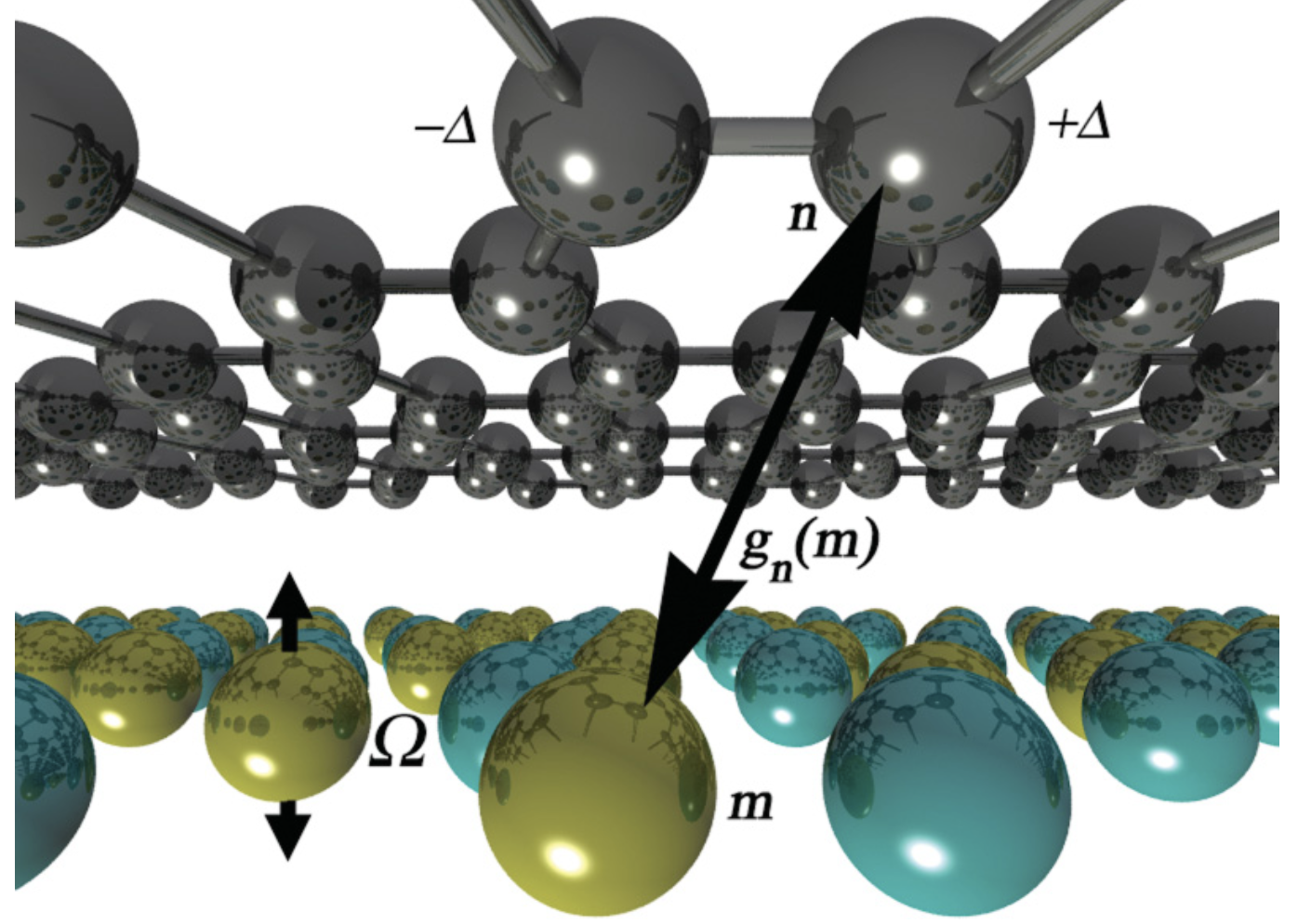
Future technological requirements - for example, cleanly meeting our energy needs; storage and processing of ‘big data’; and practical quantum computation - hinge upon discovering materials with exotic properties. Often the most unusual and exciting properties are a result of collective quantum mechanical behaviour: things that can't be predicted from the properties of isolated atoms and electrons, but only occur as a result of many of them being brought together and interacting. Harnessing this behaviour requires us to develop understanding with predictive power, but doing so is difficult because electrons in materials are correlated so can't be treated individually.
Materials and phenomena we have studied include graphene, high temperature superconductors and quantum magnets. Methods we have used include analytical tools such as effective field theories and many-body perturbation theory; and numerical approaches such as quantum Monte Carlo and Matrix Product States.
Theme 2: Quantum simulation and ultracold atoms (J. Hague, A. James, C. MacCormick)
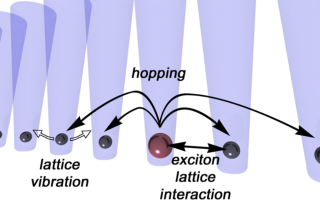 Accessing and understanding the mechanism behind a property of interest in real materials is frequently complicated by a host of unwanted effects (e.g. impurities or defects) or due to an inability to sufficiently vary the material's other properties. In some cases there might not even be a candidate material at all, just an interesting collective quantum effect we would like to study (or use).
Gases of atoms cooled to ultra low temperatures can be used to create many-body quantum systems in a clean and tuneable way. They can then be used to 'simulate' other systems and offer up a whole host of new theoretical questions in themselves.
Another line of investigation is how, and in what way, do complex quantum systems reach equilibrium or thermalise? Understanding this is an important step on the road to building practical quantum devices. Cold atom systems subjected to periodic driving, or an abrupt 'quantum quench' change of parameters can be used to realise out-of-equilibrium quantum states that are at the frontier of current theoretical efforts.
This theme complements the experimental work of the Cold atoms group within the School.


Explore

Undergraduate
Postgraduate
Policy
-
Follow us on Social media
-


