
Plasma ignition/breakdown
The aim of this project is to study the initial stages of plasma ignition – the transition between a gas and a plasma. Basic measurement methods are used, including imaging of plasma emission and also advanced measurement methods such as laser-based measurements of electric field distributions.
In addition, the ignition process is simulated using md2d, a two-dimensional fluid simulation code at Eindhoven University of Technology.
One part of the study is aimed at understanding ignition in a low pressure discharge, at identifying and understanding the ionization waves that characterise the ignition process. Other parts of the study examine ignition in plasma applications such as plasma display cells and fluorescent lamps. In these case, nearby dielectric surfaces are expected to influence the ignition processes.
 Collaborative partners include Erik Wagenaars, Wouter Brok, Tao Jiang, Maxime Gendre, and Gerrit Kroesen at Eindhoven University of Technology, where most experimental work is carried out. Funding comes from the NWO/STW funding bodies in the Netherlands and Philips Lighting (Eindhoven).
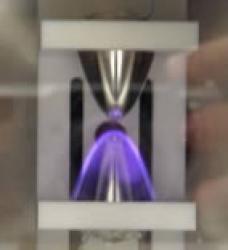
A simple electrode scheme is used to study plasma ignition at low pressure, where the two electrodes have parabolic shape, with the tips being separated by about 3 mm.
The photograph shows plasma emission from a steady-state d.c. discharge.


Explore

Undergraduate
Postgraduate
Policy
-
Follow us on Social media
-


