
Exploration Fieldwork in the Kalahari Desert, Botswana
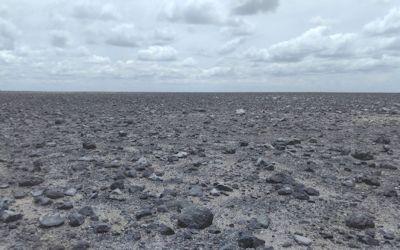
Twenty thousand years ago, the area of what is now the Ntwetwe and Sua salt pans in Botswana was submerged beneath a lake the size of Switzerland. Tectonic activity and climate change (extensive dry seasons) drained the lake over ten thousand years, resulting into the formation of the salt pans, an extremely arid place, bathed in high UV radiation and little vegetation.This area, which is now described as the Makgadikgadi paleolake, or salt pans, has been identified as a potential martian analogue.
In January 2020 the AstrobiologyOU team, in collaboration with the University of Bologna and the Botswana International University for Science and Technology, conducted an exploratory field campaign to investigate the adaptation strategies of microbial life embedded within the paleolake sediments and thriving on the surface of the salt pans.

We will explore which microorganisms live there, the metabolisms driving those communities and their strategies to cope with the extreme conditions of the Kalahari Desert (desiccation, high salinity, high UV radiation). Answers to these questions should provide insights on how life could survive and adapt to extra-terrestrial environments, such as present and past Mars.

Latest News
My Summer Internship Researching Mars
Hello, my name is Keeret! I have just completed my first year at the University of Warwick, studying Chemistry. This year helped me recognise my passion for astrochemistry and planetary science
- New publication from AstrobiologyOU
- Icy Worlds Research Featured on BBC's The Sky at Night
- Digital PCR: A Sensitive Approach for Measuring Microbial Contamination for Planetary Protection
- AstrobiologyOU academics reveal the hidden information in icy moon surface salts
- MoonRISE: OU receives grant to unite experts to protect the Moon through sustainable governance


Explore

Undergraduate
Postgraduate
Policy
-
Follow us on Social media
-


