
Communicating Your Science Workshop
Hi! My name is Rita Serra and I am a PhD student in the AstrobiologyOU group. My research is focused on microbial experimental evolution to identify genetic adaptations relevant to Martian habitability, as well as to evaluate how biosignatures can be preserved within fluid inclusions of evaporite minerals. Do you think you will remember any of that?
Chances are, as you will go on with your day, you will have completely forgotten who I am and what it is I do for a living if I present it to you the way I did. And it’s not you who is to blame, but me, for not having done my job right. You see, I have always deemed science communication to be of pivotal importance in the life of a scientist. I believe our job is only finished the moment our discoveries are able to reach people beyond the walls of our labs and institutes. Turns out, that is no easy feat, and it requires proper training!
I was lucky enough to have been able to attend the Communicating your Science workshop at Chicheley Hall from the 15th-17th April 2026, organised by the Genetics Society. It was a real challenge for me, taking me out of my comfort zone every single day, but definitely a challenge worth taking. If you incorporate genetics related topics in your research, I strongly encourage you to apply and allow yourself to dip your toes in the vast territory of science communication through this workshop.
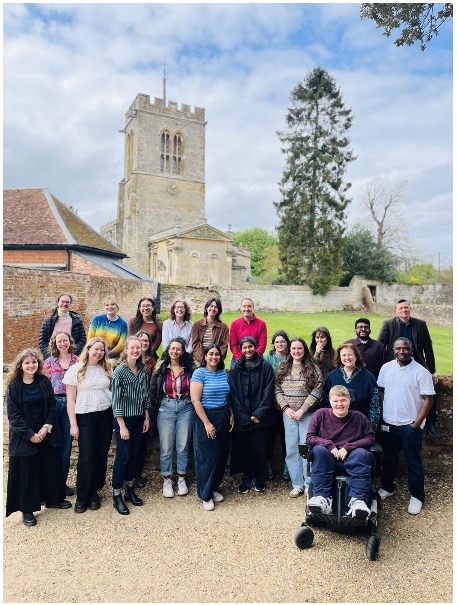
As I arrived at the venue, I immediately started chatting with the other participants. In a span of 45 minutes, I had already heard about at least 15 different PhD topics and had not been able to memorise almost any. It was hard for me to understand and remember the research of other fellow scientists. I could only imagine what it would be like for someone that chose a completely different career!
The first day of the workshop was all about storytelling, and I immediately understood it’s importance. Professors Alison Woollard and Jonathan Pettitt gave us an overview of what storytelling is and how veiling concepts into a story is a good way for people to understand and remember us better. After all, people remember stories, not technical descriptions. Then we were split in pairs and in front of our class we had to ask simple questions to our partner about their research and they had to reply avoiding jargon and trying to be straight to the point. I remember someone asked their pair what they research about and they replied they studied addiction in Drosophila melanogaster. The very first question was ‘What is Drosophila melanogaster?’ and then many people in the room went ‘Ahhh’ in unison upon understanding it was the fruit fly. I remember clearly that this way I was actually understanding the research of my colleagues much better than when we first chatted upon arrival.
Day two was the most challenging one. The morning was spent with the comedian and scientist Helen Keen analysing Stand-up comedy as a tool to speak about our science. Before this workshop, I would have never thought of taking this approach, let alone think I could possibly do it. We were then given some time to think about an idea, write it down and get ready to present it in front of our class. One thing about me is that I get really nervous before I speak in front a lot of people, so when people started presenting their skits and I was waiting for my turn, I was shaking like crazy! What impressed me the most was that everyone was making the room laugh and that I was understanding even better what their research was all about and having fun at the same time!
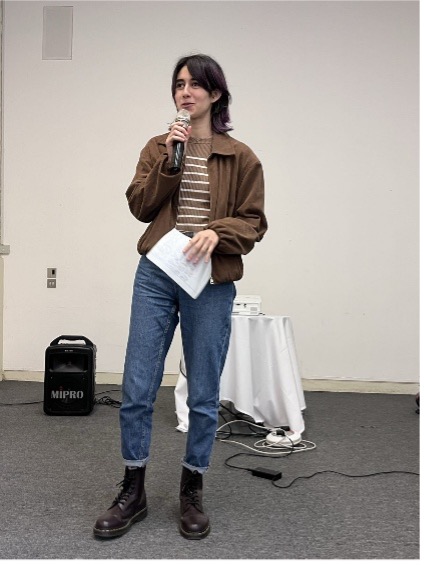
Eventually, it was my turn and I decided to focus on the first part of my project which is about microbial experimental evolution to identify adaptation to Martian relevant brines. For the sake of exemplification, allow me to bore you with the textbook definition of this process which is ‘the use of controlled laboratory populations and environments to study the mechanisms of evolution in real time, where selection can act on any and all traits and genes relevant to fitness’. There’s a bit of jargon in there and it is easy to forget. I don’t blame you. Here is a snippet of the way I decided to describe my project in the skit: ‘Microbial experimental evolution is, in essence, long-term germ torture as a tool to assess the extent of generational trauma in real time upon exposure to Martian hell’. Surprisingly, people laughed at that and the bit where I said ‘So if you have any microbes you don’t like, you can send them my way because I will know what to do’ and I still can’t believe it. What specially made me impressed was that in the last day, someone remembered my work as long-term germ torture. I’m not sure I want to be remembered in that way alone, but I guess that stuck with them much more than how I described my project like in the first paragraph of this blog!
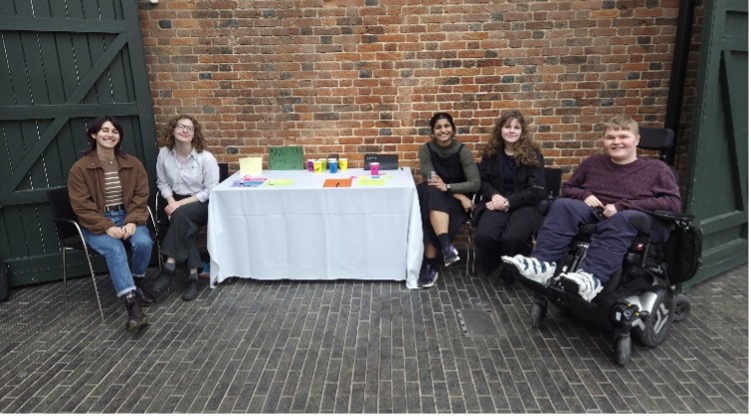
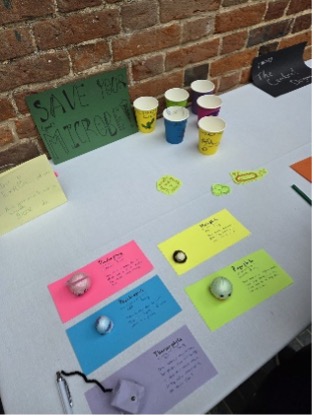
The rest of the second day was dedicated to Hands-on science taught by Fergus Powell (Head of Project Management at Fist Create the Media). We were split in groups to develop a stand for a science festival featuring at least two activities. One of the games my group designed was called “Save Your Microbe!”, aimed at helping young children learn about the existence of extremophiles (microbes that live in extreme environments). We created different microbes using polystyrene balls and paint, each labelled with its definition, such as psychrophile – cold loving microbe. The objective of the game was for children to throw each microbe into its correct habitat in order to “save” it, which for a psychrophile it would be the arctic in our example. It was also so much fun to play the games from other teams! Scientists can really be super creative.
The last day was about disseminating science in a video format. Dr. Sally Le Page showed us three videos all from the same scientist in which they were presenting in a different way. Each version gave us a different perception of the scientist which can affect whether people would trust the information or not. We were also reminded to plan our script for the edit and some essentials of video making such as correct lighting and clean audio. We were encouraged to try and make a short video which also pushed me out of my comfort zone. In the end, I enjoyed the process much more than I thought I would!
This whole experience showed me that there is a plethora of different ways to give back to the public that sense of wonder and curiosity that drew us into science in the first place. I believe I grew a lot as a scientist and potentially as a communicator.
I would like to thank the Genetics Society for this initiative once more and to also encourage other scientists to take on this adventure. This way we could ensure that science is able to reach everyone, regardless of a person’s background. And I think that is pretty awesome.
Latest News
My Summer Internship Researching Mars
Hello, my name is Keeret! I have just completed my first year at the University of Warwick, studying Chemistry. This year helped me recognise my passion for astrochemistry and planetary science
- New publication from AstrobiologyOU
- Icy Worlds Research Featured on BBC's The Sky at Night
- Digital PCR: A Sensitive Approach for Measuring Microbial Contamination for Planetary Protection
- AstrobiologyOU academics reveal the hidden information in icy moon surface salts
- MoonRISE: OU receives grant to unite experts to protect the Moon through sustainable governance


Explore

Undergraduate
Postgraduate
Policy
-
Follow us on Social media
-


