
Using Open Research Data Online (ORDO)
.png)
Open Research Data Online (ORDO) is The Open University's research data repository. Based upon the Figshare platform, ORDO can be used for the storage of live research data, but is particularly useful for archiving and publishing research data supporting a publication or once a project is completed. Data stored in ORDO will be kept for a minimum of ten years after project completion; published data will be given a DataCite digital object identifier (DOI), providing a permanent, citable web link to help you get recognition for your work.
Go to Open Research Data Online
ORDO Guidance
The Figshare User Guide is an excellent source of guidance for carrying out most tasks on ORDO.
The following guidance relates to OU-specific requirements and policies.
- Uploading Data Management Plans to ORDO
- Searching Data Management Plans on ORDO
- How to create a metadata only record on ORDO
- ORDO accessibility guidance
- ORDO and ORO content guidance
- ORDO policy
- ORDO Depositor Agreement
Uploading Data Management Plans to ORDO
The Open University Research Data Management Policy includes a requirement for all Data Management Plans (DMPs) to be uploaded to ORDO. This guidance explains how to upload your document to ORDO. For guidance on how to write a DMP, please refer to our Data Management Plans webpage.
How to upload a Data Management Plan to ORDO
- Login to ORDO using your Open University Computer Username (OUCU) and password.
- Open the ‘My content’ menu (top right) and select “Items”. This will direct you to your ‘My items’ page.
- Click “Create new”
- Select your group from the dropdown, and select “Data Management Plan” as item type. Then drag and drop the file, or use the “Browse files” function to attach your DMP.
- Click “Continue to metadata”
- Complete the metadata form, paying particular attention to the following:
- Include the name of your project in the “Item title” field
- Select “Data Management Plan” as the item type
- To make your DMP more findable, use keywords that describe your methodology, as well as your research topic. (e.g. “interview data, survey data, participatory research, software design, database design”)
- If you would like to keep your DMP private, use the “Add embargo” option on the right-hand menu. Please select “Request access to files” so that other OU researchers can contact you if they’d like to see your plan to inform their own research
- If your project is externally funded, add the funder to the “Funding” field
- Once you have completed the metadata form, click “Submit for review”. This will send the DMP to the Library Research Support team for approval. If there are any issues with the plan or the metadata, we will contact you.
If you have any questions about this process please contact the OU Library Research Support Team.
Searching Data Management Plans on ORDO
These instructions will help you to locate Data Management Plans on ORDO.
- Go to https://ordo.open.ac.uk
- Click on the magnifying glass icon in the search box at the top of the page, to navigate to the search page.
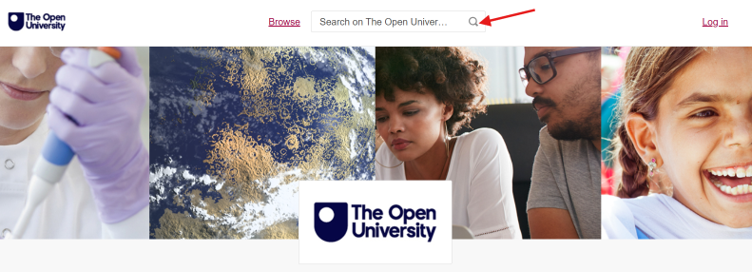
- Narrow your search down to Data Management Plans only, by locating the “Item Type” list on the left side of the page. Select “Data Management Plan” and then click “Apply filters”
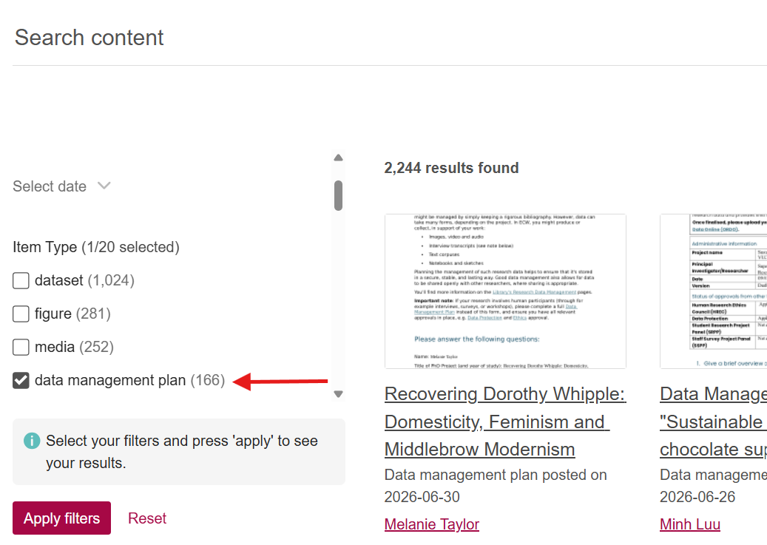
- Use the search box to narrow down your results...

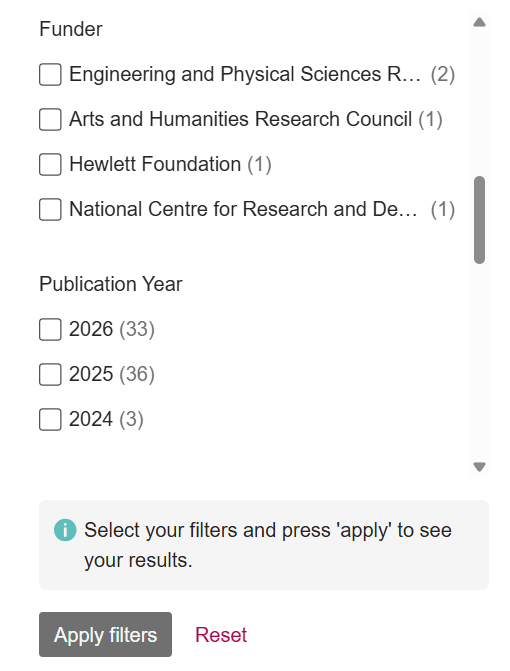
...or use the facets on the left of the screen to narrow down your results by funder, publication year, category or group
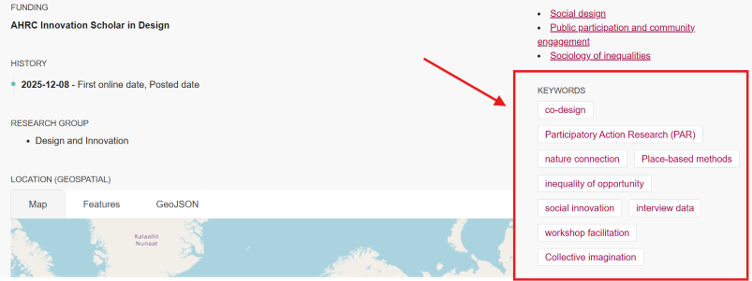
Note that the keywords on the right hand side of the screen within the item record can be clicked to search other items with the same keywords.
How to create a metadata-only record on ORDO
For some researchers Open Research Data Online (ORDO), the OU's insitutional data repository, is not the optimal place to preserve and share research data. It may be that your funder has a specific repository you must use (e.g. ESRC funded researchers must deposit data with the UK Data Service), or there may be a subject-specific repository where researchers in your field/discipline more commonly share data. In such cases, data may be archived or shared in a trusted data repository other than ORDO.
Following an update to The Open University Research Data Management Policy which came into force on 1st December 2024, you are now required to create a metadata-only record on ORDO for any research data that is archived/shared in any other data repository. This is to ensure that there is an institutional record of all archived research data.
We have automated this process for any research data stored/shared on the Zenodo repository or in any of the Figshare repositories (Figshare or Figshare Plus), so you will not need to create your own metadata records for any data published here. Please follow the instructions below to create a metadata-only record on ORDO for data published in any other repository.
How to create a metadata-only record on ORDO for data archived elsewhere
- Log in to ORDO using your Open University Computer Username (OUCU) and password. If you have any access issues, please email the Library Research Support team.
- Open the ‘My content’ menu (top right) and select “Items”. This will direct you to your ‘Items’ page.
- Click “Create new”. Enter the initial fields (group, item type), and then click “Continue without uploading files”
- Select the option to ‘Link to external files’ from the radio buttons at the top of the form and add the URL address underneath which links to the location of your data. Select the tick next to the URL address field to add and save this external link. Note: this URL should link to the metadata record for your dataset, and should, where possible, contain the Permanent Identifier (PID) your repository has assigned to your dataset, such as its DOI, Handle or UUID (e.g., https://doi.org/10.6084/m9.figshare.1234567). It is very important that this link is stable (unchanging), since this will redirect users to your dataset from ORDO. If you aren’t sure which link you should use, please email the Library Research Support team for advice.

- Add in all relevant metadata as it appears in the host repository (I.e., replicate the Title, Item Type, Description, Keywords, Authors, Funding Information and Licence that appears on the original metadata record). The categories available to select from in ORDO are likely to differ from those offered in your host repository, so you will need to select any relevant categories from the available options.
- If your host repository has given you a Digital Object Identifier (DOI) for your dataset, select ‘Manage Identifiers’ from the ‘Item Actions’ list on the right-hand menu and add the DOI into the pop-up box that appears. This ensures that we do not create a new DOI for this metadata-only record on ORDO. If your host repository offers a different Permanent Identifier (PID) such as a Handle or a UUID, you will not need to perform this step (a new DOI will be generated for the metadata-only record on ORDO, but you should continue to use the PID for your original dataset wherever you reference it).

- Select ‘Edit timeline’ from the ‘Item options’ menu on the right-hand side of the screen. Scroll down to the ‘Online Publication Date’ and select the option to ‘Set Date’. Unselect the pre-ticked box which says ‘Use initial posted date’ and enter the date the dataset was published in your host repository into the ‘Set Date’ field. Select ‘Apply changes’:

- Select the option to ‘Submit for Review’ at the bottom right of the screen. This will send the record to a review queue, and once a member of the Library Research Support Team has verified that everything looks accurate, the record will be published and made live on ORDO. You will receive a notification to say that the record has been accepted for publication.
ORDO accessibility guidance
ORDO helps make Open University research data available to a wide audience, including researchers, practitioners, policymakers and members of the public.
When preparing data and materials for upload to ORDO, it is helpful to consider accessibility from the outset. Accessible content can improve the experience for everyone, including people using assistive technologies and people accessing content in different environments or circumstances.
The guide below provides practical information and links to support you when preparing files for upload. As research outputs can take many forms, some guidance will be more relevant to certain file types than others.
Why accessibility matters
Accessibility helps ensure research outputs can be discovered, understood and used by the widest possible audience.
Many digital materials are covered by accessibility legislation and guidance, including the Public Sector Bodies Accessibility Regulations and the Equality Act. Accessibility can also support the visibility, reach and impact of research outputs.
Most content must meet WCAG 2.2 Level AA standards, ensuring it is usable by people with a wide range of needs.
Taking accessibility into account before uploading content can help reduce barriers for users and improve the overall quality of information shared through ORDO.
Read more: Accessibility regulations - the law
Quick accessibility guide for ORDO uploads
ORDO contains a wide range of research data and materials, including documents, datasets, software, images, audio, video and specialist discipline-specific formats. Accessibility approaches will vary depending on the type of content being shared. Where standard accessibility guidance is not available for a specific format, contributors should provide clear descriptions, metadata and supporting documentation wherever possible to help users understand and access the content. Library Services at the OU has created some quick tips and guidance on ensuring your content is accessibility compliant.
ORDO and ORO Content Guidance
Content that should be added to ORDO includes:
- Research datasets (audio, visual and tabular)
- Surveys
- Questionnaires
- Templates used to conduct research
- Consent forms (not completed)
- Participant Information sheets
- Recordings, presentations and posters from events that are part of a research project
- Software
Content that should be added to ORO includes:
- Journal Articles
- Authored Books
- Book Chapters
- Edited Volumes
- Conference Papers
- Blogs
- Reports
- Theses
- Patents
- Presentations, lectures, posters (from events disseminating research)
- Articles in professional publications
Connections between research data in ORDO and the related research dissemination in ORO should be made with persistent identifiers – Digital Object Identifiers (DOIs) for the outputs and ORCIDs for the people.
Exceptions and edge cases
Some outputs will not fit neatly into either category, exceptions will occur and should be dealt with on a case-by-case nature e.g.,
- Research Websites - can be archived in partnership with The Open University Archive. The archived website (WARC file) can be archived in ORDO and viewed through a standalone viewer. Individual assets from research websites (e.g., publications, research data) can be added to ORO, ORDO or OUDA (Open University Digital Archive) as appropriate.
- Databases - the data underlying a database should be archived in ORDO (as research data) the functionality of the database may not be easily archived but (if still functional) can be signposted from ORO/ORDO as appropriate.
- Software - Software should be added to ORDO utilising the connection to GitHub where appropriate. If a separate record in ORO is required a metadata only record should be created linking to the file(s) in ORDO.
- Events
- Formal collections of research papers presented at a research dissemination event should be lodged in ORO with an OU (co)editor (personal or group).
- Individual papers presented at an event disseminating research findings should be posted to ORO
- Research lectures should go on ORO. Video files may be located elsewhere (e.g. OUDA) to aid preservation and/or playback.
- Where a research event is part of the doing of research (they may involve collecting research data) they can be posted to ORDO. This is particularly the case where there is a requirement for an ORDO Collection around a research project.
Outputs from the impact of research: evidence of research impact
- Non-public evidence of research impact should go to Sharepoint (e.g. policy changes, practice guidelines, testimonials). Contact your Faculty Research Impact Manager or RES: Research Impact, Outputs and Outcomes (requires login).
- Formal evidence to be made public (e.g., a report on research impact) can go to ORO
Open Research Data Online (ORDO) Policy
Introduction
ORDO is the Open University’s research data archive. Two types of material may be stored in the archive; archival research data and live research data.
Archival research data:
- are selected for long term storage on the basis of their continuing value to the wider community
- are made openly available, except where ethical, legal, commercial or other legitimate restrictions may apply
- may not be overwritten or changed, but may be reversioned, and newer versions be given separate identifiers.
Live research data:
- are not shared openly, but may be shared with invited collaborators
- are subject to change
- may not have long term value, and may be deleted.
This policy is divided into 2 sections to reflect these types of data
Archival data
Collection Policy
- ORDO is an institutional research data repository.
- Content deposited in ORDO is restricted to:
- Data underpinning research publications which meet the Frascati definition of research; where the research has been undertaken at the Open University.
- Research data metadata, where the research dataset has been stored in another repository, or where the research data is physical.
- Research data created during the active phase of research life cycle; such data will be subject to change, is not publicly available. Live research data may be retained within ORDO for 12 months after the research is complete, after which time the depositor will be asked to relocate the data.
- Other outputs from research activities that support the mission of The Open University (see ORDO/ORO Content Guidance).
Submission Policy
- Items may only be deposited by academic staff or doctoral students of the institution, or their delegated agents.
- By depositing in ORDO, depositors are agreeing to the preservation and distribution of the metadata and full text content of their research data files. Depositors grant ORDO the right to preserve and distribute the deposited content. Full details of the terms and conditions are provided in the depositor agreement.
- Depositors take responsibility for ensuring that deposited content complies with the requirements of the Data Protection Act 2018, and other legal requirements outlined in the depositor agreement.
- Currently research staff and OU students may store up to 5 GB of research data for free (100GB for STEM users). Users may request additional storage space within ORDO, which will generate a request to the system administrator. There may be a charge for additional storage.
- Where research datasets contain physical research data the dataset metadata record should contain sufficient information for the end user to be able to consult the physical data, subject to legal, ethical or commercial constraints.
- Before items are made available publicly, a member of library staff will:
- Verify the data is within the scope of ORDO
- Check the metadata. Amendments may be made to the metadata by the archive administrator to correct errors, ensure consistency, or to add administrative metadata.
- Check the uploaded data for confidential and sensitive information, file integrity, accessibility and compliance with the FAIR principles.
- Files in a dataset may be placed under embargo for a specified period, so that the metadata records and file names are visible, but the file contents cannot be viewed or downloaded. Files should not be embargoed for more than 12 months from the date of deposit, and the embargo should last no longer than the date of publication of any research findings that reference the dataset, unless there is good reason for withholding access to data. Reasons might include compliance with commercial sponsorship agreements, protection of intellectual property rights or patent registration.
Whilst a basic check will be undertaken, it is ultimately the responsibility of the depositor to ensure that they are suitable for sharing and that appropriate consent has been obtained, where relevant.
Metadata Policy
- Deposited content must be accompanied by sufficient metadata describing its content, provenance and formats in order to support its preservation and dissemination.
- Anyone may access the metadata.
- The metadata may be re-used in any medium without prior permission for not-for-profit purposes provided the OAI Identifier or a link to the original metadata record is given.
- Metadata Records will be retained indefinitely. If a Dataset or Collection is withdrawn from the Archive, the associated Metadata Record will not be deleted, but will be annotated to record the change in status of the Dataset or Collection and the reason for this change.
Use Policy
- All data deposited on ORDO will be assigned a CC-BY licence as a default. Alternative licences will be explicitly identified on individual items as required by funders or legal, ethical or commercial considerations.
Preservation Policy
- ORDO's Preservation Policy aligns to the Open University Digital Preservation Policy (login required)
- Items will be retained for as long as research funders require, or as long as deemed to be of value to the wider community. Where they have not been reviewed already, all stored items will be reviewed after ten years to assess their continued value to the wider community. Where Faculties or Heads of Units require continued storage of unused datasets, they may be required to pay for continued storage at agreed rates.
- ORDO will try to ensure continued readability and accessibility. Where necessary and practical, items in obsolete file formats will be migrated to newer formats. The original files will be retained.
- ORDO is hosted on Amazon Web Services (AWS) which ensures a high level of security and stability for research data. Amazon S3 stores multiple, redundant copies of information and utilises an end-to-end approach to secure and harden its infrastructure, including physical, operational, and software measures. Amazon S3 provides authentication mechanisms to ensure that data is kept secure from unauthorised access.
- If necessary, an updated version of an item may be deposited; the earlier version will remain available for public view.
- Prior to any scheduled disposal and destruction, the University will ensure:
- The review of the stored data by the depositor, appropriate Faculty or Head of Unit.
- Where they are found to be suitable for destruction and disposal, the destruction shall be managed in line with regulatory and contractual obligations, and according to the sensitivity of the data in question.
- A record of the deletion will be stored with the metadata record, including the reasons for the destruction.
Takedown Policy
- The Open University takes reasonable steps to ensure that any dataset and associated metadata are an accurate and authentic output of research activity undertaken at the University, that the Dataset does not breach requirements of the funding organisation, any law, and that it does not violate or infringe any copyright, trademark, patent or intellectual property right whatsoever of any person(s) or organisation.
- Materials deposited in the Archive are made available on the terms specified by the Depositor of the Dataset, with the implied permission of all rights-holders, and will not be withdrawn from the Archive except in keeping with Archive policy or on receipt of a valid and proven complaint. Acceptable grounds for complaint include the following:
- Violation of intellectual property rights (including copyright);
- Legislative breach
- Matters of national security
- Falsification of data or failure to follow ethical guidelines
Complaint procedure
- Anyone wishing to complain on the grounds above should email [email protected] with the following information:
- Name and contact details of complainant
- A reference to the dataset in question, including DOI for the relevant metadata record
- Details of the complaint, with proof or evidence
On receipt of the complaint, ORDO support team will:
- Make an initial judgement of the validity of the complaint
- Withdraw the item from public view
- Acknowledge receipt of the complaint within 4 working days.
The complaint will then be reviewed by the ORDO Support team and other relevant University departments as necessary. If the grounds of the complaint are considered proven or plausible, the material will be permanently withdrawn from ORDO.
Once a deposited work has been removed, metadata for the deposited content will always remain to avoid loss of historical record together with a note explaining the reasons for withdrawal. The metadata of withdrawn items will not be searchable.
Live data
Permitted users
Current Open University staff and doctoral students may use the service. They may create collaborative project workspace within ORDO, then invite external collaborators to share that workspace. University staff and students remain responsible for the conduct of external collaborators they have invited to share project workspace.
Pricing policy
Currently research staff and OU students may store up to 5 GB of research data for free (100GB for STEM users). Users may request additional storage space within ORDO once logged in, which will generate a request to the system administrator.
Research Data Management Principles
ORDO users are expected to be guided by OU Research Data Management Policy.
Data Protection Act
Where personal data (as defined by the Data Protection Act 2018) are processed for research purposes in the course of a researcher’s employment or doctoral student’s registration at the Open University, the University will be the data controller under the Act for those data. This will include where personal data are stored in ORDO.
Management of risk
However, in all circumstances, the individual researcher will be personally responsible to the University for ensuring the proper administration and management of any data they have stored in ORDO. This will include the individual researcher providing such information as is reasonably required by external funders and the University to make an adequate risk assessment for data storage, and to meet the University’s legal and ethical obligations.
Duration of storage
Live research data may be stored, subject to University storage systems’ capacity, up to a maximum of 5 years after a research project has ended. Depositors will be required to review deposited data within one year after a project has ended, to decide which data may be destroyed, which need further curation to maintain value. Remaining research data may be stored for a maximum of five years; after which time depositors will be required to review the data a second time, to either destroy or archive remaining data.
Equality, Diversity and Inclusion Statement
Policies are inclusive of all Open University staff and Open University postgraduate research students, regardless of age, care experience, caring status or dependency, civil status, disability, family status, gender, gender expression, gender assignment, gender reassignment, marital status, marriage and civil partnership, membership of the Traveller community, political opinion, pregnancy and maternity, race, religion or belief, sex, sexual orientation, socio-economic background or trades unions membership status.
ORDO Depositor Agreement
- Introduction
- This Agreement records the terms on which a Dataset may be submitted to the Archive.
- By submitting a Dataset to the Archive, you are treated as having accepted the terms of this Agreement. Please pay particular attention to the following clauses:
- 4.1.1 and 4.2 which confirm that you are authorised to submit the Dataset to the archive;
- 4 .5 which deals with whether or not the Dataset needs to be treated as confidential.
- By submitting a Dataset to the Archive, you are treated as having read and accepted the terms of:
- Note that you will also be treated as having accepted the terms and conditions of the operator of the Archive and that you must ensure that you comply with those terms as well as with the terms of this Agreement.
- What happens next?
- Once you have accepted this Agreement and submitted the Dataset, your submission will be reviewed by Archive staff. The Archive is not obliged to accept your Dataset and may wish to raise specific issues with you or to impose conditions before agreeing to accept the Dataset.
- Note that even after a Dataset has been accepted, The Open University is entitled to remove a Dataset from the Archive or to impose restrictions or conditions upon a Dataset if The Open University feels that it is reasonable to do so.
- Agreement
- 3.1. In this Agreement the following words and phrases have the following meanings:
- “Agreement” means this document including all of its terms and conditions.
- “Archive” means the research data archive and any other systems used by the OU to catalogue, manage and share Datasets now or in the future.
- “Dataset” means a set of files containing the evidence base on which a research project is based and any accompanying materials or documents.
- “Metadata means any descriptive information about the Dataset which may be Record” used to facilitate discovery, management, re-use and preservation.
- 3.1. In this Agreement the following words and phrases have the following meanings:
- Confirmations
- Status
- Authorisation to use the Dataset
- You acknowledge that providing false, incorrect, inaccurate or misleading information when submitting the Dataset may amount to misconduct which may give rise to disciplinary proceedings.
- Either you are the Principal Investigator of the Project and wish to deposit the Dataset in support of the research findings of the Project or you have been authorised by the Principal Investigator of the Project to deposit the Dataset in support of the research findings of the Project.
- By depositing the Dataset in the Archive, you confirm that:
- The OU is entitled to store the Dataset in the Archive;
- The OU is entitled to make the Dataset available for others to access and use;
- To the extent that it is necessary to do so, you permit the OU to use any rights that you may have in the Dataset;
- The Dataset does not contain defamatory or unlawful material or any false or misleading research results.
- To the best of your knowledge and belief either:
- The OU is the sole owner of the Dataset and the rights to the material contained in the Dataset; or
- The OU has permission from all rights holder(s) in the Dataset including third parties or OU employees, students or staff (whether internal or external to the OU) to deposit the Dataset in the Archive and to allow others to access and use the Dataset including any copyright works or other intellectual property contained within the Dataset.
- 4.3. You confirm that you have been authorised to use any confidential information that forms part of the Dataset and that you are entitled to submit that information as part of the Dataset;
- 4.4. You confirm that none of the information that is included in the Dataset is subject to any existing obligations of confidentiality that restrict its use in anyway.
- Confidentiality – use of Dataset
By submitting the Dataset, you confirm that the Dataset does not need to be treated as confidential and can be made available on an unrestricted basis , or that you have applied the necessary embargo or access restriction to the data. If this is not the case, do not submit the dataset but contact the Library Research Support Team. - Metadata Record
You confirm that you have duly specified in the Metadata record:- any embargo period that needs to apply to the whole or any specified parts of the Dataset; and
- any restrictions that need to apply to the use of the whole or part of the Dataset.
- You confirm that, to the best of your knowledge and belief, the Metadata Record contains sufficient information to ensure that the Dataset is discoverable and sufficient explanatory documentation to ensure that the Dataset is understandable and reusable.
- Data Protection and personal information 4.8. Where identifiable personal data is included within the Dataset, you confirm that:
- Any personal data included in the Dataset has been collected and used in accordance with data protection legislation ;
- Any individual whose personal data is included within the Dataset has provided written and informed consent to their personal data being included in the Dataset and being submitted to the Archive so that it can be made available to others for their access and use.
- Where anonymised information is included within the Dataset, you confirm that:
- The standard of anonymisation or psuedony m i sation used is adequate having regard to the nature and sensitivity of the information;
- All necessary steps have been taken to safeguard the rights to privacy of individuals involved in the research where explicit permission to share non-anonymised data has not been granted.
- Intellectual Property
You confirm that:- The Dataset is original and does not infringe any copyright, trademark, patent, or other rights whatsoever of any third party;
- Where the Dataset includes material prepared by a third party, you have obtained permission to include the material in the Dataset and to submit it to the Archive;
- You have removed any material from the Dataset that you do not have permission to use;
- Where the Dataset was commissioned, sponsored, supported or developed in collaboration with any other organisation, you have fulfilled all obligations to that organisation and have their authorisation to submit the Dataset to the Archive.
- Status
- Permissions granted to the Open University
- By submitting the Dataset to the Archive, you accept that the OU:
- Will manage the Archive as it sees fit in order to achieve the Archive’s aim of preserving and making information available for access and use by others. This may include translating or reformatting the Dataset;
- May, if it sees fit, migrate the Dataset or sublicence all the contents of the Dataset to a repository other than the Archive, including a repository controlled by a person other than the OU on condition that:
- No charge for use of the Dataset will be levied by the destination repository without the OU’s prior written consent.
- The destination repository is obliged to continue to grant Access to the Dataset on the same terms as set out in this Agreement;
- All Metadata are migrated with the Dataset;
- By submitting the Dataset to the Archive, you accept that the OU:
- Management of the Dataset
- 6.1. The Archive will clearly identify the name(s) of the creator(s) or rights-holder(s) of the Dataset as specified in the Metadata.
- 6.2. The OU is not under any obligation to take legal action in the event of breach of intellectual property rights or any other right in the Dataset.
- 6.3. The OU may suspend or restrict access to the Dataset as it sees fit.
- Operation of the Archive and the limit of the OU’s responsibility
- The infrastructure of the Archive is operated by an independent contractor on behalf of the OU. As a result, the Archive is made available to users in accordance with the operator’s terms and conditions. In particular:
- The Archive is provided on an “as available” basis and the OU does not guarantee that the Archive will be available uninterrupted or at any particular time .
- The operator requires that the Archive is only used for non-commercial purposes.
- The OU cannot guarantee the physical integrity of the Dataset once it has been placed in the Archive and the OU does not accept any liability in respect of the loss of or damage to any of the Dataset.
- The operator is entitled to restrict or deny access to any Dataset that has been submitted to the Archive in the event that any copyright or other disputes arise.
- The OU cannot accept responsibility for matters relating to the operation of the Archive that are outside of the immediate control of the OU.
- Before submitting a Dataset or before accessing and using the Archive all users will be required to register with the operator of the Archive and to accept the operator’s terms and conditions. Users of the Archive must adhere to the operator’s terms and conditions when using the Archive and may be individually liable if they fail to do so.
- The OU recommends that all those using the Archive review the operator’s terms and conditions on a regular basis.
- The infrastructure of the Archive is operated by an independent contractor on behalf of the OU. As a result, the Archive is made available to users in accordance with the operator’s terms and conditions. In particular:
Contact us


Explore

Undergraduate
Postgraduate
Policy
-
Follow us on Social media
-


