
Carbon Management
The Open University has committed to Net Zero 2050
At The Open University (OU), sustainability is a valued part of our mission, shaping how we work, what we teach, and how we make a positive difference in the world around us. Our Net Zero commitment reflects a clear, long-term ambition to reduce our environmental impact and contribute meaningfully to tackling climate change. This commitment is underpinned by two key milestones.
Our Two Key Milestones:
1. Net Zero by 2030 (Scope 1 and 2 emissions)
By 2030, the OU will achieve Net Zero emissions across Scope 1 and Scope 2. This includes emissions from sources we directly control - such as our estate, fleet, and on-site fuel use (Scope 1), as well as emissions from the electricity we purchase (Scope 2).
To reach Net Z.E.R.O our works will focus on these programmes:
• Zero-low carbon heating – Transitioning heating systems to electric alternatives to phase out gas (fossil fuel)
• Energy Efficiency: Delivering projects that reduce energy use through building fabric improvements, system upgrades, enhanced controls, and fostering a more sustainable workplace culture
• Renewables: Expanding on-site renewable energy generation and securing renewable energy contracts to support the use of zero-carbon electricity
• Optimisation: Implementing an ‘Adaptive’ campus to improve how our spaces and systems perform and respond to changing needs
This milestone reflects a rapid and proactive approach to cutting emissions within our direct control.
2. Net Zero by 2050 (All scopes)
By 2050, the OU will reach Net Zero across all emission scopes, including Scope 3, our indirect emissions. These are typically the most complex to address and include areas such as procurement, supply chain activities, business travel, commuting, and waste.
We are still at an early stage in our Scope 3 journey and are currently developing our baseline dataset. Establishing a robust and accurate baseline is a critical first step, as it will enable us to better understand where our most significant impacts lie and to prioritise meaningful, data-driven actions for reduction moving forward.
Energy usage
| 2020/21 | 2021/22 | 2022/23 | 2023/24 | 2024/25 | |
| Gas (MWh) | 15,132 | 15,396 | 13,851 | 13,523 | 13,481 |
| Electricity (MWh) | 12,582 | 12,788 | 12,235 | 11,447 | 11,373 |
| Total Energy (MWh) | 27,714 | 28,185 | 26,086 | 24,971 | 24,854 |
| % Change from PY | 1.7% | -7.4% | -4.3% | -0.5% | |
| % Change from Baseline | 2% | -6% | -10% | -10% |
Carbon Emissions - Scope 1& 2 (tCO2e)
| 2020/21 | 2021/22 | 2022/23 | 2023/24 | 2024/25 | |
| Scope 1 (Gas) | 2,772 | 2,810 | 2,534 | 2,473 | 2,466 |
| Scope 2 (Electricity) | 2,671 | 2,473 | 2,534 | 2,370 | 2,013 |
| Total Scope 1 & 2 (Energy) | 5,443 | 5,283 | 5,067 | 4,844 | 4,479 |
| % Change from PY | -2.9%% | -4.1% | -4.4% | -7.5% | |
| % Change from Baseline | -3% | -7% | -11% | -18% |

View our policies, statements, reports and guidance relating to sustainability here.
Carbon Management
The University has a strong track record of delivering energy efficiency and carbon management initiatives. Since the 2005/06 sector baseline, we have reduced our Scope 1 and 2 emissions by 64% as of 2024/25.
Building on this progress, we have established a new 2020/21 baseline for our carbon and sustainability reporting, this is aligned with the Learn and Live strategy, in which our Net Zero commitment was first outlined.
Carbon tracking
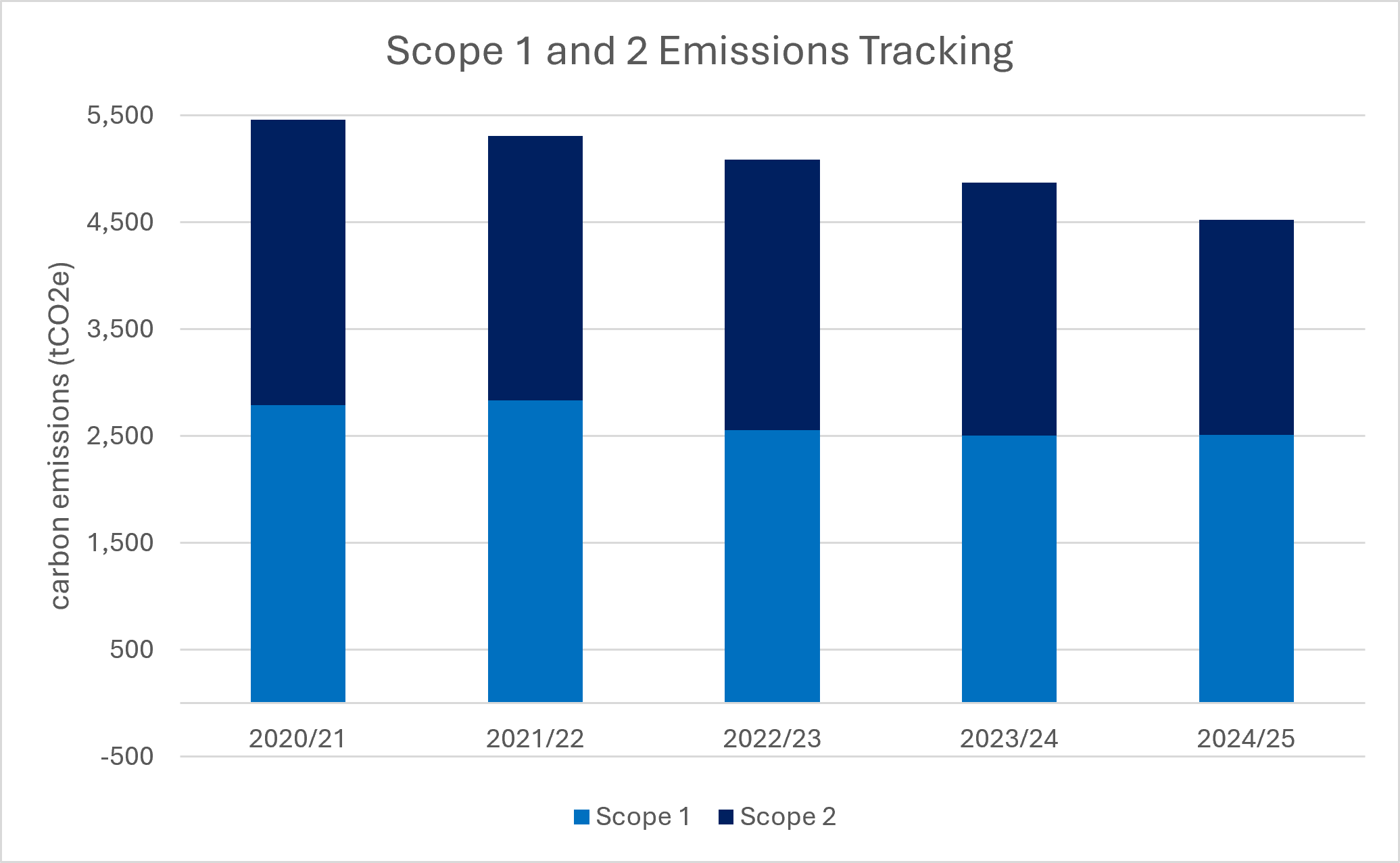
| 2020/21 | 2021/22 | 2022/23 | 2023/24 | 2024/25 | |
| Scope 1 (gas & fleet emissions) | 2,788 | 2,835 | 2,555 | 2,504 | 2,511 |
| Scope 2 (Electricity) | 2,671 | 2,473 | 2,534 | 2,370 | 2,013 |
| Total Scope 1 & 2 (tCO2e) | 5,459 | 5,308 | 5,089 | 4,874 | 4,524 |
Since establishing the new 2020/21 baseline, the University has reduced its emissions by 17%. This progress has been driven by a range of key initiatives, including:
- Consolidating office space and mothballing underutilised areas
- Introducing a 1°C temperature reduction across buildings during winter
- Decommissioning the Wellingborough data centre and consolidating operations to Walton Hall
- Continuation of LED upgrade works
- Decommissioning the Wellingborough data centre and consolidating operations at Walton Hall
- Retrofitting the OU in Wales Cardiff office, including LED lighting upgrades, installation of a 14.5 kW solar PV system with battery storage, high-efficiency reverse-cycle air conditioning units, and a Building Management System (BMS) upgrade
For more information on how to get involved with sustainability at The Open University, please visit the main sustainability webpage.


This work feeds into the OU's support of the above UN Sustainable Development Goals.
Contact us - General
Email : Estates-Liaison
Estates Liaison Line:
+44(0)1908 653286
Main Switchboard
+44(0)1908 274066
The Open University
Estates
Geoffrey Crowther Building
Walton Hall
MILTON KEYNES
MK7 6AA
Opening Hours:
08:00-17:00 Monday-Friday
Contact the OU
Estates Related Sites


Explore

Undergraduate
Postgraduate
Policy
-
Follow us on Social media
-


