
Good EDI practice - Equity, Diversity and Inclusion Strategic Plan
4. Good EDI practice
4.1 Our commitment to sharing good practice and collaboration
The University is committed to sharing good EDI practice and collaborating so that equity, diversity and inclusion are not isolated initiatives but part of a coherent, university-wide approach. This supports a culture of continuous improvement and helps make the OU a university of choice for staff and students.
We already promote equity and belonging, embed EDI in training and KPIs, provide platforms and a central EDI repository to share evidence-based practice, use existing channels to highlight impact, and draw on EDI champions and staff networks to share good practice and spread learning.
To further strengthen this approach, we will use key vehicles for change to embed, evaluate, and scale effective EDI practice across the institution. This will include:
- Enhancing training and professional development to build capability and confidence in delivering inclusive practice across all roles.
- Strengthening the use of data and dashboards to better understand disparities, monitor progress, and inform decision-making.
- Developing evaluation mechanisms to assess the effectiveness and impact of EDI initiatives and ensure accountability.
- Drawing on research and scholarship to inform practice and assess what works in improving outcomes for staff and students.
- Identifying and scaling effective approaches to reduce duplication, share learning, and embed successful practice across faculties and units.
We will further encourage innovation and accountability in delivering the EDI Strategic Plan by increasing the sharing of good practice and reducing duplication of effort; establishing a community of practice aligned to the EDI priority areas; promoting peer learning circles between units and faculties; and creating more opportunities to showcase successful, evidence-based EDI initiatives that improve outcomes for staff and students.
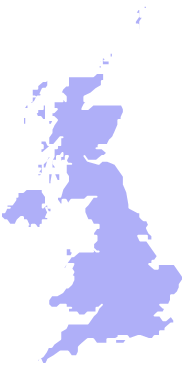
4.2 Good EDI practice in the Nations
The Nations play a key role in delivering the EDI Strategic Plan as part of the devolved operating model of the University. Acting under the authority and strategic direction of central governance, the Nations are responsible for translating institutional priorities into locally relevant action, ensuring effective delivery, engagement, and policy alignment within their contexts. This includes working with local stakeholders, identifying and responding to nation-specific needs, and embedding EDI principles across activities and decision-making. While aligned to the overarching strategic framework, the Nations have the flexibility to prioritise and tailor delivery to reflect local demographics, challenges, and opportunities, enabling a more responsive and impactful approach to advancing equity, diversity, and inclusion across the institution.

The Open University in Ireland
Legal context
EDI activity in Northern Ireland (NI) is underpinned by the Northern Ireland Act 1998, which deems the University to be a Public Authority. This means we are required to:
- give due regard to the promotion of equality of opportunity across the protected characteristics covered by Northern Ireland equality legislation
- give regard to the promotion of good relations between the two community traditions.
Together, these commitments form our statutory equality duty.
Since 2012, a single OU Equality Scheme has met the legislative requirements of the UK as a whole, including our duties in Northern Ireland. Each year, we offer an Annual Progress Report to the Equality Commission for Northern Ireland (ECNI), evidencing progress against our equality duties and the commitments made in the OU Equality Scheme. We also have a statutory duty to provide Fair Employment data to ECNI on the composition of our workforce in Northern Ireland.
Access and Participation
In our Outcome Agreement with the Department for the Economy, we have committed to address regional imbalance, widen access and participation, and raise productivity by tackling barriers to education access.
To meet our access and participation goals, we are further developing strategic partnerships with key stakeholders, including AWARE NI, The Kings Trust and Libraries NI, to introduce more people from widening access demographics to the benefits of lifelong learning.
We are also working to:
- support more young people with a statement of Special Education Needs to access higher education through the OU
- diversify our marketing casebook by developing new student case studies, featuring women studying STEM subjects, students with a shared disability; and young men from IMDQ1 areas, to showcase skills and employability messaging.
Reaching and supporting students across Ireland
We will continue working to reach all areas of Ireland through our core recruitment activity and validation agreements with Further Education colleges in each Northern Irish county.
We also provide tailored advice and guidance to scholarship students in Ireland, including Black Open Futures, Carers, Inclusive Futures and Sanctuary scholars.
Future priorities

Over the coming years, in support of the EDI Strategic Plan, the OU in Ireland will engage with a range of strategic and legislative initiatives which intersect with our legal duties, including the Northern Ireland Disability Strategy 2025-2035 (Department for Communities), race equality legislation reform, a new departmental Widening Participation Strategy, engagement with the Office of Identity and Cultural Expression, and developing relationships with grassroots organisations in the LGBTQIA+ space.
The Open University in Wales
Legal, regulatory and funding context
EDI legislation in Wales is anchored in the UK-wide Equality Act 2010 which protects individuals from discrimination based on nine characteristics.
In Wales, distinct specific Statutory Duties (the 2011 Regulations) require listed public bodies, including educational institutions, to publish equality objectives, impact assessments, and engage with citizens.
The OU in Wales is regulated by the Office for Students (OfS) and funded by Medr, the body responsible for funding and regulating the tertiary education and research sector in Wales. We therefore support Medr in meeting its obligations as a listed public educational body in Wales.
Social responsibility, wellbeing and future generations
In 2015, a landmark Welsh law was enacted which sets out five ways of working to enable public bodies to achieve seven wellbeing goals. The Wellbeing and Future Generations Act 2015 calls for “a society that enables people to fulfil their potential no matter what their background or circumstances” and is inspired by indigenous wisdom and the Seventh Generation Principle. The Act guides and encourages a collective endeavour to improve the economic, social, environmental and cultural wellbeing of Wales.
Aligned to the UN Sustainable Development Goals and reflecting the approach set out within the Inner Development Goals, the OU in Wales has developed an integrated approach to inclusion, bringing together EDI, Sustainability and Wellbeing under the banner of “Social Responsibility”.
The rich intersections that exist between these disciplines underpin our approach to ensuring that the OU in Wales reflects and contributes to the wider OU mission to be inclusive, ethical, and socially responsible.
Race equality and anti-racism
To support Welsh Government ambition to make Wales an anti-racist nation, we have proactively supported and informed The OU’s Race Equality Charter Bronze Award work. We have also designated bespoke resources to embed the identified actions across the University’s work.
Our evolving cohort of champions supporting social responsibility work will enable the OU in Wales to continue taking a proactive and holistic approach that supports, guides and empowers staff and students to embody our inclusive principles.
Access, participation and socio-economic inequity
The OU recognises that socio-economic deprivation is a key driver of inequity. Students residing in IMDQ1 are therefore prioritised within the Access and Participation Plan (APP). This is particularly relevant in Wales, in the context of the Wales Socio-economic Duty and where socio-economic inequity continues to shape access, participation and student outcomes.


The Open University in Scotland
Legal, regulatory and funding context
The Scottish Funding Council (SFC) embeds EDI as a cross cutting requirement across its entire Outcome Framework and Assurance Model (OFAM). This means we must evidence how EDI is integrated into governance, planning, delivery, and monitoring of all outcomes.
We must also demonstrate compliance with EDI legislation through Public Sector Equality Duty (PSED) reporting, and delivery of National Equality Outcomes (NEOs). These include:
- improving success, retention and satisfaction across protected characteristics
- reducing gender imbalances
- improving disabled students’ experience
- supporting mental health
- tackling harassment
- ensuring representative staff, Boards and Courts.
Other statutory requirements in Scotland include The Children and Young People (Scotland) Act which places ‘corporate parenting’ responsibilities on all post‐16 education bodies, and the British Sign Language (Scotland) Act which requires all public bodies to publish a BSL action plan.
Our approach to EDI in Scotland
The OU in Scotland demonstrates to the SFC that EDI is:
- Strategic: embedded in governance, planning and financial decision-making.
- Evidence-based: underpinned by robust data and Equality Impact Assessments (EIAs).
- Integrated: visible across teaching, research, estates, student experience, and workforce culture.
- Improving: supported by clear actions to address inequalities and enhance outcomes for students and staff.
Corporate parenting and support for carers
Through delivery of our Corporate Parenting Plan, we have seen an increase in the number of undergraduate entrants declaring care-experience which we are proud of. We continue to support sector initiatives that raise awareness of corporate parenting in higher education and the language of care, utilising OpenLearn Create where suitable and where opportunities arise.
Through our work in Scotland to support carers, the whole OU was awarded Carer Positive (Established) status, an award operated by Carers Scotland on behalf of the Scottish Government.
Future focus areas will include:
- Exploring disparities in completion, continuation and pass rates to identify where further support may be needed.
- Continuing to embed student voice
- Raising staff awareness of Corporate Parenting responsibilities
- Strengthening partnerships with other Corporate Parents (e.g., Hub for Success, CEECEF)
Partnership work
The OU in Scotland works in partnership with a range of organisations to support work on racism, gender balance, gender-based violence, estranged students and forced migration.
We also participated in Scotland’s first survey on the prevalence of Gender Based Violence (GBV) at Scottish HEIs. This survey was led by EmilyTest, the GBV in education charity, and was the first ever Scotland-based survey of its kind across universities and colleges.

4.3 Overarching activities and practice
Equality Impact Assessments (EIAs)
EIAs ensure that every policy, project or service is designed and delivered in a way that is fair, inclusive and does not disadvantage any group. By systematically assessing the potential effects of our decisions on people with protected characteristics, as well as factors such as caring responsibilities, socioeconomic background and intersectionality, EIAs help us identify risks early, plan mitigating actions and embed equity thinking into everyday practice. They also enable us to meet our legal duties under the Public Sector Equality Duty (PSED), Equality Act 2010 and Section 75 of the Northern Ireland Act 1998 by demonstrating how we consider equality in our decision making.
In June 2026, an updated EIA template (2026) and EIA screening tool (EIA-ST) were launched to streamline and simplify the process for authors. The EIA-ST is a webform that gathers background information on new or significantly amended activities to help the EDI team better support and inform authors if a full EIA is needed (as not every activity will need a full EIA). This prevents unnecessary completion of full EIAs if not required and ensures the EDI team is involved earlier and more effectively. In addition to this, guidance has been created on what 'significant amendments' includes, and information has been added to the EIA intranet page on supporting documents / processes that may be required if an author is introducing a new activity. Accessing EIAs has also been made easier for staff, as they can now be accessed directly via the Intranet A–Z. We will continue to update our webpage(s) and publish relevant guidance to support the EIA process for staff where and when applicable.
Staff Networks
Staff networks create safe, supportive spaces where staff can share experiences and strengthen belonging. They also provide lived experience and insights that help the University shape more inclusive policies, practices and decision-making. They increase visibility of diverse groups and play an active role in driving cultural change across the OU. We recognise the value they bring, which is why we are committed to supporting them with dedicated budget, full-time equivalent (FTE) release time for chairs/co-chairs, and ongoing guidance from the EDI team, ensuring networks have the resources they need to thrive and contribute effectively to institutional EDI priorities.
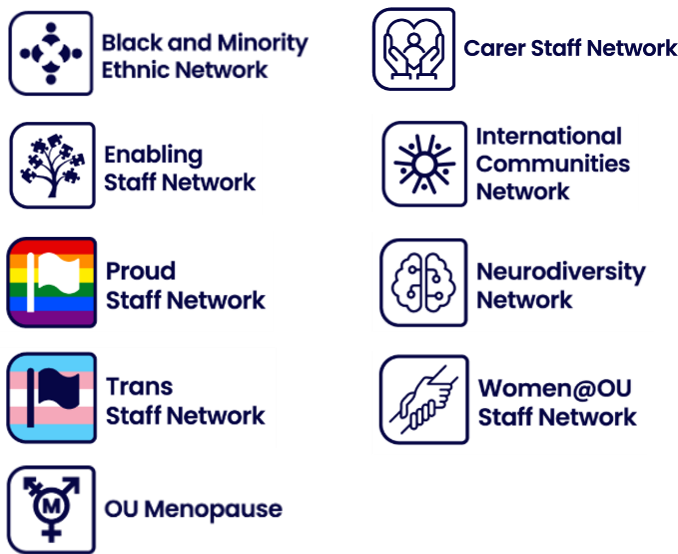
At the OU, we have 9 Staff Networks:
- Black and Minority Ethnic Network
- Carer Staff Network
- Enabling Staff Network
- International Communities Network
- Proud Staff Network
- Neurodiversity Network
- Trans Staff Network
- Women@OU Staff Network
- Menopause Moments
Student support, connection and community
OpenSU (Students Union) provides a number of ways in which students can access support, advocacy and advice as well as opportunities for students to form connections with each other and build student-led communities.
Below are some examples of student-centred support activities:
- Welcome Week
- Individual Representation Service
- Community drop-ins
- OU Students Connect
- OU Pride
- Equality, Diversity and Inclusion newsletter
- Black, Asian and Minority Ethnic Students Group
- Disabled Students Group
- OU Wellbeing App
- Allyship Hub
- Menopause Support Hub
- Neurodiversity Support Hub
Carers at the OU
The OU recognises that caring responsibilities are a significant, and often under-acknowledged, part of colleagues’ and students’ lives. Caring intersects with multiple dimensions of inequity, including gender, wellbeing, career progression and engagement. Women are more likely to experience a “double burden” of paid work and unpaid care, while men may face barriers to openly identifying as carers or seeking support due to workplace norms and expectations.
The OU has taken steps to strengthen support for colleagues and students with caring responsibilities, including:
- clarifying entitlements and the process for requesting unpaid Carer Leave through the Dependants and Carers Leave Policy and Procedure
- launching the Carer Passport institution-wide in January 2024, providing a confidential tool to support conversations between carers and line managers about support needs and working arrangements
- linking the Carer Passport to related support, including Agile Working, Career Breaks, Wellness Action Plans and Contingency Leave
- adding Supporting Carers as a Manager to the People Manager Toolkit in 2025, enabling managers to respond more effectively and consistently to carers’ needs
- maintaining membership of Employers for Carers to support our carer-inclusive practice
- supporting the Carer Staff Network, which provides peer support and helps shape institutional practice
- strengthening collaboration between the Carer Staff Network and the Athena Swan team, ensuring care is reflected in the new Athena Swan Action Plan
- achieving Carer Positive Established status in OU Scotland through our work supporting carers at the OU and through sector-wide initiatives.
Together, these actions help normalise conversations about caring, support more consistent management practice, and provide a clearer framework for colleagues and students with caring responsibilities.
The Access and Participation Plan (APP)
The APP is committed to removing the barriers identified as perpetuating disadvantage and inequity for Black students, students with mental health difficulties, and those from areas of socioeconomic disadvantage. Together, these groups represent around 30% of OU students. Our goal is to address the challenges within the University’s culture, systems and practices and to strive for structural change, supported by the OU’s annual financial commitment of £2.5m towards activity designed to reduce inequity. By establishing equity as our foundation, we aim to move beyond making adjustments to accommodate unequal opportunities and instead create lasting change.
Inclusive Curriculum
The Inclusive Curriculum Tool (ICT) was developed in 2018 to help authors and editors review OU curriculum content, including assessment, to improve inclusion and accessibility. Its use has been mandated by VCE Academic for all new curricula since March 2022. Version 6, launched in September 2023, includes 56 prompts covering all protected characteristics, supported by guidance and resources to inform revisions and content development. Version 7, now in development, will move the ICT to a digital platform, integrate OU-developed AI tools, and improve coverage, consistency, and impact evaluation.
Learning and Development
- Allyship Programme. In 2024, we launched our Allyship Programme to empower colleagues to become effective allies and actively contribute to our Equity goal and inclusive University culture. Through the programme, colleagues gain a deeper understanding of why action is needed and how to use their power and privilege to help build a more equitable University and society. So far, across two cohorts, more than 300 colleagues have engaged with allyship learning and over 90 have completed the full programme.
- EDI Learning Hub. Also in 2024, we introduced the EDI Learning Hub as a central platform and starting point for individual learning, where colleagues can deepen their understanding of a wide range of EDI topics. The Hub offers a wealth of resources, including open-source content such as online articles, YouTube videos, and TED talks, alongside materials created by the OU EDI Team and colleagues across the University. It also acts as a central mechanism for delivering and signposting learning linked to REC and Athena Swan action plans, supporting staff engagement with key EDI priorities. Recognising that EDI is a collective responsibility, the Hub is a valuable tool in our journey to becoming a more inclusive community. By offering foundational knowledge and diverse viewpoints, it aims to broaden perspectives, amplify the voices and experiences of marginalised communities, and support everyone in their EDI learning.
- New Equity and Inclusion Essentials mandatory training. In August 2026, we replaced Equality Essentials with the new mandatory Equity and Inclusion Essentials course. Updating and improving the course was an action within the Athena Swan Bronze action plan. Developed in-house by the EDI Team, the new course provides a fresh and up-to-date foundation to key EDI concepts, our legal duties and what good equity practice looks like in everyday work at the OU. The training underpins delivery of both REC and Athena Swan actions by establishing a consistent baseline of knowledge and expectation across the University. We have worked with a range of internal stakeholders to ensure the course is relevant to our community, aligned with our equity commitments, and offers clear, practical guidance on what EDI means at the OU.
- Union Black. In 2024, we published the one-hour version of the Union Black course on OpenLearn and MyLearningCentre (MLC). The course explores the history and experience of people racialised as non-white. It is designed to inform, inspire, challenge and enable staff and students to take steps towards anti-racism.

Contact us
Equality, Diversity and Inclusion
The Open University
Walton Hall
Milton Keynes
MK7 6AA
Email [email protected]


Explore

Undergraduate
Postgraduate
Policy
-
Follow us on Social media
-


