
Game-based learning for police training in child interviewing [Ref 2.06]
Academic team: Dr Anne Adams, Jenny Hart, Andy Ryan
Policing partners: Lancashire Police, Metropolitan Police Service, Thames Valley Police
Status: Complete
We have developed an award-winning child witness interview training simulation (CWIS) that addresses gaps in the knowledge and skills of new recruits and serving officers when interviewing child witnesses to build rapport with children and develop the quality of communication skills. CWIS incorporates triggers for emotional recognition to support the training of rapport building of early career front-line police officers when interviewing children.
Embedding CWIS within training will enable the police to obtain the following benefits:
- Decreasing time taken to gain competency in child interviewing
- Promoting deeper understanding of the many factors affecting child interviewing in the real world
- Enriching traditional classroom training approach
- Enabling large-scale deployment outside the classroom
Outputs
| Title | Outputs type | Lead academic | Year |
|---|---|---|---|
| Co-created evaluation: identifying how games support police learning | Journal item | Adams, A | 2019 |
| Winning evidence | Article | Adams, A | 2018 |
| Child witness interview simulator for UK police - trailer | Video | 2017 | |
| Game-based learning for police training in child interviewing | Final Report | Adams, A | 2017 |
| Understanding engagement within the context of a safety critical game | Paper | Hart, J | 2017 |
| Simulation-based learning for police training in gaining initial accounts from children | Conference poster | Adams, A | 2017 |
| Game-based learning for police training in child interviewing | Executive summary | Adams, A | 2016 |
| Exploring emotion representation to support dialogue in police training on child interviewing | Conference paper | Margoudi, M | 2016 |
News
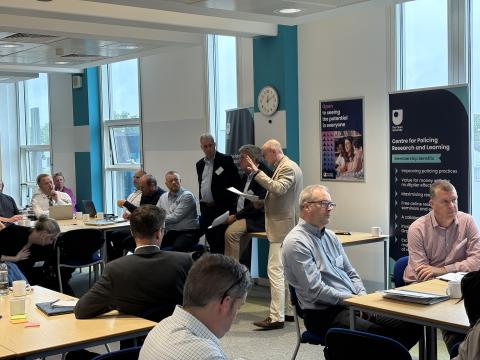
Blog post - Help shape the next chapter of CPRL
The future of policing will increasingly depend upon its ability to learn, innovate and collaborate.
- Blog post - From evidence to action: Convening partnerships to build more Inclusive Workplaces in policing
- Blog post - Building the next generation of football policing: Research, professional development and national learning
- From Conversation to Coordination: CPRL's Emerging Role in National Problem Solving


Explore

Undergraduate
Postgraduate
Policy
-
Follow us on Social media
-


