
Renewing CPRL: Governance, Collaboration and the Future of Policing Research
The Centre for Policing Research and Learning (CPRL) is entering a new phase of development at The Open University. The appointment of Professor Clifford Stott as Academic Director reflects a renewed institutional commitment to policing research following a period of uncertainty for both the Centre and the wider policing research landscape. It signals a clear ambition to reposition CPRL as one of the UK’s leading centres for policing research, innovation and collaborative problem solving.
As we are all aware, policing now confronts an increasingly complex landscape of challenges. From violence against women and girls, legitimacy and disproportionality, through to artificial intelligence, digital transformation, cyber-enabled crime and emerging technologies, the demand for robust, strategically focused research has never been greater. CPRL is uniquely positioned to respond because of one of its defining strengths: our national membership network and our capacity to mobilise collaboratively at scale.
Over recent months, and following feedback received through our Engagement Day in January, we have begun a substantial programme of reflection and reform designed to ensure CPRL is properly configured for the future. Central to that process is a renewed focus on the priorities of our member forces and partner organisations. Our aim is to strengthen CPRL as a genuinely national platform through which policing organisations, researchers and practitioners can identify shared challenges, reduce duplication, and develop evidence-informed solutions that address national priorites with direct operational relevance and impact.
One of the first areas requiring change has been our governance and engagement structure. Historically, the Membership Group Meeting (MGM) operated both as a dissemination forum and as the principal governance mechanism through which priorities and funding decisions were ratified. That model worked effectively in a pre-COVID environment where face-to-face engagement formed a central part of the Centre’s operation. However, the transition toward predominantly online interaction created new challenges. Over time, the distinction between governance, operational engagement and dissemination became increasingly blurred, and representation across the membership became less strategically coherent.
As a result, CPRL is now moving toward a revised model of engagement designed to strengthen representation, improve operational coordination and better reflect the realities of contemporary policing collaboration.
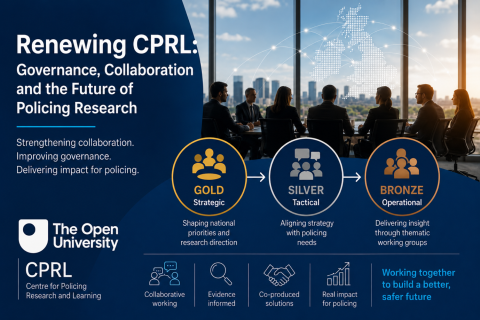
Perhaps this new structure is best understood in terms of a Gold–Silver–Bronze (GSB) JESIP-style architecture aligned broadly around strategic, tactical and operational functions.
As outlined in an earlier blog, our plan is that from October 2026 membership representation within CPRL will continue through the MGM, but increasingly this will operate at strategic and tactical levels, most likely through nominated Silver leads from member organisations. Our current intention is that operational engagement will transition into thematically aligned working groups organised around key policing priorities and areas of expertise. These ‘Bronze’ groups will provide the primary spaces for operational activity, shaping research agendas, generating operational learning, developing collaborative projects and supporting innovation through co-production. The Collaboratives will then provide a wider framework through which these activities connect into national dialogue, partnership development and knowledge exchange. Throughout this process, we will ensure that Gold-level leadership remains fully sighted on how CPRL is delivering against the strategic priorities set across the portfolio of collaborative activity.
This revised structure will allow CPRL to focus more clearly on developing meaningful research programmes, pursuing external funding opportunities, generating high-quality outputs and maximising research impact nationally. Importantly, it strengthens the relationship between operational realities and national policing priorities while ensuring that the Centre remains responsive to the needs of its members.
The transition toward our new governance and operational model will take place over the summer, with the intention that the next Membership Group Meeting in October will formally launch the new arrangements.
In the interim, The Open University has agreed the establishment of an Interim Executive Group (IEG) to support the transition process. The IEG will include representation from the current Chair and Vice Chair alongside Acting Strategic Engagement Lead Iain Raphael and University leadership. One of its principal tasks will be to oversee the development of the new governance arrangements and the election process for future leadership roles.
A particularly important part of this transition is ensuring that our membership is represented in genuinely diverse and meaningful ways. We therefore anticipate appointing several Vice Chairs to ensure broad representation across policing and partner organisations, and we strongly encourage members interested in contributing strategically to the future direction of CPRL to consider putting themselves forward.
Under the proposed structure, the MGM will become a more focused strategic and tactical forum involving policing leads, university research leadership and wider stakeholders, including representatives connected to national scientific and policy agendas. The MGM will meet three times per year and will ratify the appointment of an Executive Group responsible for supporting CPRL’s operational governance and delivery between meetings.
Alongside these changes, CPRL is also developing a broader programme of collaborative activity, including national problem-solving forums, partnership events, research development initiatives and continuing professional development opportunities. Our ambition is to ensure CPRL becomes not simply a research centre, but a national platform for evidence-informed policing innovation capable of mobilising expertise rapidly and collaboratively around the major challenges facing policing and society.
These developments represent an important moment for CPRL and for policing research at The Open University. We are deeply grateful for the continued support and engagement of our members and partners and look forward to working collaboratively to shape the next chapter of the Centre’s development.
Published 11 May 2026
Upcoming Events
Membership Group Meeting
Thursday, October 15, 2026 - 10:30 to 12:30
Online, Microsoft Teams
Online seminar: TBC
Tuesday, November 10, 2026 - 13:00 to 14:30


Explore

Undergraduate
Postgraduate
Policy
-
Follow us on Social media
-


