
From Policing the Crowd to The Portland Framework: CPRL, Co-Production and the Future of Public Order Policing
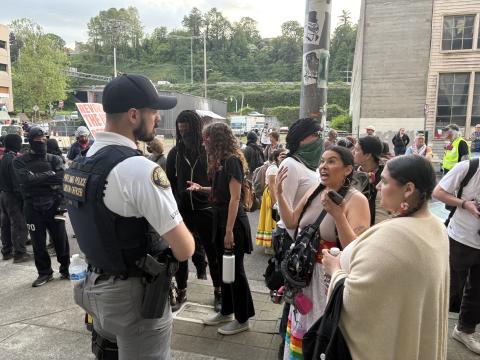
The recent publication of Policing the Crowd brought together more than two decades of research, theory, and operational experience examining the psychology of crowds and its implications for public order policing. At its core, the book charts a major shift in how crowd events are understood internationally: away from outdated assumptions that crowds are irrational and inherently dangerous, and toward evidence-informed approaches grounded in legitimacy, facilitation, communication, and dynamic interaction.
These developments are not merely academic. They have profound implications for how law enforcement agencies manage protest, major events, public disorder, and collective emergencies in increasingly complex social and political environments.
Few places currently illustrate these challenges more clearly than the United States. Over recent years, US law enforcement agencies have faced intensifying protest activity, heightened political polarisation, growing scrutiny of police legitimacy, and increasingly difficult operational environments surrounding public assembly and public order management.
Within this context, the Centre for Policing Research and Learning (CPRL) has been working closely with policing agencies across the United States through a series of collaborative projects funded by the US Department of Justice. These projects reflect the core principle around which CPRL operates - co-production between researchers and practitioners to generate operationally relevant evidence capable of informing real-world policing challenges.
Over the last five years this work has involved collaboration with a range of agencies across the US, including recent projects in Columbus, Ohio, and Portland, Oregon. These partnerships have focused on understanding how contemporary research in crowd psychology and police legitimacy can support more effective, proportionate, and constitutionally grounded approaches to public order policing.
One of the most important outcomes of this work has been a major workshop held recently in Portland, Oregon, bringing together law enforcement agencies from across the Western United States alongside researchers, practitioners, and organisations including the National Policing Institute and George Washington University. The workshop focused on one central question: what should Dialogue Policing look like within the specific legal, organisational, and operational realities of the United States?
Today CPRL is publishing the outcome of that process: The Portland Framework: Guidance for Dialogue Policing in the United States.
The framework represents what we believe is a significant milestone in the evolution of dialogue policing internationally. For the first time, agencies, researchers, and policing stakeholders have come together collaboratively to define a distinctively US-informed model of dialogue policing grounded not in the simple transfer of European practice, but in the operational experiences and constitutional context of policing in the United States itself.
The guidance is intended as a practical resource freely available to US law enforcement agencies seeking to develop dialogue-led approaches to public order policing. It brings together three interconnected components:
operational guidance and minimum standards for dialogue policing;
a professional profile defining the skills and competencies required of Dialogue Officers;
and a structured training framework to support capability development and professionalisation.
Importantly, the framework positions dialogue policing not as a passive or peripheral function, but as a central operational capability that supports situational awareness, improves command decision-making, reduces unnecessary escalation, and helps agencies deliver more proportionate and legitimate public order responses.
Alongside CPRL’s expanding work on football-related public order policing, protest management, police legitimacy, and crowd psychology, the publication of the Portland Framework highlights the increasingly important international role the Centre is playing in one of the most strategically significant areas of contemporary policing research and practice.
At a time when police agencies globally face mounting challenges around protest, legitimacy, public trust, and the management of collective events, the need for operationally grounded, evidence-informed, and collaboratively developed approaches to public order policing has never been greater.
Published 20 May 2026
Upcoming Events
Membership Group Meeting
Thursday, October 15, 2026 - 10:30 to 12:30
Online, Microsoft Teams
Online seminar: TBC
Tuesday, November 10, 2026 - 13:00 to 14:30


Explore

Undergraduate
Postgraduate
Policy
-
Follow us on Social media
-


