
Blog post - Managing Ultras in European football: Why cultural knowledge matters as much as intelligence
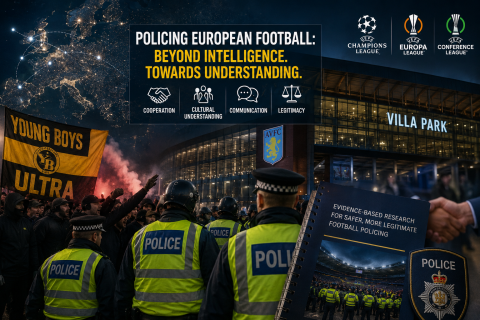
As English clubs once again enter the closing stages of all three European competitions, policing football-related disorder abroad and managing visiting Ultra groups in the UK remains a salient policing issue across the country. These fixtures take place within highly visible and politically sensitive environments where policing decisions can carry significant implications not only for public safety, but also for legitimacy, public confidence, and international relationships between clubs, supporters and police agencies.
It is precisely because these issues are so highly consequential, that the Centre for Policing Research and Learning (CPRL), working alongside West Midlands Police and international research partners, is publishing new evidence-based research examining the disorder that occurred during the UEFA Europa League fixture between Aston Villa FC and BSC Young Boys in November 2025.
The report, produced jointly by researchers from CPRL at The Open University and the University of Bern, forms part of an ongoing programme of international research examining the policing of football crowds and the changing dynamics of supporter behaviour across Europe. The study was supported through funding from the Swiss National Science Foundation and draws upon extensive ethnographic observational research conducted before, during and after the fixture itself.
The collective disorder that unfolded inside Villa Park was serious. Police officers were assaulted and injured, supporters were arrested, one of whom was imprisoned, and the match was temporarily disrupted following a confrontation between police and visiting supporters from the Young Boys “Ultra” movement. Yet one of the report’s most important findings is that the disorder was not pre-planned and cannot be understood simply through traditional assumptions about “risk fans” or organised hooliganism.
Instead, the report argues that the escalation emerged unintentionally and situationally through a series of interactional misunderstandings shaped by differing football cultures, contrasting expectations around legitimacy and authority, and failures in the transfer of culturally relevant knowledge during international police cooperation.
This distinction matters.
Historically, international football policing arrangements evolved in response to major incidents such as the Heysel stadium disaster and wider concerns around organised football violence. Over time, substantial progress has been made through the development of international cooperation frameworks, National Football Information Points (NFIPs), intelligence sharing systems and coordinated operational planning. The UK has played a leading role in much of that innovation.
However, contemporary European football presents new challenges. Increasingly, police forces across the UK are policing highly organised Ultra groups whose identities, leadership structures and supporter cultures differ significantly across Europe. While some groups contain individuals willing to engage in confrontation, the report highlights that risk is often interactional rather than dispositional. In other words, disorder frequently develops through how situations evolve, how policing actions are interpreted, and whether legitimacy and communication are maintained when they come under pressure.
A central finding of the report is that the protocols of international police cooperation currently remain too heavily focused on criminal intelligence and supporter categorisation, while giving insufficient attention to the transfer of cultural and identity-based interactional knowledge. The issue is not simply how many supporters are travelling, or whether individuals are considered “risk” supporters. It is also whether host forces understand the identities of the groups involved, how those groups organise themselves, how authority and social influence operates within them, what forms of behaviour are culturally normative, and which intermediaries possess legitimacy capable of supporting de-escalation.
The Aston Villa v Young Boys fixture provides a particularly important case study because the most serious disorder occurred not at the point of initial misconduct, but after a recognised intermediary within the Ultra group was arrested during what supporters understood to be an attempt to calm the situation. The report argues that this intervention unintentionally disrupted internal supporter regulation and transformed a containable situation into a collective confrontation.
The implications extend far beyond one match or one force and the patterns reflect confrontation with Ultra supporters elsewhere in the UK this season.
Many UK police forces now routinely police European competition fixtures and will recognise the operational pressures these events create. They involve international travel, unfamiliar supporter cultures, rapidly evolving crowd dynamics, intense media scrutiny and significant reputational risks. They also increasingly require policing approaches capable of balancing public safety, legitimacy and proportionality within highly complex environments.
The CPRL’s work in this area, including supporting the National Observer Programme for Football Policing, is designed precisely to help policing adapt to these changing realities. The aim is not to excuse criminality or minimise the seriousness of disorder. Rather, it is to understand more clearly how and why escalation occurs so that policing, clubs and partner agencies are better equipped to prevent it.
Importantly, the report also highlights the value of reflective practice and evidence-based partnership working. West Midlands Police engaged openly with the research process and worked collaboratively with CPRL and international partners to examine the incident critically and constructively. In doing so, the force demonstrated not just a willingness to learn from complex operational challenges and contribute to wider national and international learning around football policing but also the value of membership within the CPRL.
As English clubs continue to compete on the European stage, the operational challenges associated with policing international football are only likely to grow. The key lesson emerging from this research is therefore straightforward but important: effective policing of contemporary football crowds requires more than intelligence and enforcement alone. It also depends upon legitimacy, communication, cultural understanding and the ability to work alongside those capable of influencing crowd behaviour from within.
That is not a soft alternative to public order policing. Increasingly, it is central to getting it right.
Report available here.
Published date 18th May 2026.
Upcoming Events
Membership Group Meeting
Thursday, October 15, 2026 - 10:30 to 12:30
Online, Microsoft Teams
Online seminar: TBC
Tuesday, November 10, 2026 - 13:00 to 14:30


Explore

Undergraduate
Postgraduate
Policy
-
Follow us on Social media
-


