
Salmon farming in Scotland: Scope for positive change
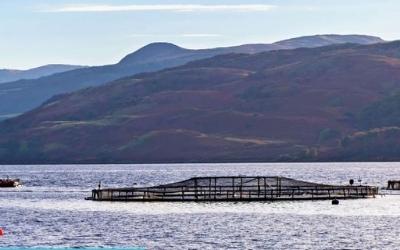
Researchers at The Open University’s (OU) and University of Edinburgh’s Innogen Institute have prepared a policy brief with evidence-based recommendations for governments and other stakeholders to reduce the global warming potential and negative biodiversity impacts of fish farming in Scotland.
The policy brief is based on the OU-funded report: 'Fish farming in Scotland: Optimising its contribution to climate and environmental policies', by Amy McGoohan, Joyce Tait, Alan Raybould, Stuart Parris and Kim Hammond.
As most of the world’s wild capture fisheries show signs of overexploitation, fish farming is set to have an increasingly important role in meeting global demands for protein from fish and shellfish.
Scotland produces 200 Ktonnes/year of farmed salmon and the industry’s ambition is to double production by 2030.
The sector is already investing heavily in innovations that can increase production and at the same time contribute to lowering the carbon footprint, protecting biodiversity and ensuring high standards of animal welfare.
However, to fully realise the benefits of such innovations, a supportive circular economy and policy environment is required to deliver optimal outcomes across the entire value chain.
The policy brief makes several recommendations to achieve this. These include:
- Creating policy and economic incentives for producing and using novel sustainable aqua-feed ingredients given that the greatest impact in lowering global warming potential and protecting biodiversity will come from novel aqua-feed ingredients, such as single celled protein or insect meal developed as part of a circular bio-economy.
- Using life cycle analysis or an equivalent approach to prioritise support for innovations or combinations of innovations that will have the greatest impact on both climate change and biodiversity objectives.
- Developing and implementing a public communication strategy that supports stakeholder understanding of the value of innovative technologies in meeting widely agreed societal objectives – Net Zero, a circular economy and preventing biodiversity loss.
The policy approach proposed in the brief could contribute to international discussions on aquaculture-related initiatives, and is relevant to other sectors in which technological innovations can help deliver climate change and biodiversity objectives.
Professor Joyce Tait, lead author of the policy brief and Co-Director of Innogen, said:
“Innovative technologies are key to shift food production systems towards achieving net-zero emissions as part of a circular bio-economy.”
News

Nearly half of Scottish grads first in family to attend uni
OU graduation ceremonies have taken place in Glasgow, celebrating the class of 2026 and recognising four honorary graduates.

Former trucker shifts gears to pursue doctorate
A former truck driver is on the road to becoming a Doctor of Clinical Psychology with the NHS after a return to education revealed undiagnosed learning difficulties.
Media contacts
Media enquiries
OU in Scotland Media Relations:
Call 0131 549 7932
OU UK Press Office:
Call 01908 654316
Out-of-hours:
07901 515 891
Visit our OU UK news site
Newsletter
Sign up for our quarterly e-newsletter, Open Outlook.


Explore

Undergraduate
Postgraduate
Policy
-
Follow us on Social media
-


