
How arts and culture can act as a vessel for climate action

Author:
Jessie Lindsay is a freelance Arts and Heritage Project Producer and Climate Literacy Trainer. She is studying towards a Bachelor of Arts (Honours) in Environmental Science with The Open University in Scotland.
Ahead of the Edinburgh Science Festival 2026, Jessie Lindsay, an Arts and Heritage Project Producer and Climate Literacy Trainer, considers how arts and culture can be used as an effective catalyst for environmental change. Jessie previously worked as a Science Communicator at the festival, teaching children about renewable energy and how to build wind turbines.
When I mention climate change to my friends they roll their eyes, and I don’t blame them.
Our social feeds are saturated with crisis narratives and disillusionment. Is it real, is it not? Can we do anything about it? From my own conversations, many people pass the responsibility on to others and accept there is nothing they can do. End of discussion.
Different way to host climate conversations
However, I believe arts and culture can repair these wounds and offer a different way to host climate conversations; one that isn’t controlled by the usual media narratives.
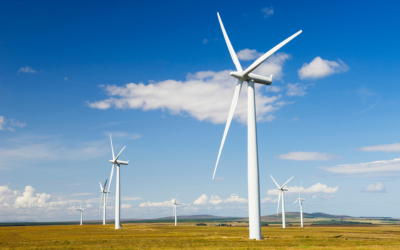
A lot of my work centres on how communities rely on one another, and explores the ways we can live through mutual support and exchange of knowledge.
Bringing people together through art and culture can show people how environmental damage and social inequality are interconnected.
When communities share their experiences, it builds empathy and a sense of shared responsibility for how we treat each other and the planet.
Through art, we can tell stories of climate justice and hope to empower people to take local action.
A connecting, common language
What data is to science, art is to society: evidence of our impact on the world. Creative practice translates what data cannot – values, emotions, lived experiences – into a common language people feel more connected to.
This connection is what drives people to engage with climate action, not news headlines and statistical reports.
Through art, we can tell stories of climate justice and hope to empower people to take local action.”
Throughout my Open University journey, my understanding of policy has changed. I no longer view it with criticism.
Instead, I view it as transformative, as an opportunity to create a set of instructions that will lead the way towards positive change. Without policy, people can only guess how to act.
One of my key goals is to bring policymakers and creatives together, along with scientists, to challenge our capabilities to meet Scotland’s commitments to the United Nations’ Paris Agreement and have a stronger response to climate change.
The solutions are out there, but our processes of devising policy have become stagnant.
Creative influence in decision-making
I would like to see more creative influence in decision-making – giving people an opportunity to reimagine our infrastructure, our cities, society and relationship with the natural world.
With this in mind, I am in the process of establishing a Community Interest Company in Social Climate Action. Where we will work with community leaders to embed sustainability and resilience.
Without creativity, climate conversations run dry. The best engagement I have witnessed is by bringing people together through art, heritage and culture.”
Our first initiative is learning firsthand about community shares in renewable energy companies.
It is both a research project and an artistic response to the environmental and social impacts brought to a village on the east coast of Scotland by the expansion of a wind farm.
I am also currently managing the production of an artist-led, community project ‘What A Beautiful Place To Fall Over’, documenting Leith in the face of gentrification.
The work uses music, poetry, photography, filmmaking and live performances as a way to explore how social landscapes are changing and the impact this has on local businesses.
Without creativity, climate conversations run dry. The best engagement I have witnessed is by bringing people together through art, heritage and culture.
I see creativity as a frontier for common ground. While people have different beliefs, we can engage by our shared behaviours – through music, movement, tradition and celebration.
Simply put, creativity is the excuse to get together, climate is the action to be discussed, and heritage is what reminds us of our place in the world, our values and our accountability to the planet and one another.
News
New approach to grow support for tree planting
A free tool for planners and community groups has been published by researchers.
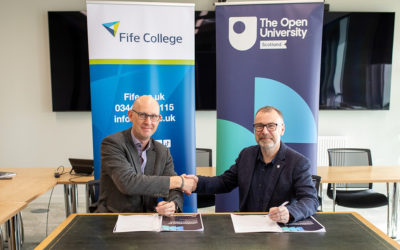
New investment to create Fife skills partnerships
A three-year programme will create clearer routes from Fife College to degree-level Open University study.
Media contacts
Media enquiries
OU in Scotland Media Relations:
Call 0131 549 7932
OU UK Press Office:
Call 01908 654316
Out-of-hours:
07901 515 891
Visit our OU UK news site
Newsletter
Sign up for our quarterly e-newsletter, Open Outlook.


Explore

Undergraduate
Postgraduate
Policy
-
Follow us on Social media
-


