
Flexible learning helps neurodivergent students thrive
_0.png) Author:
Author:
Lindsay Wilson, Depute Director of Student Experience at The Open University in Scotland.
In this short blog, Lindsay Wilson, Depute Director of Student Experience at The Open University (OU) in Scotland, explores how flexible learning is helping neurodivergent students to access higher education and to achieve their ambitions.
Over the past decade, the number of students with autism studying with The Open University has increased almost ten-fold. For me, this emphasises our commitment to supporting all learners.
One of the biggest misconceptions about university is that there is only one way to succeed. Too often, we assume that university students are young people coming straight from school, learning in crowded lecture halls and studying to fixed timetables, because that is what tends to happen in a classroom.
The reality is that not everyone learns in a straight line.
Removing barriers
For many neurodivergent students, traditional university environments can present significant barriers. But a different learning approach can make all the difference.
At The Open University, our flexible model allows students to study from home, or wherever they feel most comfortable and able to concentrate. There are no crowded lecture theatres and no expectation to be on campus every day. Instead, students can create routines and learning environments that work for them.
While this flexibility is often particularly valued by neurodivergent learners, it is important to remember that it benefits all students, including those who are parents, carers, and those balancing studying with working. We support all learners because everyone’s circumstances are different.
Our approach also offers an alternative route into higher education. Most OU undergraduate degrees have no formal entry requirements, and students apply directly to us rather than through UCAS. That opens doors for people who may have felt that university was not an option for them.
What is especially interesting about the increase in students with autism studying with us, is that we have not specifically targeted or advertised to learners who are neurodivergent. Instead, neurodivergent students are finding us through word of mouth. As we continue to improve support for neurodivergent students and develop staff knowledge and expertise, more learners are discovering that our model works for them.
Zara's story
 One student whose story has stayed with me is Zara Mahon. Several years after leaving school, having struggled academically and been told she had few prospects, Zara enrolled with The Open University. She went on to graduate with a first-class honours degree in psychology with counselling.
During her studies, one of Zara's tutors recognised that dyslexia might be contributing to the difficulties that she was experiencing and encouraged her to seek a diagnosis.
Zara said: “Getting that diagnosis changed my life. It helped explain some of the anxiety I experienced around studying. It was the puzzle piece that made those difficulties begin to make sense.”
Zara’s experience highlights the importance of recognising that students learn in different ways. It also demonstrates the value of having staff who understand how to support diverse learning needs.
Supporting students during their studies and beyond
Although our students study remotely, they are never studying alone. Students are supported by tutors throughout their modules, providing direct academic guidance. We also have specialist disability support teams who help students access the tools and adjustments they need to succeed, whether that involves accessible study materials, specialist technology or assessment accommodations.
Our commitment to supporting neurodivergent learners extends beyond our student community. We recently launched a free toolkit for parents, carers and educators to help them better understand and support neurodivergent children and young people.
Plus, our OpenLearn platform also hosts a dedicated Neurodiversity Hub, offering free courses, articles and resources covering autism, ADHD, dyslexia and other aspects of neurodiversity.
Although our students study remotely, they are never studying alone. Students are supported by tutors throughout their modules, providing direct guidance.”
We are also proud to be one of the first universities to sign up to the Scottish Tertiary Enhancement Programme (STEP) Language Accessibility Promise, which has been designed to enhance student-facing communication. It includes the commitment to communicate directly, clearly and honestly while showing compassion for and understanding of students’ needs and experiences.
Flexibility and quality
Flexibility should never be mistaken for a lack of ambition. Our courses are carefully designed, academically rigorous and supported by structured learning materials, clear assessment deadlines and expert teaching.
The OU is gold-rated for teaching excellence and was named University of the Year 2025 for Teaching Excellence. It is also ranked in the top three universities for student employability, while the OU in Scotland was ranked second in Scotland for overall student satisfaction in the 2026 National Student Survey.
Perhaps most importantly, we need to challenge the myth that doing university differently somehow means achieving less. An OU degree is not a less ambitious form of higher education. It is simply a different route to the same goal.
Higher education should be accessible to everyone with the ability and determination to succeed. Sometimes, that means recognising that there is more than one way to learn, and more than one path to achieving your ambitions.
A wide range of support and services is available for Open University students in Scotland.
This blog is a version of an article originally published in The Herald.
28 August 2026
News

New approach to grow support for tree planting
A free tool for planners and community groups has been published by researchers.
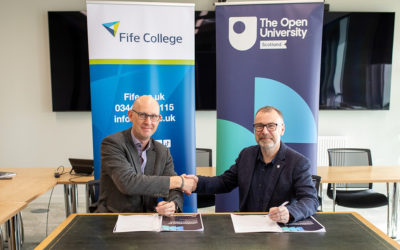
New investment to create Fife skills partnerships
A three-year programme will create clearer routes from Fife College to degree-level Open University study.
Media contacts
Media enquiries
OU in Scotland Media Relations:
Call 0131 549 7932
OU UK Press Office:
Call 01908 654316
Out-of-hours:
07901 515 891
Visit our OU UK news site
Newsletter
Sign up for our quarterly e-newsletter, Open Outlook.


Explore

Undergraduate
Postgraduate
Policy
-
Follow us on Social media
-


