
Earn-and-learn study to strengthen Scotland's workforce
 Author:
Martin Boyle is Principal of The Open University in Scotland.
As Scotland looks to the future of its public services, one challenge remains constant: how to build and sustain a skilled workforce. Across health, social care and education, demand continues to outpace supply, placing increasing pressure on employers to recruit, retain and develop staff.
While different policy approaches may emerge following the Scottish Parliament election, there is broad consensus on one point: Scotland needs flexible, accessible routes into professional careers, particularly for people already in work.
At The Open University (OU) in Scotland, this has been our mission for decades. Long before “earn and learn” became a policy focus, the OU built its approach around widening access, lifelong learning and supported distance education. Our model enables people to gain professional qualifications without stepping away from work, family or their communities.
Scotland’s national university for lifelong learning
As Scotland’s national university for widening access and lifelong learning, we meet people where they are – in their workplaces and communities. Over many years, we have developed a model that supports people to succeed in higher education alongside work and other commitments while directly responding to workforce needs.
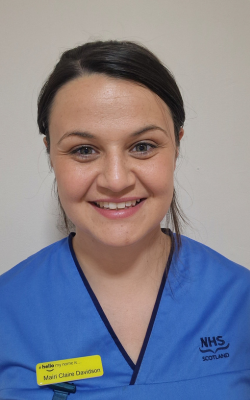
This is particularly visible in nursing, where our work-based degree programmes enable healthcare support workers to become registered nurses while remaining in employment.
This not only widens access to the profession but also strengthens healthcare services by developing talent already within the workforce.
I see the transformative impact of this flexibility every day. Take Mairi Claire Davidson, based in the Outer Hebrides, who was able to train and qualify as a nurse while continuing to live in the islands, allowing her to continue supporting her local community while developing professionally.
For people living in more remote parts of Scotland, flexible study can make the difference between accessing higher education or not.
Balancing study alongside family life was not always easy for Mairi Claire: “Lots of study was undertaken in my own time, often late at night when my children were in bed,” though she valued “the flexibility of being able to complete university work when it suited me.”
Without the option to study through the OU, she said she would never have uprooted her family and left the island to pursue nursing on the mainland.
Practice-based degrees
The same principle applies to our social work education. Our practice-based degrees allow students to qualify while continuing to work in care roles, supporting a vital “grow your own” approach for local authorities facing recruitment challenges.
Laura McHarrie’s journey reflects that model. Laura had never seen university as something that was “necessary”. It was only after joining Dumfries and Galloway Council as a Social Work Assistant that she was encouraged to develop her skills further and began studying social work with the OU while remaining in employment.
Balancing study with work and family life, including becoming a mother, Laura completed her qualification part-time over eight years while gaining experience across different social work teams.
She went on to graduate with first-class honours and now works as a Practice Educator within the Council, supporting new social work students during placements - a full-circle journey!
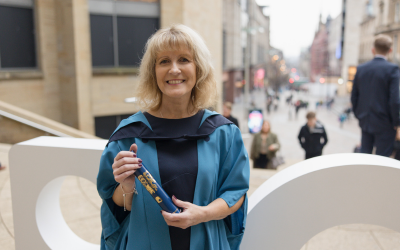
Fellow social work graduate Gina Wallace, who is profoundly deaf and studied with us while working full time, agreed on the importance of our flexibility and personalised support, especially to disabled students: “If you have a disability as I have, the OU support and guidance is five star.”
This integration of learning and practice is key to addressing Scotland’s skills challenges.
Employers need people who can develop in role, apply their learning immediately and remain within the workforce. That is exactly what our model delivers. And our contribution also extends to other sectors.
While we do not offer a Professional Graduate Diploma in Education (PGDE) in Scotland, we provide flexible professional learning for teachers and education practitioners in areas such as inclusive practice, leadership, pedagogical innovation, practitioner enquiry and digital education. This reflects our broader role in upskilling the existing workforce.
Supporting learners from diverse backgrounds
As the Scottish Government seeks to create a more responsive skills system, flexibility will become increasingly important. With open access, part-time study and a strong track record of supporting learners from diverse backgrounds, the OU continues to reach those who might otherwise be excluded from higher education.
This is about more than individual opportunity; it’s about building the workforce Scotland needs in a way that is inclusive, flexible and rooted in communities.
In a policy landscape evolving to meet complex workforce demands, the OU’s long-established work-based model offers a blueprint for what effective “earn and learn” can look like at scale.
This article was originally published in The Herald.
21 May 2026
News

New approach to grow support for tree planting
A free tool for planners and community groups has been published by researchers.
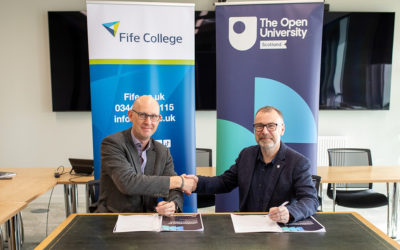
New investment to create Fife skills partnerships
A three-year programme will create clearer routes from Fife College to degree-level Open University study.
Media contacts
Media enquiries
OU in Scotland Media Relations:
Call 0131 549 7932
OU UK Press Office:
Call 01908 654316
Out-of-hours:
07901 515 891
Visit our OU UK news site
Newsletter
Sign up for our quarterly e-newsletter, Open Outlook.


Explore

Undergraduate
Postgraduate
Policy
-
Follow us on Social media
-


