
Believability: Park et al. (2023), ‘Generative Agents’
Suman Gupta (22/09/2026)
(1) Why is this publication of interest?
This paper, ‘Generative Agents: Interactive Simulacra of Human Behavior’ (Park et al. 2023), outlines the principles (the ‘architecture’) for a model that simulates the behaviour of a group of ‘generative agents’. The joint workings of these principles are demonstrated by describing such a simulation. The simulation takes place in a closed-world virtual environment (‘sandbox’), resembling a village, like those found in SIMS games. Simulations like this are generally conducted prior to introducing such agents for open-world interactions, or for analysing open-world conditions (social agent-based models).
The ‘generative agents’ are like gaming avatars without human players behind them. They are grounded here upon LLM (ChatGPT) processing. In the simulation described here, they are initially attributed some minimum features/identity markers and given memory feeds (observational and reflective/abstract). To meet a set objective (such as, organising a party), the agents interact and develop autonomously thereafter, correlatedly at individual and collective levels. Along the way interim or collateral objectives might appear. The agents’ identities and interactions are articulated in ordinary language, and their autonomous development works through LLM embeddings, via moves which follow complex chains of prompts-inferences. The developmental direction, we may presume, is determined through combinations of adversarial and cooperative calculations by the agents. For an observer, watching the agents’ individual/collective behaviours is akin to viewing an impromptu performance or a fly-on-the-wall documentary without human involvement.
The success of this simulation is gauged by what the authors present as a concept of ‘believability’:
Believable agents are designed to provide an illusion of life and present a facade of realism in the way they appear to make decisions and act on their own volition, […]. These agents can populate and perceive an open world environment like the one we inhabit, and strive to behave in ways that exhibit emergent behaviors grounded in social interactions with users or other agents with the aim of becoming believable proxies of our behavior in hypothetical simulations of individuals and communities. (Park et al. 2023: section 2.2)
Whether these generative agents in their sandbox are believable ultimately depends on observers finding them so. The concept of ‘believability’ in this specific iteration is of particular interest for literary/cultural studies researchers.
(2) What are the contexts of the point of interest?
The concept of ‘believability’ here appears to sit between two familiar and much discussed ideas.
On the one hand, it recalls the abidingly popular phrase ‘suspension of disbelief’. S.T. Coleridge used it originally for a mode of expression that makes the implausible/impossible (the supernatural) appear to be meaningful and even familiar, contra Wordsworth’s expression of the everyday as novel (Coleridge 2014 [1817]: 208). Critical elaborations of the phrase since have largely stayed with the contrary pulls between what is depicted (unbelievable) and how it is depicted (believably). A useful departure from that construction appeared in Norman Holland’s (2008) neuroscientific ruminations on the phrase, asking why readers enjoy fantastical or unrealistic narratives. He concluded that readers do not quite suspend disbelief but concurrently disbelieve and nevertheless go along with the unbelievable as believable. Actually, readers suspend their usual practical or responsible approach to everyday communications and assume a disposition of compliant distance/detachment towards unbelievable narratives. For human-machine communications, the phrase cropped up at the very early stages of chatbot development. When Joseph Weizenbaum developed one of the first chatbots ELIZA in the 1960s, he observed that those interacting with it ‘suspended disbelief’ (Weizenbaum 1976: 189) and felt they were having meaningful exchanges (effectively anthropomorphising the chatbot, widely studied as the ‘ELIZA effect’).
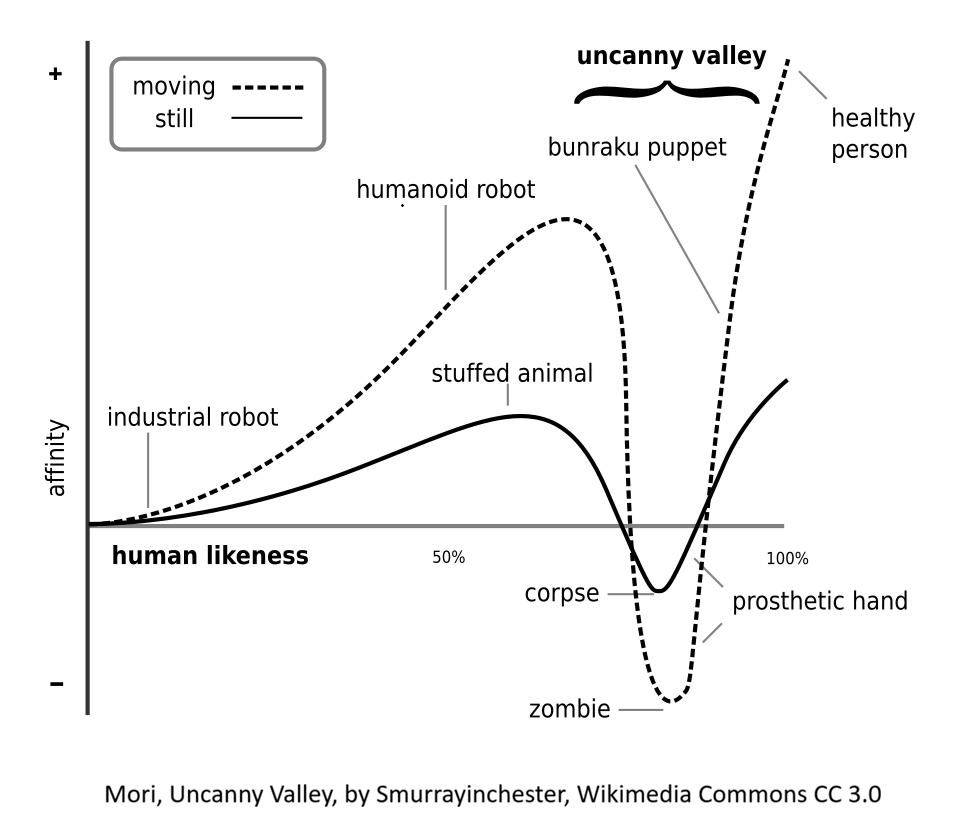
On the other hand, the concept of ‘believability’ recalls Masahiro Mori’s (2012 [1970]) formulation of the ‘Uncanny Valley’, variously elaborated since. This is more specific to human-machine interactions and seems to work against the anthropomorphising trend. In brief, towards humans/animals we usually extend a human affinity; however, when we discern some machinelike features where human/animal appearance and behaviour was anticipated, there’s a proportional dip in affinity – a feeling of eeriness or uncanniness creeps in (the dip is marked as the ‘uncanny valley’ in the graph alongside). Insofar as human affinity goes, the stiltedness or routineness of machine-like features has a negative effect on believability.
By negotiating between such ideas, the concept of ‘believability’ was ploughed for immersive video/computer games post-1990s. Until around 2020, the thrust of realising believable gaming avatars concentrated on neurosensory human actions/expressions rather than linguistic communication. It was understood that chatbot technology for ordinary-language (‘natural language’) communication wasn’t up to scratch. A useful overview of this phase is found in Hingson ed. (2012). However, the recent development of neutral networks like ChatGPT has made for a step-change in designing believable ‘generative agents’ by focusing precisely on ordinary-language communication in simulated situations, as the paper in question here shows (for more of a breakdown of such believability via LLMs, see Xiao et al. 2024).
(3) What points for further investigation and discussion arise?
Insofar as ‘believability’ goes, the main takeaway from Park et al. (2023) is that ordinary-language processing via LLMs offer a rich basis for simulations involving believable generative agents:
The key observation is that large language models encode a wide range of human behavior from their training data. If prompted with a narrowly defined context, the models can be used to generate believable behavior. (section 2.3)
That LLMs enable this is reasonably demonstrated; how LLMs enable this is an open question of the greatest interest for literary/cultural studies.
The established creative and critical practices of literature are powerfully invested in understanding how ordinary language is used to reflect, construct, and intervene in the world via texts. What is real or unreal, plausible or implausible, persuasive or unconvincing, compelling or anodyne in this respect is the very stuff of literary interests. The considerations attach to every element of literary attention to texts: themes, forms, stylistic/narrative ploys, contexts, etc. These established practices form a current condition of literary knowledge, which is ever open to more searching insights. Such LLM-grounded simulations offer scope for plumbing further depths in that direction. Concentrated attention to how LLMs enable ordinary-language processing towards believable social constructs could bring more granular and penetrating insights into our current creative and critical practices.
References
Coleridge, Samuel Taylor (2014 [1817]). Biografia Literaria. Edinburgh: Edinburgh UP.
Hingston, Philip ed. (2012). Believable Bots: Can Computers Play Like People? Berlin: Springer.
Holland, N. Norman (2008). Spider-Man? Sure! The neuroscience of suspending disbelief. Interdisciplinary Science Reviews, 33(4), 312–320.
Mori, Masahiro (2012 [1970]). The Uncanny Valley. Trans. Karl F. MacDorman and Norri Kageki. IEEE Spectrum, 12 June.
Park, Joon Sung, Joseph C. O'Brien, Carrie J. Cai, Meredith Ringel Morris, Percy Liang, Michael S. Bernstein (2023). Generative Agents: Interactive Simulacra of Human Behavior.
Weizenbaum, Joseph (1976). Computer Power and Human Reason: From Judgment to Calculation. San Francisco: W.H. Freeman.
Xiao, Yang, Yi Cheng, Jinlan Fu, Jiashuo Wang, Wenjie Li, Pengfei Liu (2024). How Far Are LLMs from Believable AI? A Benchmark for Evaluating the Believability of Human Behavior Simulation.
Image credit: Sunspiral (2014), Tetraspine Tensegrity Robot Simulation Crawling Over a Wall, via Wikimedia Commons, Creative Commons Attribution-Share Alike 4.0 International license


Explore

Undergraduate
Postgraduate
Policy
-
Follow us on Social media
-


