
Anaerobic Microbiology
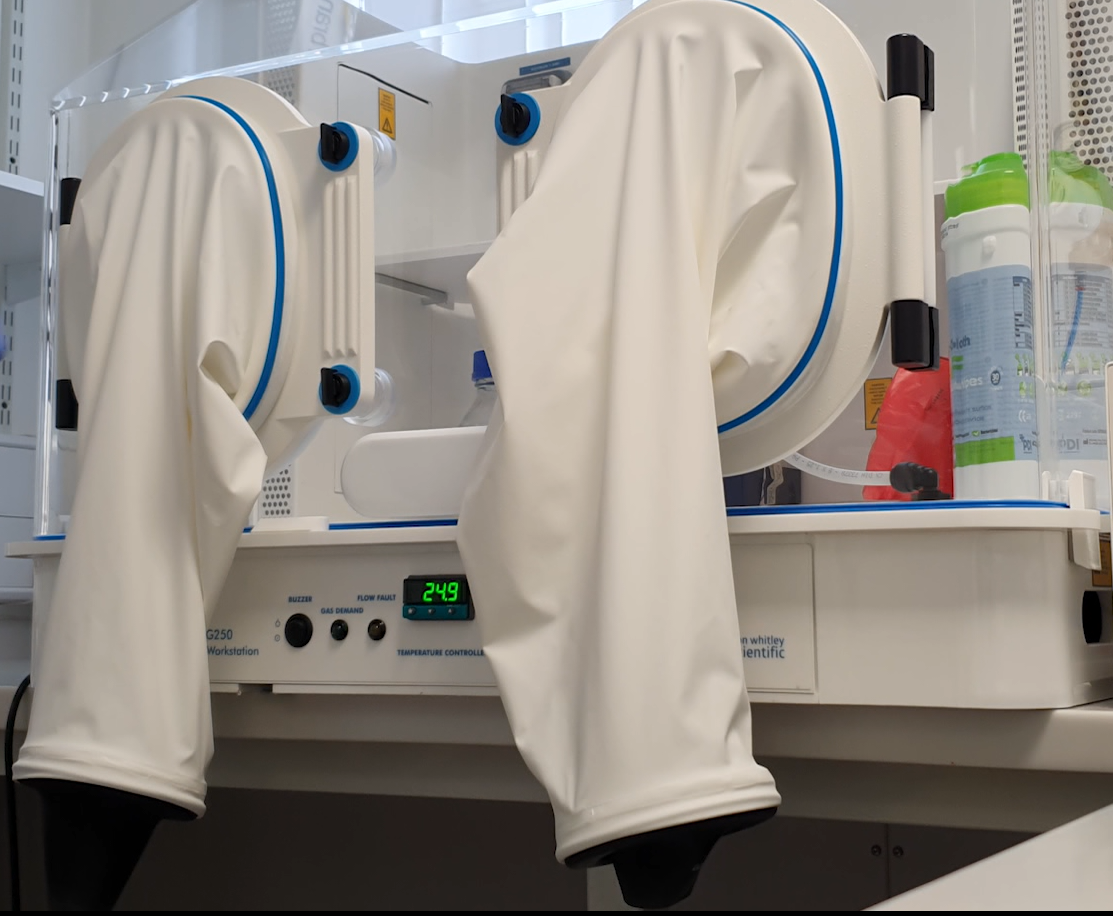
It is predicted that if life did exist elsewhere in the Solar System it would be predominantly anaerobic. AstrobiologyOU's anaerobic facility allows culturing and manipulation of samples under these conditions, which is used for studying microbial analogues of potential life.
Description
The anaerobic facilities consist of anaerobic chambers and gas purging stations. The anaerobic chambers are routinely used for preparing growth media and solutions and inoculating and sampling cultures. A designated chamber is allocated for working with environmental samples from anaerobic field sites.
The anaerobic chambers eliminate oxygen to 0-5 ppm using H2 (5 % or less) and a palladium catalyst to remove oxygen by forming water. Samples are transferred in and out of the chamber through a vacuum airlock to reduce the amount of O2 entering the chamber. Gloves attached to two large portals are used to manipulate samples within the chamber.
There are two anaerobic gas purging systems, which are routinely used to make anaerobic media and solutions, and to replenish headspaces of anaerobic cultures. Station A is a mixing station, which allows the composition of the gases to be mixed e.g. H2, CO2 and N2. Station B is a mixing station specifically for H2/CO2. An oxygen trap is incorporated into each of the stations to ensure oxygen does not enter the media.
Specification
Anaerobic chambers
| Detail | Coy Anaerobic Chamber | Don Whitley Chamber |
|---|---|---|
| Model | Coy 4ft polymer gloved manual purge airlock heated | DG250 |
| Volume | 410 L | 270 x 90 mm petri dishes |
| Dimensions | 1956 x 660 x 610 mm (l x d x h) | 810 x 760 x 635 mm (l x d x h) |
| Composition | Alloy C276 /316 SS | T316 Stainless Steel |
| Gas composition | 5 % H2 15 % CO2 80 %N2 | 5 % H2 15 % CO2 80 %N2 |
| Max and min temperature | Ambient +4 °C to 40 °C | Ambient +5 °C to 45 °C |
| Max and min humidity | Ambient | Ambient |
| Composition | Polymer |
Gas purge stations
| Detail | Station A | Station B |
|---|---|---|
| Gas mixtures | N2 or CO2 | |
| Max and min flow rate | ||
| Maximum pressure | 1.7 bar N2, 1 bar CO2 | |
| Composition of tubing |
| Station A - EGL115 | Station B - EGL116 | Station C - EGL117 |
|---|---|---|
| CO2/H2 (20% : 80%) | N2 | N2 and CO2 |
| Headspace gas mix | Purging station | Purging station |
For more details please read:
Macey, M. C., Fox-Powell, M., Ramkissoon, N. K., Stephens, B. P., Barton, T., Schwenzer, S. P., Pearson, V. K., Cousins, C. R. and Olsson-Francis, K. (2020). The identification of sulfide oxidation as a potential metabolism driving primary production on late Noachian Mars. Scientific reports, 10, article no. 10941.
Macey, M. C., Curtis-Harper, E. and Olsson-Francis, K. (2019). Draft Genome Sequence of Clostridium sp. Strain E02, Isolated from an Estuarine Environment. Microbiology resource announcements, 8(2)
Curtis-Harper, E., Pearson, V. K., Summers, S., Bridges, J. C., Schwenzer, S. P. and Olsson-Francis, K. (2018). The Microbial Community of a Terrestrial Anoxic Inter-Tidal Zone: A Model for Laboratory-Based Studies of Potentially Habitable Ancient Lacustrine Systems on Mars. Microorganisms, 6(3), article no. 61.
Contact
For all enquiries please visit our Contact page


Explore

Undergraduate
Postgraduate
Policy
-
Follow us on Social media
-


