
Vacuum and cryo-enabled micro-Raman spectroscopy
Micro-Raman spectroscopy is analytical technique that probes molecular structure. It is highly versatile, allowing researchers to identify both organic and inorganic compounds and visualise their spatial association on a microscale. In the AstrobiologyOU Icy Worlds Laboratory, micro-Raman spectroscopy is used in conjunction with a temperature and pressure-controlled sample stage (‘cryostage’) to subject samples to ultra-low temperatures and pressures typical of planetary environments. This equipment is routinely used to study the properties of materials such as ice, salts and organic compounds that may be found on the surfaces of icy worlds.
Description
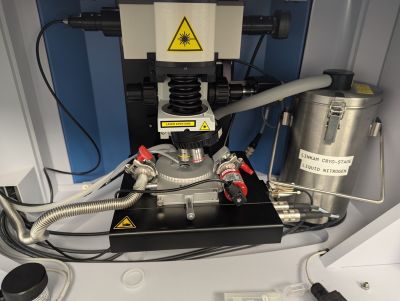 The Raman spectrometer is a Horiba Labram HR Evolution, equipped with x5, x10, x50 long working-distance objectives suitable for use with the cryo-stage. Excitation is available at visible wavelengths (532, 785 nm) and UV (He-Cd).
Cryostage temperature and pressure can be programmed to change at user-defined rates and/or hold at user-specified points. A variety of sample containers are available for the loading of both liquid and solid samples. Samples can be loaded at room temperature or into a pre-chilled stage.
| Cryostage specification | |
|---|---|
| Model | Linkam FDCS19 with motorized valve |
| Temperature range | Room temperature to -196 °C (77 K) |
| Cooling rates | 0.1 – 150 °C/min (to approx. -20 °C); 0.1 - ~130 °C/min (to -196 °C) |
| Heating rates | 0.1 – 150 °C/min |
| Pressure range | Ambient – 10-2 mbar (at room temperature); ambient – 10-3 mbar (at cryo temperatures) |
| Pressure change rate | User-defined; approximated as step-wise changes in pressure. |


Explore

Undergraduate
Postgraduate
Policy
-
Follow us on Social media
-


