

Regulating Failure: Corporate Harm and the Political Economy of England’s Water Crisis
The contemporary political economy of water provision in England offers a particularly stark illustration of how corporate harm is produced, normalised, and managed within a framework of regulatory accommodation. Recent developments surrounding the water industry do not reveal isolated failure or regulatory oversight; rather, they expose a system in which environmental harm is both anticipated and ignored, financial instability is accommodated, and accountability is continually deferred.
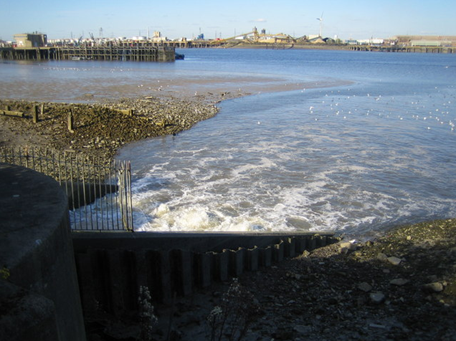
Image: River Thames: Crossness Sewage Treatment Works outfall by Nigel Cox, available via Geograph, licensed under CC BY-SA 2.0. (Depicting the discharge point of wastewater into the Thames, highlighting the structural embedding of environmental harm within privatised water systems, such as those operated by Thames Water).
At the empirical level, the scale of regulatory breach is no longer in dispute. Extensive inspection activity has demonstrated that non-compliance is widespread across the sector. As reported by Utility Week, “almost a quarter of 10,000 water asset inspections uncover breach”. This is not an outlier finding. ITV News describes a “record number of checks” uncovering “thousands of breaches”, while The Mirror similarly documents extensive violations of environmental rules. The consistent message across reporting is striking: the problem is systemic, not exceptional.
These breaches are not trivial. They relate to infrastructure central to environmental protection and public health, including wastewater systems and pollution controls. The UK government has emphasised the scale of inspection activity, noting that targets had been “smashed” through over 10,000 “health checks on water network” assets. Yet this emphasis on inspection volume risks obscuring a more fundamental issue: Whilst the expansion of monitoring has revealed the depth of non-compliance, but it has not been matched by a commensurate escalation in enforcement.
This disjuncture—between detection and consequence—sits at the heart of the current crisis. From a critical criminological perspective, what is being exposed here is not simply regulatory failure, but regulatory accommodation of harm. The system identifies harm, documents it extensively, and then enables its consequences to be negotiated away.
Nowhere is this more evident than in the case of Thames Water. According to The Guardian the company is “close to [a] deal that would spare it Ofwat fines until 2030”. The implications are difficult to overstate. A firm associated with widespread environmental breaches could avoid financial penalties for years to come. Deterrence, already limited, is further weakened; accountability is deferred to an indefinite future.
The consequences extend beyond a single firm. If such concessions are granted, they establish a precedent across the sector. Regulatory breaches become negotiable, with enforcement contingent on corporate fragility and financial risk, effectively allowing firms to negotiate away the consequences of non-compliance. The limited “pressure points” available to regulators— fines, sanctions, enforcement actions— are effectively neutralised. Practices such as sewage dumping, infrastructure neglect, and the extraction of revenue from consumers continue, but without meaningful constraint.
It is in this context that critiques of differential enforcement acquire force. This emerging picture is one in which formal rules exist, but their application is uneven. As has been observed, there appears increasingly to be “one law for us, another for corporations and capital”. This is not simply rhetorical flourish; it reflects a material asymmetry in how legal and regulatory frameworks are operationalised. For individuals, rules are enforced. For large corporate actors, they are negotiated.
The financial context within which these developments unfold is central to understanding this asymmetry. For example, Thames Water has become the focus of renewed investor interest following a failed takeover attempt, with investors calling to be allowed to bid for the company. At the same time, reporting suggests that prospective bidders are seeking conditions that would shield them from liabilities associated with pollution, leakage, and infrastructural failure. In effect, entry into the sector is contingent not on compliance, but on the relaxation of enforcement.
This is not a deviation from the system; it is a reflection of how the system operates. The governance of water provision has become deeply entangled with financial imperatives. Investor confidence, creditor recovery, and market stability are prioritised, while environmental protection and public accountability are subordinated. Regulation, in this context, functions less as a constraint on corporate behaviour than as a mechanism for managing corporate risk.
The distributional consequences of this arrangement are clear. The costs associated with environmental harm, infrastructural neglect, and financial restructuring do not disappear. They are displaced. In practice, they are borne by consumers, who face rising bills alongside declining service quality and deteriorating environmental conditions. The burden of systemic failure is thus redistributed onto the public, even as corporate actors are shielded from its immediate consequences. Critics have described this process in stark terms, referring to the systematic “fleecing” of customers—language that, while polemical, captures the underlying dynamics of extraction from a captive user base under conditions of weak accountability.
Empirical evidence of environmental harm reinforces the urgency of this issue. Reporting by BBC News and The Independent highlights ongoing pollution incidents and failures in wastewater management, underscoring the tangible consequences of regulatory inadequacy. These are not abstract harms; they manifest in degraded waterways, ecological damage, and risks to public health. Yet the regulatory response remains characterised by negotiation and delay.
Campaign groups, including We Own It, have increasingly drawn attention to the implications of ongoing restructuring processes. Warnings that creditor-led deals risk entrenching existing failures have been accompanied by calls for political intervention, including efforts to encourage constituents to contact their MPs. Such interventions reflect a growing recognition that decisions of profound public consequence are being made within frameworks that are largely insulated from democratic oversight.
Under these conditions, the limits of incremental reform become increasingly apparent. The repeated exposure of widespread breaches, combined with the ongoing dilution of enforcement mechanisms, suggest that intensifying existing regulatory practices will not, in itself, resolve the underlying problem. The claim that “more of the same can’t solve problems” is not rhetorical exaggeration, but a reflection of structural reality.
It is at this point that the terms of debate begin to shift. Among campaign groups and commentators, calls for more fundamental intervention have intensified. Demands for public ownership —including the nationalisation of water services—are no longer marginal, but are increasingly being advanced as necessary responses to systemic failure. Such proposals emerge not from abstract ideological preference, but from the cumulative evidence that existing arrangements have proven incapable of aligning corporate priorities with environmental protection or public accountability.
This does not require the abandonment of analytical rigour in favour of advocacy. Rather, it requires that analysis be followed through to its logical conclusions. A system that consistently produces harm, redistributes its costs onto the public, and shields those responsible from sanction cannot be understood as functioning effectively. It must instead be recognised as operating in contradiction to its stated purposes.
For those concerned with environmental protection, public accountability, and the governance of essential services, the implications are therefore clear. The issue is not whether individual firms comply with regulatory requirements, but whether the current model or provision is capable of securing compliance in the first place. If it is not, then passive observation is insufficient.
Engagement—whether through supporting campaigns, scrutinising regulatory decisions, or responding to calls to contact MPs—becomes an integral part of addressing the problem. The availability of such avenues, including initiatives urging constituents to intervene politically, signals that the governance of water is not merely technical or economic, but fundamentally political.
What recent developments expose is not a temporary crisis, but a structural condition. The persistence of widespread breaches, regulatory leniency in enforcement, and the systematic shifting of costs onto consumers together point to a model that is both unsustainable and inequitable. Under such conditions, the question is no longer whether change is necessary, but what form that change must take—and who will compel it.
About the author: Sharon Hartles holds a BA (Hons) in Criminology and an MA in Crime and Justice (Distinction) from The Open University. Her work centres on crimes of the powerful, state-corporate harm, and systemic injustice. She examines how power and justice systems enable harm and protect dominant interests, producing critical, accessible scholarship grounded in real-world impact.


Explore

Undergraduate
Postgraduate
Policy
-
Follow us on Social media
-


