
Copyright and licences
Getting published means entering into an agreement with a publisher. It is at this point you should be aware of copyright and licences. This page will help you to understand how copyright and licences will affect you during the publishing process.
Copyright
Publishers often expect authors to assign copyright to them as part of the publishing agreement. As an author you are the first owner of copyright unless it has been claimed by a funder or an employer. Note: The Open University does not claim copyright over research outputs published by OU researchers.
Publishers will frequently require the transfer of that copyright in the form of a Copyright Transfer Agreement (CTA). Once this has been signed the copyright of the work belongs to the publisher. The publisher may grant some rights back to you, e.g. reuse for non-commercial purposes or for deposit in a repository, but that decision lies with the publisher. Agreements vary from one publisher to another.
Always read the CTA; if the rights are too restrictive consider negotiating with the publisher. Author Addendums have been created to allow authors to revise publisher standard contracts, e.g. SPARC (The Scholarly Publishing and Academic Resources Coalition) Addendum and Science Commons' Scholar's Copyright Addendum Engine.
Even if you retain copyright, publishers may require an exclusive license to publish. In this case, you may be given almost the same level of rights as you would have if you assigned copyright to the publisher.
Copyright and Open Access
If you publish in an Open Access (OA) journal or publish an Open Access book/monograph, you will most likely retain copyright in the published material, and you will be able to assign certain rights to users in the form of a licence (see the Licences section below).
However, even in an Open Access publishing contract, you need to be aware of what rights you are granting the publisher. The key thing to look out for is anything which states that you are granting the publisher ‘exclusive rights’, as this may mean that you, as the author (even though you are still the copyright holder), may have to request permission from the publisher to do certain things with the published material, e.g. to re-use the material in other publications (such as translations/abridged versions), or for any commercial use of the work. Essentially, it may mean that you have the same rights to reuse the material as any third-party user of the content granted under the licence assigned. It could also mean that you are no longer in control of authorisation over third-party use of your work. The following blog posts on the Plan S website and the Authors Alliance website highlight some of these issues in more detail.
What to do instead:
- Grant a non-exclusive licence: This is the ideal scenario for open access, as it allows the author to retain copyright and the right to use the work freely.
- Grant a limited exclusive licence: You can grant a publisher exclusive rights for specific aspects, such as first publication, but be sure to carve out specific exceptions for yourself in the contract.
- Negotiate the contract: Do not be afraid to negotiate with publishers to remove restrictive language or add clauses that protect your ability to share your work.
It is important that you ask to see the publishing contract as early as possible. This way, if there are any terms you are not happy with, you still feel able to shop around for a different publisher.
If you are at all unsure of what rights you are granting a publisher in a contract, please send the contract to the Library Research Support Team for review. We can advise and help you to negotiate contract terms with the publisher.
Licences
If you publish in an OA journal or publish an OA book/monograph you will most likely be asked to add a licence to the output to allow its reuse. Creative Commons licences are increasingly common, and there are several licence variations which determine how the material can be shared and reused.
Gold OA articles are often published with one of the more permissive licences, CC BY, which allows reuse only on condition of attribution. CC BY licences are increasingly required by research funders when publishing Gold OA, such as UKRI, since they can enable greater visibility and impact of research, as well as maximising possibilities for reuse. See our Open Access Policies pages for further details.
Articles made OA by the Green route are likely to have less permissive licences, e.g. Elsevier allow the Author's Accepted Manuscript to be deposited in an OA repository with a CC BY-NC-ND licence which allows for non-commercial, non-derivative use.
Open Access monograph/book publishers tend to use less permissive licences as standard, such as a CC BY-NC-ND licence, but they will typically allow the author to choose a more permissive licence upon request or where required by the funder, so it’s a good idea to understand the different licensing options available to you.
Understanding Creative Commons licences
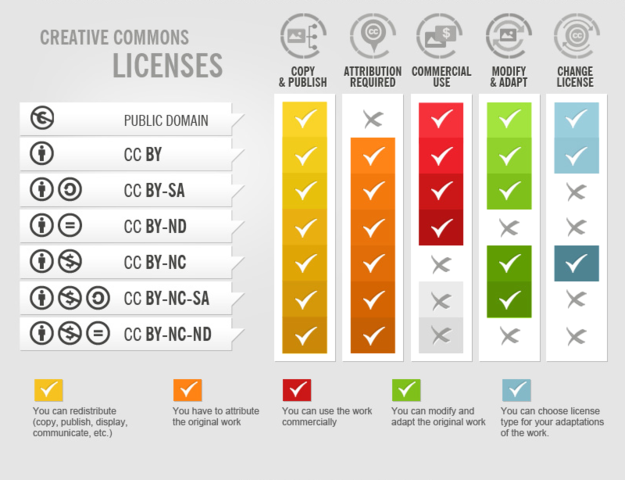
© JoKalliauer. Creative Commons Licenses, Wikimedia Commons. This image is licensed under the Creative Commons Attribution-ShareAlike licence.
Having a good understanding of Creative Commons licences will help you when applying them to your published work and will help you to know how to use third-party copyrighted content licensed in this way. There are six main types of Creative Commons licence, ranging from the most permissive (CC BY), to the least permissive (CC BY-NC-ND). Each licence begins with CC BY. This stands for 'attribution', meaning that the user of the Creative Commons licensed work must provide an appropriate credit to the copyright holder. When using content licensed by Creative Commons, it is important to always follow the terms and conditions found on the licence. In addition to crediting the copyright holder, always include a URL to the source of the content, and a URL to the licence itself. For licences that permit modification of a work, you must also indicate if you have made any changes to the original.
In addition to the main licences, a Public Domain licence (CC0) is available. This is a 'no-rights reserved' tool and not considered to be part of the main suite of Creative Commons licences. It is unlikely that you will be required to apply CC0 to your publications. However, knowledge of this licence may be useful should you wish to reuse third-party content released under this licence. Crediting the copyright holder is not a requirement of this licence. But it is recommended that you do so to protect yourself from any potential copyright infringement.
The CC BY licence allows you to use the licensed work, as long as you credit the creator of that work. You can copy the work, publish it, use it for commercial purposes, modify and adapt it, as well as change the licence type when you share it.
SA means ‘ShareAlike’. The CC BY-SA licence allows you to build upon an existing work, modify it, adapt it and share it, even for commercial purposes. Whatever you create and publish as a result of any modifications you make must be shared by you under the same licence terms. For example, you cannot modify an image under this licence and upon publication restrict it with a non-commercial licence.
The ND ‘NoDerivatives’ element of the CC BY-ND licence prohibits you from modifying and adapting a work and sharing that adaptation. This includes modifications such as resizing images, removing text, watermarks, and logos from documents, etc. The work can be shared only in its original form. You are permitted to share for commercial purposes.
A work licensed by CC BY-NC cannot be shared, modified, or adapted for commercial purposes. This is the 'NonCommercial' element. You can modify the work and change the licence when you share it for non-commercial purposes only.
The CC BY-NC-SA licence is more restrictive as it combines both the non-commercial and 'ShareAlike' elements of the Creative Commons licences. Works under this licence cannot be used for commercial purposes and can only be shared under the same licence. You can make modifications and adapt the work.
Finally, the CC BY-NC-ND is the least permissive of all available licences. Modification is not permitted, and works cannot be shared for commercial purposes. Sharing works under this licence must be under the same licence type, it cannot be changed.
Contact us


Explore

Undergraduate
Postgraduate
Policy
-
Follow us on Social media
-


