
Demand management – study of internal demand pressures [Ref 3.03]
Academic team: Dr Paul Walley and Anna Jennison Phillips, Senior Practitioner Fellow (Gloucestershire Constabulary)
Policing partners: Gloucestershire Constabulary, Thames Valley Police, Bedfordshire Police, Hertfordshire Constabulary and Humberside Police
Status: Complete
This project is part of the Centre’s research into ways in which demand can be managed and sustainably reduced. After an initial scoping study, it was identified that much internal demand is self-generated, partly through not getting things right first time. The main study investigated a sample of demand at Gloucestershire Constabulary to identify the underlying causes of “failure” or repeat demand. The outcome was to identify how the adaptation of prioritisation to increase one-touch resolution can help reduce unnecessary demand.
Outputs
| Title | Outputs type | Lead academic | Year |
|---|---|---|---|
| A study of non-urgent demand to identify opportunities for demand reduction | Article | Walley, P | 2018 |
| Service quality in policing: a failure demand perspective | Research paper | Walley, P | 2018 |
| Demand and capacity management within the police service | Video | Walley, P | 2017 |
| Reducing demand by meeting needs effectively | Video | Jennison-Phillips, A | 2017 |
| Demand management in the public sector: developments and issues | Conference paper | Walley, P | 2017 |
| Failure demand themes | Project extract | Walley, P | 2017 |
| Scoping study summary report on demand management | Summary report | Walley, P | 2016 |
| The use of failure demand in police services | Literature review | Walley, P | 2015 |
News
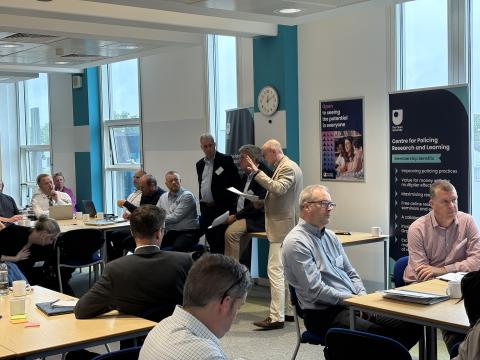
Blog post - Help shape the next chapter of CPRL
The future of policing will increasingly depend upon its ability to learn, innovate and collaborate.
- Blog post - From evidence to action: Convening partnerships to build more Inclusive Workplaces in policing
- Blog post - Building the next generation of football policing: Research, professional development and national learning
- From Conversation to Coordination: CPRL's Emerging Role in National Problem Solving


Explore

Undergraduate
Postgraduate
Policy
-
Follow us on Social media
-


